Doomberg reframes a recent trade escalation not as a political spat, but as the potential detonation of an economic nuclear device that could shatter a half-century global order. While most coverage focuses on the immediate market volatility, this piece argues that Beijing's recent move to restrict rare earth exports represents a calculated, decades-in-the-making strategic cannon that the United States is ill-equipped to counter.
The Escalation Ladder
The author begins by grounding the conflict in the mechanics of diplomacy, noting that "Negotiation in the classic diplomatic sense assumes parties more anxious to agree than to disagree." Doomberg suggests this assumption has collapsed. The narrative traces how the executive branch recently expanded export controls, a move the administration viewed as closing a loophole but Beijing interpreted as a betrayal of a recent truce. As Doomberg puts it, "To the Chinese, it was a gross violation of a truce in the trade war that had been agreed to just weeks earlier, consistent with what it was seen as a pattern of the US reneging on its agreements."
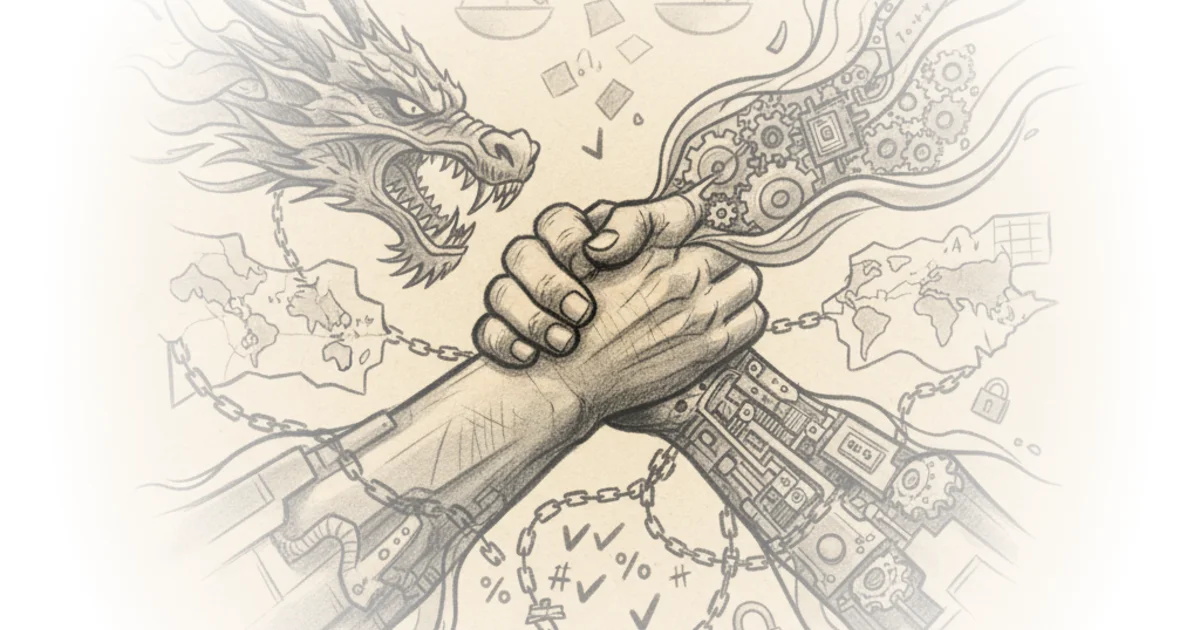
This framing is crucial because it shifts the blame from impulsive rhetoric to a breakdown in institutional trust. The author argues that Beijing's response was not a knee-jerk reaction but a pre-planned maneuver. "Perhaps fed up with what it perceived as [the administration's] bully approach to dealmaking, Beijing dropped the hammer on October 9," Doomberg writes. The resulting policy requires licenses for the export of technologies used in rare earth mining and processing, as well as for the manufacturing of magnets essential for military technologies.
The stakes are undeniably high. Doomberg highlights the sheer scale of Chinese dominance: "These restrictions send a particularly powerful signal because Chinese companies control more than 90 per cent of the world's processing capacity for rare earths." The author correctly identifies that these materials are not just commodities but the lifeblood of modern infrastructure, from electric vehicles to defense systems. By freezing purchases of US soybeans alongside these export controls, Beijing is building a multi-layered leverage strategy.
The rare earths that Beijing is increasing its control over are critical to a range of technologies from electric vehicles to wind turbines and defence systems.
Critics might note that the US has been actively diversifying its supply chains for years, and that a total embargo could accelerate the development of non-Chinese processing capabilities, potentially weakening Beijing's long-term leverage. However, the author's point about the immediate shock to the system remains valid.
The Nuclear Option
The commentary takes a dramatic turn when analyzing the market's reaction to the administration's threat of 100% tariffs. Doomberg describes the ensuing market rout as a "wild post" that "wiped out trillions of dollars in shareholder value." But the core of the argument lies in the interpretation of China's counter-move. The author asserts, "China's move was tantamount to a threat of economic nuclear war; that the Chinese have total escalation dominance in this scuffle."
This is a bold claim, yet Doomberg supports it by emphasizing the deliberation behind the Chinese decision. "If we are correct, the end of a 50-year world order and the beginning of a new one are upon us," the author warns. The logic follows that China would not have fired this "strategic cannon" without being "convinced of its definitive efficacy." The piece suggests that the US administration may have miscalculated the depth of China's preparation, leading to a scenario where Washington is forced to "beat a temporary retreat."
The author's tone here is grave, moving beyond standard economic analysis to a geopolitical prognosis. "These judgments are hardly hyperbolic," Doomberg insists, framing the current trade war as "an important battle of World War III." This language elevates the stakes from a tariff dispute to an existential struggle over the structure of global power.
China's decree last week was almost certainly the result of decades of careful planning—a strategic cannon that would not have been fired if leaders in Beijing weren't convinced of its definitive efficacy.
Bottom Line
Doomberg's strongest argument is the assertion that Beijing's rare earth restrictions are a premeditated strategic weapon rather than a reactive measure, forcing a reckoning with US supply chain vulnerabilities. The piece's biggest vulnerability is its deterministic view of a "new world order" emerging immediately, potentially underestimating the resilience of global markets to adapt to new constraints. Readers should watch closely to see if the administration can rapidly pivot its supply chain strategy or if the predicted retreat becomes a reality.