LegalEagle's Devin Stone does something rare in pop-culture analysis: he treats a blockbuster sequel not as a fantasy, but as a case study in military law, contract thresholds, and the brutal hierarchy of the armed forces. While most reviews focus on the adrenaline of the dogfights, Stone dissects the specific legal vulnerabilities of the protagonist, revealing that the film's most thrilling moments are also its most legally precarious.
The Helmet Paradox and the Cost of Rebellion
Stone opens with a seemingly trivial observation that quickly escalates into a lesson on jurisdiction. He notes that the protagonist, Maverick, rides a motorcycle without a helmet in California and potentially Nevada, violating state laws that apply even on military installations. "He wouldn't even get through this gate without the gate guard saying yeah man put your helmet on," Stone observes, highlighting the irony of a high-ranking officer ignoring basic safety protocols. This isn't just nitpicking; it sets the stage for a deeper analysis of insubordination. Stone argues that the character's refusal to wear a helmet is a microcosm of his larger legal problem: a pattern of disregarding orders.
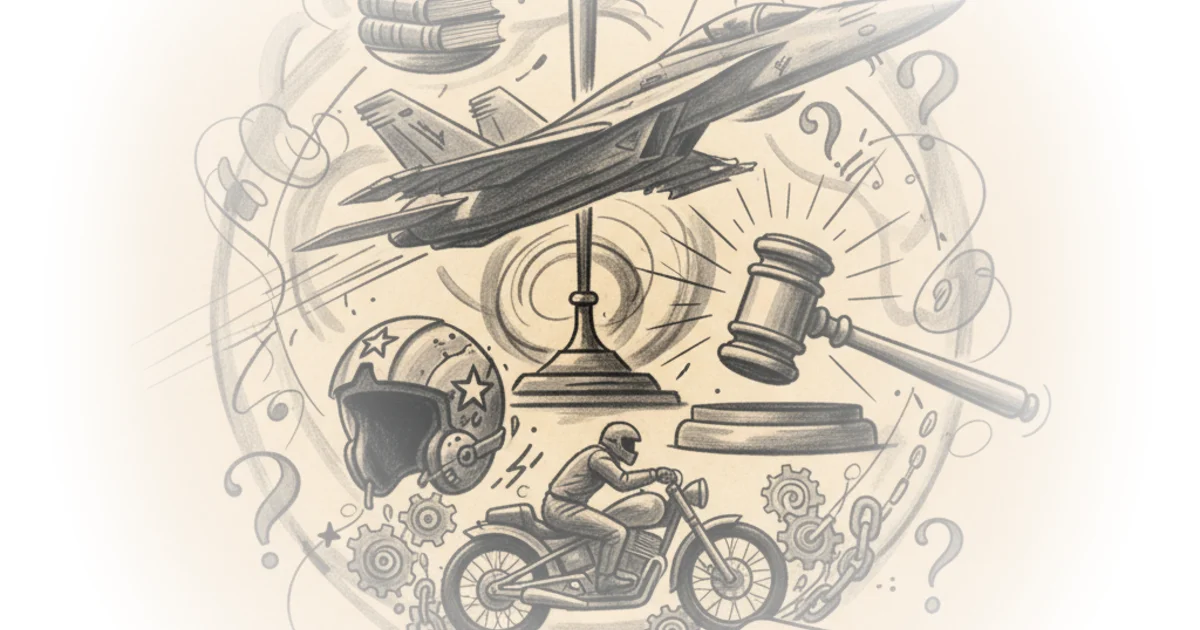
The commentary shifts to the core conflict: Maverick's unsanctioned flight to test a weapon system beyond its contract threshold. Stone points out that the military contract specified Mach 10, yet the team achieved Mach 10.2 in a flight explicitly forbidden by their superiors. "It doesn't help their case when they say we did this unsanctioned flight after you literally ordered us not to do it," Stone writes. He identifies this as a clear violation of Article 92 of the Uniform Code of Military Justice, which mandates obedience to superior officers. The legal reality here is stark: Maverick isn't just a rogue hero; he is a captain who has put his entire chain of command at risk. Stone notes that by disobeying, Maverick has also endangered his senior enlisted staff, who are equally liable for following an illegal or reckless order.
Critics might argue that in the high-stakes world of national defense, results often justify the means, rendering the legal technicalities moot. However, Stone effectively counters this by emphasizing that the military operates on a system of checks and balances where procedure is the only thing preventing chaos. "You can sometimes get your senior enlisted in trouble which is exactly what Maverick did," he explains, underscoring that the law protects the institution, not just the individual.
He's not the only one on the hook here. That Senior Chief or whoever he is working with that guy's in trouble too.
The Hard Deck and the Illusion of Safety
The analysis deepens when Stone examines the concept of the "hard deck"—a notional ground level below which a pilot is considered "dead" in training. In the film, Maverick lowers the hard deck to 5,000 feet, a move Stone describes as legally and procedurally dangerous. "5,000 ft is not just a rule it is a law as immutable as Gravity," Stone asserts, noting that violating this boundary is a serious breach of protocol that could lead to court-martial. He draws a parallel to the original film, where Maverick's low-altitude flyby was a joke; here, the stakes are life and death, and the legal consequences are real.
Stone also addresses the protagonist's rank, questioning why a Captain (equivalent to a Colonel) is still flying experimental craft. "It seems like an awful high rank to be flying some experimental craft," he argues, pointing out that higher-ranking officers typically spend less time in the cockpit to maintain proficiency. This detail adds a layer of realism to the character's stagnation; he is a Captain not because he is rising, but because his insubordination has stalled his career. Stone suggests that Maverick's refusal to die or retire is a narrative device that clashes with the rigid promotion structures of the Navy.
The commentary also touches on the geopolitical backdrop, noting the film's reliance on generic antagonists. Stone observes that the movie avoids specific real-world nations, creating a "jingoistic nationalist" tone without engaging with actual policy. "They're just the bad guys and frankly I miss movies where it's just like this is a generic bad guy and we're going to fight them because they're really terrible without having to get into the actual real real life geopolitics of it all," he writes. This choice simplifies the legal and moral landscape, allowing the focus to remain on the internal military dynamics rather than international relations.
The Human Cost of Procedure
Perhaps the most poignant part of Stone's analysis is his discussion of the relationship between Maverick and Rooster, the son of Maverick's late friend. Stone highlights the ethical complexities of a superior officer commanding a subordinate with whom they have a deep personal history. "A father should not be commanding his son or daughter once you get further enough a field though a cousin or you know a grand nephew I think it becomes less important," he explains. He notes that while Rooster could technically request a reassignment, the power dynamic makes it unlikely to succeed.
The climax of the legal analysis comes with the unauthorized flight into the restricted range. Stone points out that Maverick's decision to fly without clearance is a direct violation of range control rules. "Pilots like anyone else they have to follow range control rules you can't just go randomly into a range whether it's flying or doing something else in the military," he states. The danger is compounded by the potential for collision with other aircraft. Stone's framing here is crucial: the heroism of the final mission is built on a foundation of illegal acts, and the administration's decision to let Maverick proceed is a political gamble, not a legal one.
You have put me in a difficult position captain. On the one hand you have demonstrated that this Mission can be flown perhaps the only way it could be survived on the other hand you did it by stealing a multi-million dollar military aircraft.
Bottom Line
Devin Stone's commentary succeeds by stripping away the Hollywood gloss to reveal the rigid legal framework that governs military aviation. His strongest argument is that Maverick's actions, while cinematically satisfying, represent a cascade of legal failures that would result in court-martial in the real world. The piece's greatest vulnerability is its reliance on the assumption that the military would strictly adhere to procedure even in the face of an existential threat, a tension the film itself exploits but the law does not always resolve. Readers should watch for how real-world defense contractors and the executive branch navigate the fine line between innovation and insubordination in future high-stakes programs.