Ben Burgis dissects a dangerous paradox: a self-proclaimed monarchist who claims to see the "obvious" truth of our era is simultaneously horrified by the authoritarian reality the current administration is actively constructing. This piece cuts through the noise of online polemic to ask a vital question for any observer of power: when a movement claims to be restoring order, what happens when that order begins to look like a fever dream of conspiracy and unchecked executive force?
The Myth of the Truth-Teller
Burgis opens by dismantling the persona Curtis Yarvin has cultivated. Yarvin, a tech billionaire's protégé who advocates for a CEO-president, frames himself as a lonely prophet. "For the past two decades, I've been watching the world wake up to the obvious," Yarvin writes, invoking George Orwell to suggest that reality itself has been a lie. Burgis points out the sheer audacity of this rhetorical move. "Substantively, I'm amazed that someone like Yarvin can cite George Orwell as if they were on the same team without bursting into flames." The irony is palpable; Orwell spent his life warning against the very kind of authoritarian fantasy Yarvin is selling.
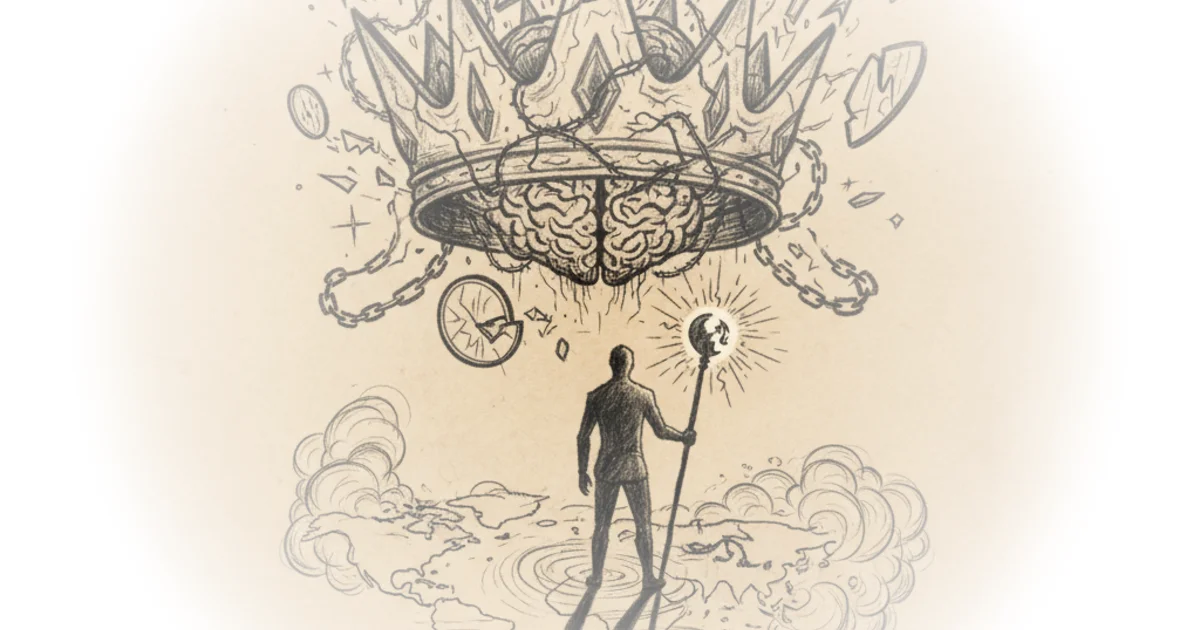
The author argues that Yarvin's worldview relies on a specific, cold nihilism. He claims that "truth has no army, that no angels will ride to our rescue," a sentiment Burgis notes is shared by both the "advanced atheist" and the "advanced Christian." This framing is crucial because it strips away the moral pretense of Yarvin's politics. It suggests that for Yarvin, the collapse of democratic norms isn't a tragedy to be mourned, but a necessary correction to a "decadent" system. Burgis connects this to the historical figure of Joseph de Maistre, who viewed the French Revolution not as a political failure, but as "God's punishment of the decadent liberals." Yarvin, Burgis suggests, is channeling this same reactionary impulse, viewing the chaos of the present as a divine or natural reckoning.
"The Father of Lies could not stand against the Lord of Hosts. That this fantasy itself was part of the lie—that truth has no army, that no angels will ride to our rescue—was too much."
The Contradiction of the CEO-King
The commentary then pivots to the economic contradictions at the heart of Yarvin's philosophy. Yarvin wants a United States run like a corporation, yet he despises the very historical forces that made modern capitalism possible. Burgis asks a piercing question: "Does Yarvin actually think we should still be living under the semi-feudal system that immediately preceded the French Revolution?" The answer, according to Burgis, is a confusing "yes." Yarvin is retroactively hostile toward the "decadent liberals" who tried to reform the ancien régime, the old order of hereditary duties and landed aristocracy.
Burgis highlights the absurdity of wanting to return to a pre-revolutionary world while worshipping "bold innovative" tech CEOs. "Even the basic conception of property rights we have now... is something that absolutely didn't exist under the ancien regime." The argument is that the tech boom Yarvin idolizes is a direct product of the bourgeois revolutions he claims to hate. To want the output of modern capitalism without the input of liberal democracy is, as Burgis puts it, "several steps more insane." Critics might argue that Yarvin is merely using hyperbole to critique modern bureaucracy, but Burgis insists we take the logic seriously: if you reject the revolutions that created the modern world, you cannot logically claim to want the modern world's economic engine.
The Escalation of Authoritarianism
Perhaps the most alarming section of the piece is Burgis's analysis of what Yarvin actually wants from the current administration. Yarvin claims the "second Trump revolution" is failing because it isn't authoritarian enough. "It is failing because it spends all its time patting itself on the back," Yarvin writes. Burgis lists the administration's actual actions: arresting legal residents for writing op-eds, cutting university funding to punish protesters, deploying troops on thin pretexts, and asserting the right to extra-judicial killings. "Apparently, though, all this is so far short of what Curtis wants that it inspires him to this little analogy disparaging the math skills of cats."
The piece exposes the terrifying gap between what the public sees as extreme and what Yarvin considers insufficient. Yarvin warns of "vengeance" that will "dwarf the vengeance after 2020," implying that the current crackdown is merely a warm-up. Burgis notes the chilling implication of a Vice President calling this man a friend and influence. The administration's actions, from the rhetoric of Stephen Miller comparing activists to "monkeys" to the actual deployment of federal power, are being judged by Yarvin as inadequate. "What would be enough to satisfy him?" Burgis asks, forcing the reader to confront the possibility that the current trajectory is only the beginning of a much darker chapter.
"The second Trump revolution, like the first, is failing. It is failing because it deserves to fail. It is failing because its true mission... is still as far beyond its reach as algebra is beyond a cat."
The Conspiracy as Methodology
Finally, Burgis dissects Yarvin's approach to history and truth, revealing it to be a method of cherry-picking conspiracy theories to fit a pre-determined narrative. Yarvin swallows whole the story of Norman Dodd and the Ford Foundation, a tale that claims the US foreign policy establishment's goal from 1917 to 1989 was to "comfortably merge" with the Soviet Union. Burgis dismantles this with historical rigor, noting that the US fought two world wars and a cold war against the USSR, killing millions of peasants to prevent communist expansion. "When Yarvin says... convergence with the USSR was the goal of the US foreign policy establishment... I think he maybe should have taken a slighter longer glance."
The author points out that Yarvin's method involves disregarding academic historians in favor of "memoirs by right-wing cranks" found on Google Scholar. This isn't just bad history; it's a deliberate strategy to create an "esoteric forbidden truth" that makes followers feel special. Burgis notes the confusion in Yarvin's timeline, where he seems unsure if Eisenhower or Nixon was secretly a Democrat, a mistake that reveals the hollowness of his "truth-telling." The result is a worldview where the administration's most extreme actions are justified by a history that never happened, and where the "Cathedral" of universities and media is blamed for everything, from the assassination of a single individual to the failure of a political revolution.
Bottom Line
Ben Burgis's critique succeeds by refusing to treat Yarvin's ideas as mere eccentricities, instead exposing them as a coherent, albeit terrifying, blueprint for authoritarianism that the current administration is already beginning to enact. The strongest part of the argument is the historical grounding that shows how Yarvin's rejection of liberal democracy contradicts the very economic system he claims to champion. The biggest vulnerability in the administration's current path is its reliance on a conspiracy-laden ideology that demands ever-escalating repression, leaving no room for compromise or reality. Readers should watch for how the administration's rhetoric shifts from "restoring order" to the kind of totalizing vengeance Yarvin is now demanding.
"The man needs an editor. From 1917 to 1989, at the highest levels of policy, convergence with the USSR was the goal of the US foreign policy establishment. Got that?"