Stuart Buck delivers a stinging critique of the recently formed Department of Government Efficiency (DOGE), arguing that its current trajectory is not just ineffective, but actively destructive to the very systems it claims to fix. The piece's most striking revelation is not a call for more cuts, but a warning that the administration's approach is driven by a fundamental misunderstanding of how public institutions function, relying on hallucinatory AI and ignoring decades of expert consensus. For busy leaders watching the federal machinery grind to a halt, Buck offers a necessary reality check: you cannot run a government like a Silicon Valley startup without breaking the public trust.
The Myth of the Easy Win
Buck begins by dismantling the premise that government waste is a simple accounting error waiting to be corrected. He points to the sheer complexity of federal data systems, noting that "it is foolish to cry 'fraud' after a day or two looking at a database." Instead of rushing to judgment, Buck argues that a legitimate efficiency drive would require years of immersion to understand why data looks the way it does. He illustrates this with a story from his time on the board of the Houston Education Research Consortium, where a ten-fold spike in Native American student enrollment was actually a clerical error confusing "Indian Americans" with "American Indians." This anecdote is crucial because it exposes the danger of superficial audits. When the executive branch treats data anomalies as evidence of malice rather than systemic confusion, they risk dismantling programs based on ghosts in the machine.
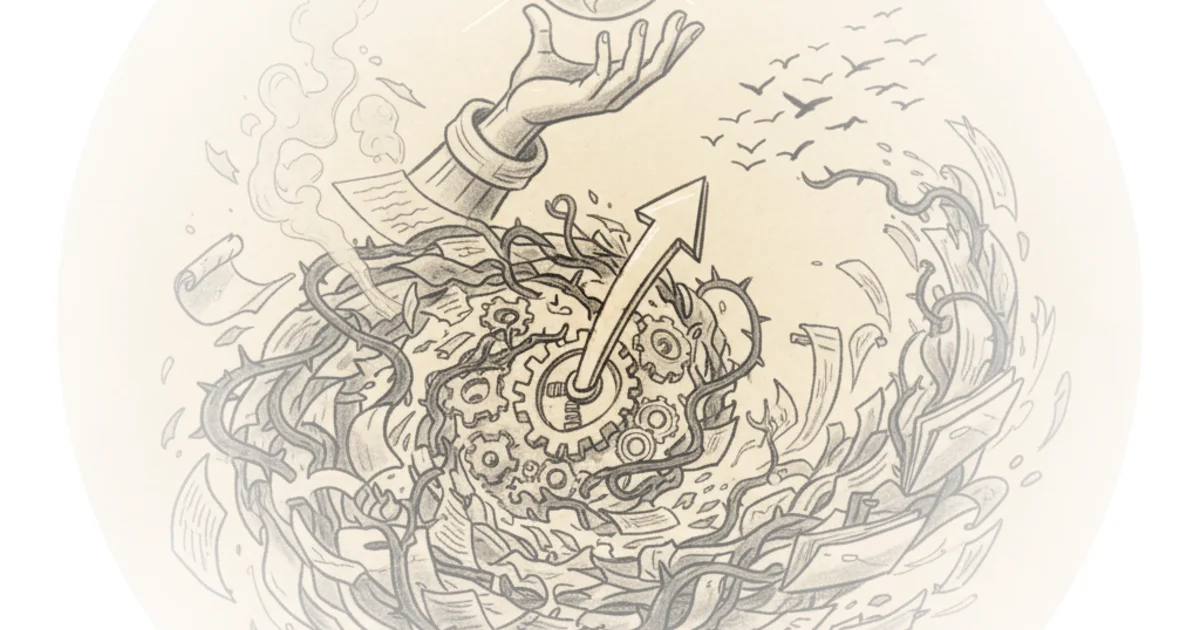
The author contends that true efficiency requires deep, qualitative work. "Most government workers aren't complete slackers," Buck writes, "they (more than anyone) want to find ways to make their jobs more efficient and effective. Just ask them!" This framing shifts the blame from the workforce to the leadership, suggesting that the current administration's hostility toward civil servants is counterproductive. Critics might note that some agencies are indeed bloated, but Buck's evidence suggests that the real inefficiency lies in the bureaucratic red tape that prevents workers from doing their jobs, not in the workers themselves.
"The rhetoric of efficiency is currently all-pervasive... But a government is not a private-sector company and cannot be run like one."
The Perils of Private-Sector Logic
A central pillar of Buck's argument is the distinction between business resilience and government stability. He quotes strategist Vaughn Tan to explain why removing all "slack" from a system is dangerous. In the private sector, companies that optimize for zero redundancy often collapse when the market shifts. Governments, however, must be ready for unpredictable crises like pandemics or natural disasters. Buck warns that "an organisation built around efficiency is optimised for a particular configuration of its operating environment... When the environment changes, it falls apart because it has no slack to fall back on."
This is a vital insight for policymakers. The administration's push to slash costs in areas like pandemic preparedness or disaster relief may look good on a spreadsheet today, but it leaves the nation vulnerable tomorrow. Buck emphasizes that we don't want fire departments or the military to be "busy every day"; their value is in their readiness, not their daily utilization. By treating these essential services as inefficiencies to be eliminated, the current strategy risks creating a fragile state that cannot respond when the next crisis hits.
When Efficiency Becomes Farce
The piece takes a sharp turn when Buck examines the actual performance of the current DOGE. He argues that the department has failed to follow its own proposed best practices, instead focusing on impossible deficit targets and trivial cost-cutting. "Anyone who had the slightest familiarity with the federal government knew that was completely impossible," Buck writes regarding the goal of cutting trillions without touching entitlements or defense. The result has been a focus on low-hanging fruit, such as canceling a $21,000 coaching program, while ignoring the massive structural drivers of spending.
Perhaps most damning is Buck's account of DOGE's reliance on flawed technology. He cites ProPublica's reporting on Sahil Lavingia, a tech founder who joined the effort only to be fired after admitting the government wasn't rife with fraud. Lavingia's experience highlights the disconnect between private-sector expectations and public reality. "I did not find the federal government to be rife with waste, fraud and abuse," Lavingia stated, noting that fraud is "relatively nonexistent." Instead of listening, the administration relied on AI models that "hallucinated the size of contracts," inflating values from $35,000 to $34 million. Buck uses this to illustrate a broader point: "The admission that DOGE has been using hallucinatory LLM models might explain the staggering number of basic errors that DOGE has made."
The human cost of this approach is palpable. Buck describes how Lavingia was "ghosted" and fired simply for being transparent about the lack of easy wins. This culture of silence ensures that the administration never learns from its mistakes. As Buck notes, "It's not clear that DOGE itself has uncovered even one case of actual fraud," yet it has managed to destroy trust and disrupt essential services like the federal retirement system.
"Letting someone go for being transparent in the most maximally transparent organization is a little bit entertaining."
Bottom Line
Stuart Buck's most compelling contribution is his insistence that government efficiency cannot be achieved through speed and cuts alone; it requires patience, expertise, and a respect for the unique nature of public service. The argument's greatest strength is its refusal to accept the administration's narrative of rampant fraud, replacing it with evidence of systemic complexity and AI-driven incompetence. However, the piece's biggest vulnerability is its reliance on the assumption that the administration will ever be willing to listen to the very experts it has marginalized. Readers should watch for whether the next phase of these reforms continues to prioritize performative cuts over genuine structural improvement, or if the reality of the failures described by Buck forces a course correction.
"We don't want governments collapsing and being replaced... This means that governments and public sector institutions must be built to be ready for their operating environments to change unpredictably over long periods of time."
The administration's current path prioritizes the appearance of efficiency over the reality of resilience, a trade-off that could leave the nation exposed when the next crisis arrives.