Kings and Generals reframes the Viking Age not as a chaotic barbarian invasion, but as a calculated geopolitical conquest driven by specific demographic pressures and strategic foresight. While popular history often fixates on the violence, this piece compellingly argues that the Great Heathen Army's success was less about brute force and more about exploiting the fractured political landscape of Anglo-Saxon England. The analysis is particularly striking in how it details the transition from hit-and-run raiding to the establishment of fortified statecraft, a shift that fundamentally altered the British Isles.
The Mechanics of Conquest
The author begins by dismantling the myth of random aggression, pointing instead to structural push factors in Scandinavia. "In modern-day Norway, there was overpopulation and poor farming land," Kings and Generals writes, "To the south, the Danes faced aggression from their mighty Christian neighbor, the Frankish Empire." This context is crucial; it transforms the Vikings from mere pirates into rational actors seeking survival and status. The commentary effectively highlights how these pressures prompted a migration that evolved from coastal raiding to permanent settlement.
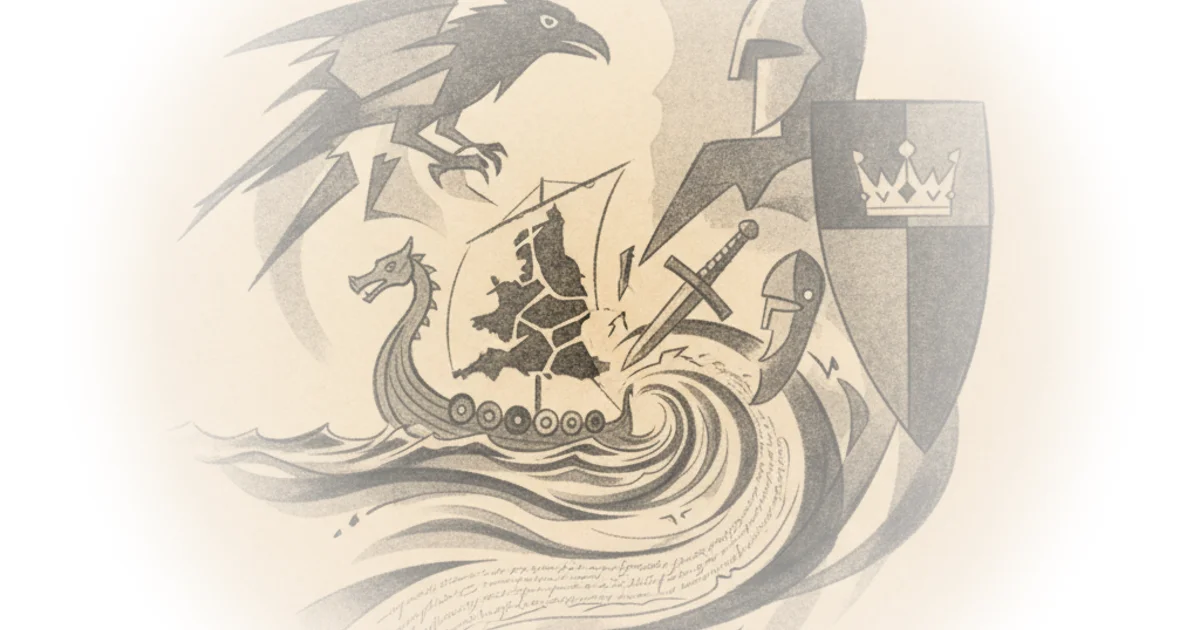
The piece then pivots to the internal weaknesses of the English kingdoms, noting that "the land of England was divided into a patchwork of Christian kingdoms... Their rulers fought over land, wealth, prestige, and power, making and breaking alliances as it suited them." This fragmentation is presented as the primary enabler of the invasion. The author illustrates this with the tragic fate of Northumbria, where two rival kings, Osberht and Aelle, were so consumed by their own succession dispute that they allowed the invaders to capture York in 866. "Osbert and A were forced to set aside their differences, combining their armies and preparing to retake York," the text notes, only to be decisively defeated. This sequence underscores a recurring theme: the Vikings did not just win battles; they won the political game by exploiting English disunity.
The great army's campaigns had so far followed a similar strategy. They captured a town, fortified it, crushed any local resistance, killed the local king, and then took control of his kingdom.
This observation is the analytical core of the piece. It moves beyond the narrative of a single battle to identify a systematic method of regime change. The author details how the Vikings utilized fortified bases like Reading to control the surrounding countryside, a tactic that required a level of logistical sophistication often denied to them in popular imagination. Critics might note that the reliance on Norse sagas for the leadership structure—specifically the claim that Ivar, Halfdan, and Ubbe were sons of Ragnar Lothbrok seeking revenge—blurs the line between historical fact and mythological embellishment. However, the author wisely treats these claims as part of the invaders' own narrative motivation rather than absolute historical record.
The Turning Point at Ashdown
The narrative culminates in the Battle of Ashdown in 871, a clash that the author frames as a desperate gamble for the survival of the House of Wessex. The stakes are described with palpable urgency: "The fate of Wessex and maybe even England itself hung in the balance." The tactical breakdown here is exceptional, particularly the description of the shield wall dynamics. Kings and Generals writes, "As the two sides grew closer, they exchanged war chants, insulting one another and calling on their god or gods to support their cause." This humanizes the combatants, moving the focus from abstract strategy to the visceral reality of the clash.
A pivotal moment in the analysis involves King Æthelred's delay for prayer while his brother, Prince Alfred, faced the initial Viking assault. The author captures the tension perfectly: "Without his brother, Alfred was left in command... So with his shield wall in order, he commanded his troops to march to meet the Vikings." The text praises Alfred's initiative, quoting the contemporary scholar Asser: "with the rush of a wild boar, he courageously led the Christian troops against the hostile army." This moment is significant because it highlights the emergence of Alfred not just as a king, but as a military commander willing to take risks when the established hierarchy faltered.
The victory at Ashdown was not a clean sweep but a grueling contest of endurance. "The fight raged for several more hours with each side pushing at weak points in their opponent's shield wall, trying to make a breakthrough," the author explains. The eventual collapse of the Viking line is attributed to the cumulative pressure of the West Saxon attack, leading to the deaths of several Viking earls and the flight of Halfdan. The author notes that "Viking casualties mounted and their shield wall began to loosen. Openings appeared in the wall and were ruthlessly penetrated by West Saxon attacks." This description of the shield wall's fragility under sustained pressure offers a realistic view of Anglo-Saxon warfare, countering the notion of invincible barbarian warriors.
The tide had turned in favor of the West Saxon, but the Vikings held their nerve and continued the fight.
This line encapsulates the resilience of both sides. While the English won the day, the author is careful not to paint this as the end of the conflict. The piece reminds the reader that "the conflict between the House of Wessex and the Vikings would last until the 11th century as they bitterly fought for dominion over England." This long-term perspective prevents the reader from viewing Ashdown as a definitive resolution, instead framing it as a critical pause in a centuries-long struggle. The reference to the "Reeve of Dorchester" in the opening serves as a bookend, connecting the initial Viking arrival in 789 to the full-scale invasion, illustrating the slow, terrifying escalation of the threat.
Bottom Line
Kings and Generals succeeds in transforming a familiar historical event into a nuanced study of military strategy and political fragility. The strongest element is the clear delineation of the Viking shift from raiding to state-building, which provides a deeper understanding of why their conquest was so successful. The piece's main vulnerability lies in its reliance on potentially legendary accounts for the Viking leadership's motivations, though this is handled with appropriate caution. For the busy reader, the takeaway is clear: the survival of England was not guaranteed by divine favor alone, but by the tactical adaptability of leaders like Alfred and the catastrophic disunity of his predecessors.