Slavoj Žižek delivers a startling diagnosis of our digital age: cyberspace is not a place of liberation from rules, but a perverse trap where we desperately crave the very authority we claim to reject. In this dense, provocative analysis, the philosopher argues that our obsession with conspiracy theories and online identity games reveals a deep psychological need for a hidden "big Other" to make sense of a world that has lost its symbolic anchors. This is not just theory; it is a lens for understanding why modern life feels so simultaneously chaotic and controlled.
The Paradox of the Culture of Complaint
Žižek begins by dissecting the modern "culture of complaint," suggesting it is a form of hysteria where individuals blame a non-existent authority for their own failures. He writes, "far from cheerfully assuming the inexistence of the big Other, the subject blames the Other for its failure and/or impotence, as if the Other is guilty for the fact that it doesn't exist." This framing is brilliant because it flips the script on victimhood; instead of seeking genuine autonomy, the complainer demands that an invisible power intervene to fix their misery, thereby confirming their own dependence.
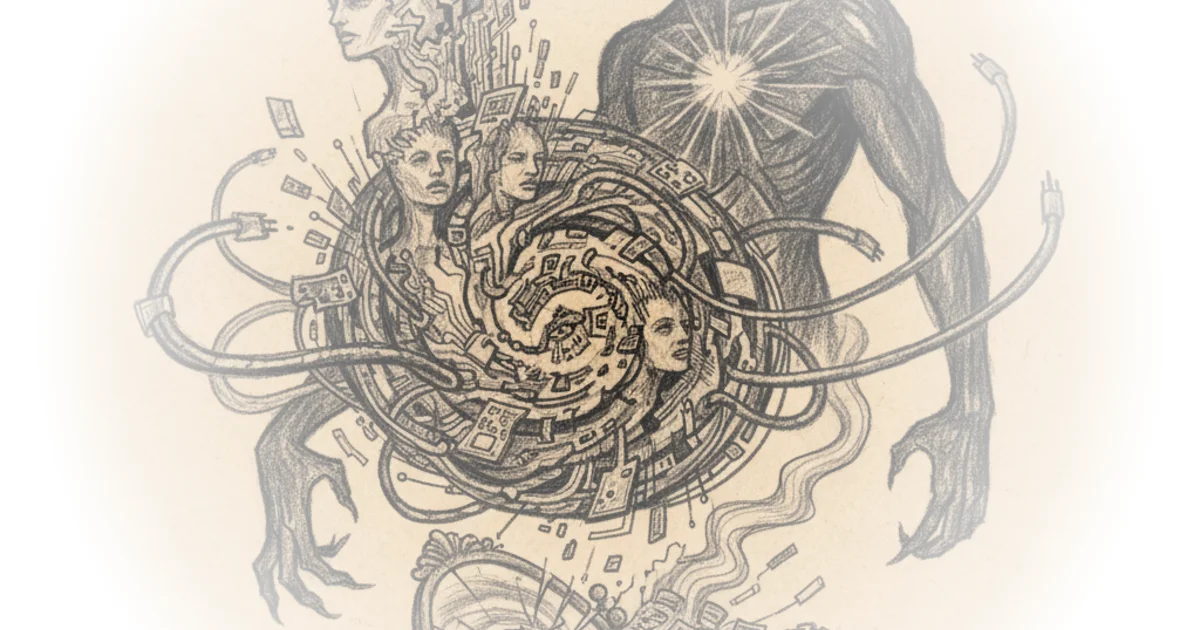
The author argues that this logic prevents true revolutionary action. "Instead of complaining to the Other and expecting it to act... they still address themselves to it: by way of translating their demand into the terms of legalistic complaint, they confirm the Other in its position in the very gesture of attacking it." The core insight here is that by demanding rights from a system we claim is broken, we inadvertently validate the system's power to grant them. Critics might note that this risks dismissing legitimate grievances from marginalized groups as mere psychological games, but Žižek's point is structural: the form of the complaint reinforces the very hierarchy it seeks to dismantle.
The typical subject today is the one who, while displaying cynical distrust of any public ideology, indulges without restraint in paranoiac fantasies about conspiracies, threats, and excessive forms of enjoyment of the Other.
The Return of the Big Other in Real Life
As the symbolic order collapses, Žižek observes a paradoxical resurgence of belief in hidden powers. He notes that "the paradoxical result of this mutation in the 'inexistence of the Other'... is precisely the re-emergence of the different facets of a big Other which exists effectively, in the Real, not merely as a symbolic fiction." This explains the explosion of conspiracy theories, from right-wing populism to liberal obsessions with secret government experiments. We no longer believe in the official story, so we invent a darker, more coherent one where an "Other of the Other" pulls the strings.
This dynamic is vividly illustrated in the realm of "false memory syndrome," where the figure of the father as a sexual harasser "returns in the real." Žižek draws a sharp parallel here, noting that the controversy over whether abuse was "fantasized or... a plain fact" mirrors Freud's insistence on the "murder of the 'primordial father' as a real event in the humanity's prehistory." Just as the Priory of Sion conspiracy wove together Templars and the Holy Grail to replace the fading power of religious symbols with a tangible, bodily reality, modern narratives seek to ground our anxiety in a concrete, often terrifying, truth. The argument holds weight because it connects disparate cultural phenomena—conspiracy theories, New Age spirituality, and family trauma—under a single psychoanalytic umbrella: the desperate need for a real authority to replace the one that has vanished.
Cyberspace as the Ultimate Perverse Space
The piece culminates in its most provocative claim: the internet is the perfect stage for perversion, defined not as sexual deviance but as a specific relationship to the Law. Žižek writes, "in contrast to the neurotic who acknowledges the Law in order occasionally to take enjoyment in its transgressions... the pervert directly elevates the enjoying big Other into the agency of Law." In cyberspace, we create worlds with self-imposed rules where we can survive any catastrophe, effectively disavowing the reality of death and sexual difference.
He illustrates this with the example of "Slaves are Us," an agency where high-powered executives pay to be treated rudely by cleaners, finding that "being brutally ordered to do their job and shouted at... is the only way open to them to gain access to Being." This is the crux of the digital experience: we build platforms where we are the masters of the rules, yet we crave the submission to an algorithm or a community standard that tells us who to be. The pervert, Žižek argues, "longs for the very rule of Law," and the internet provides a universe where the Law is not a prohibition but a game we can control.
The pervert's aim is to establish, not to undermine, the Law: the proverbial male masochist elevates his partner, the Dominatrix, into the Law-giver whose orders are to be obeyed.
This analysis reframes our online behavior not as rebellion, but as a desperate attempt to install order in a chaotic world. However, one might argue that this view underestimates the genuine potential for digital spaces to foster new, non-hierarchical forms of community that don't rely on the "big Other." Yet, even these spaces often devolve into new forms of rigid rule-enforcement, suggesting Žižek's diagnosis is uncomfortably accurate.
Bottom Line
Žižek's strongest contribution is his ability to link the abstract collapse of traditional authority to the concrete, often disturbing, behaviors of the digital age, revealing our online lives as a masochistic search for order. The argument's vulnerability lies in its heavy reliance on psychoanalytic jargon, which can obscure the very real material conditions driving these cultural shifts. Readers should watch for how this "perverse" relationship to authority evolves as artificial intelligence begins to act as the ultimate, unchallengeable Law-giver in our digital ecosystems.