Brad DeLong doesn't just revisit a decades-old philosophy debate; he weaponizes it against the current hype cycle surrounding artificial intelligence. By channeling computer scientist Scott Aaronson, DeLong argues that our intuition about machines "faking" understanding collapses when we stop imagining a small rulebook and start imagining a planet-sized datastore. This isn't abstract metaphysics; it's a necessary reality check for anyone trying to distinguish between a sophisticated autocomplete and genuine emergent cognition.
The Scale of the Argument
The piece centers on a rebuttal to John Searle's famous "Chinese Room" thought experiment, originally proposed around 1980 to argue that symbol manipulation cannot equal understanding. Searle asked us to imagine a person in a room following a rulebook to answer Chinese questions without knowing the language. DeLong, citing Aaronson's 2013 work Quantum Computing Since Democritus, suggests this image is a trap because it relies on a misleadingly small scale.
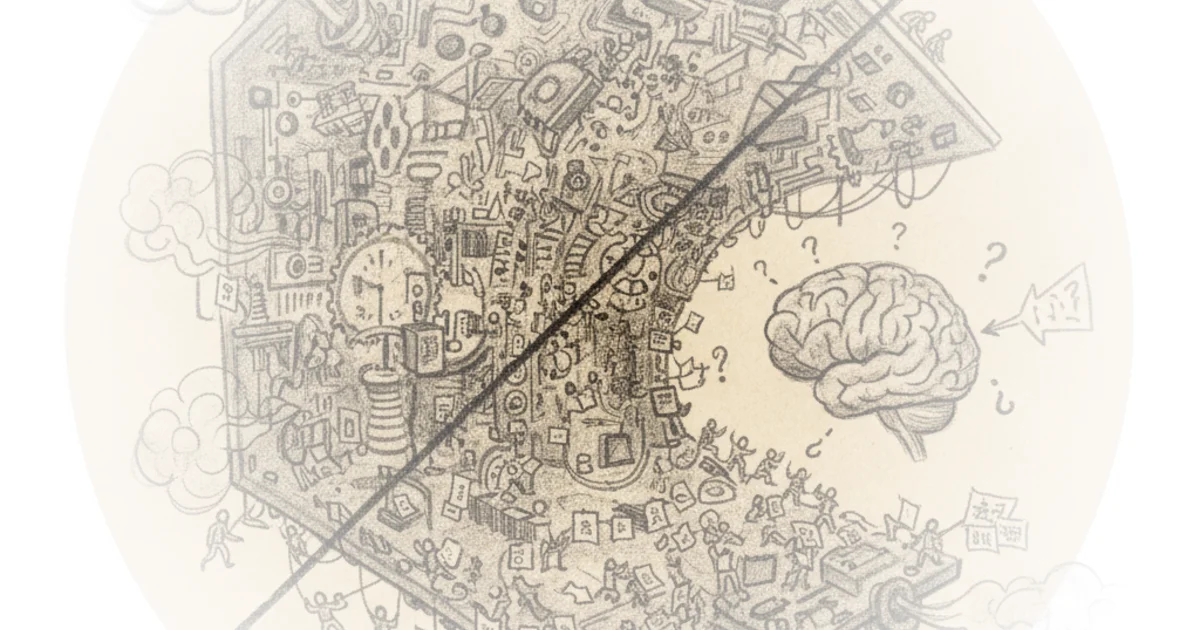
"Searle's image gets its force from a misleading picture of a small rule book, or a few shelves of books that together constitute a lookup table," DeLong writes. He argues that if we scale this up to reality, the intuition flips. He paraphrases Aaronson's vision of a system so vast it would require a "datastore Earth-sized, and searched by tens of thousands of near-light-speed robots." The sheer computational weight, DeLong suggests, forces us to reconsider whether the system possesses emergent properties that the reductionist view misses.
This framing is powerful because it shifts the debate from "is it a robot?" to "at what point does quantity become quality?" It challenges the reader to admit that our brains are also just bundles of neurons following physical rules, yet we grant ourselves understanding while denying it to machines.
"After a certain point complexity gains metaphysical significance: it is no longer 'just…', but rather something for which... the emergent properties of the complex are so weighty that the reductionist perspective misses what any sensible observer would see as the real point."
Critics might note that DeLong and Aaronson are still dancing around the hard problem of consciousness. Even a planet-sized simulation could theoretically lack subjective experience, a distinction that remains elusive regardless of scale. However, the strength of this argument lies in its refusal to accept a "meatist double standard."
The Stochastic Parrot Dilemma
DeLong applies this philosophical framework to the current AI boom, specifically Large Language Models (LLMs). He admits he is struggling to abandon his default skepticism, which views these systems as "stochastic parrots, super-autocomplete on steroids plus Clever Hans at scale and speed." He is searching for the specific tripwire where the metaphor of a "room-sized" simulation shifts to a "planet-sized" understanding.
"I am wondering at what point will it no longer make sense for me to approach pretty much all of the questions about the current AI boom using my base frame," DeLong writes. He acknowledges that while machines vastly exceed human calculation capabilities, they often fail at basic reasoning without constant human correction. He describes the current state of AI as a "jagged frontier" where the technology works only if we "stop watching it like a hawk and instantly correcting it where it goes obviously and stupidly wrong."
This self-correction is vital. DeLong isn't dismissing AI; he is warning against premature adoption of the "thinking machine" frame before the evidence supports it. He fears becoming a "goalpost-mover" or, worse, a "gullible moron helping reinforce the forces that I see as net negative now." He specifically targets the venture capitalist tendency to rebrand failed Web3 schemes as AI, noting the risk of "FIW3TAI" (Failed in Web3, Try AI).
The Threshold of Understanding
The core tension DeLong explores is the transition from rote manipulation to real thinking. He recalls that twenty-five years ago, fluency in natural language might have been the threshold for considering a machine intelligent. Today, that threshold feels insufficient. He asks, "Where on the scale from a room to a planet-sized datastore... does the frame that is useful for thinking shift?"
He references the evolutionary history of the human brain, noting that we are the products of "300 million years of that process of variation and selection and scaling." Yet, he remains unconvinced that current models have crossed the divide. "I see absolutely no signs anywhere in these systems that they are close," he asserts, maintaining that they are still on the "John Searle [room-sized] side of the 'Chinese Room' divide."
DeLong suggests that if we are to accept machines as conscious, we must do so only when they emulate humans in every observable respect, a view he attributes to philosopher David Chalmers. "If computers someday become able to emulate humans in every observable respect, then we'll be compelled to regard them as conscious, for exactly the same reasons we regard other people as conscious," DeLong notes. Until then, the "seams in the cardboard" of the current AI facade remain visible.
"Our current frontier LLMs are much too simple… You can see the seams in the cardboard facing the street that is the façade of this particular Potemkin Village, if you look…"
Bottom Line
DeLong's most compelling contribution is his refusal to let the scale of computation be hidden by the simplicity of the metaphor, forcing a rigorous re-evaluation of what "understanding" means at planetary scales. His biggest vulnerability is the lack of a concrete metric for that shift, leaving the reader with a philosophical threshold rather than a technical one. Watch for the moment when AI systems stop needing constant human correction to handle complex reasoning; that may be the true tripwire DeLong is waiting for.