Nature's Longevity Playbook and Its Limits
Aria Schrecker's survey of the animal kingdom's longest-lived creatures for Works in Progress is a tour through biological marvels that forces a sobering question: even if science could borrow the tricks evolution has given to lobsters, jellyfish, and Greenland sharks, would the tradeoffs be worth it? The article walks a careful line between wonder and realism, cataloging the mechanisms behind extreme lifespans while acknowledging that most of them come packaged with lifestyles no human would envy.
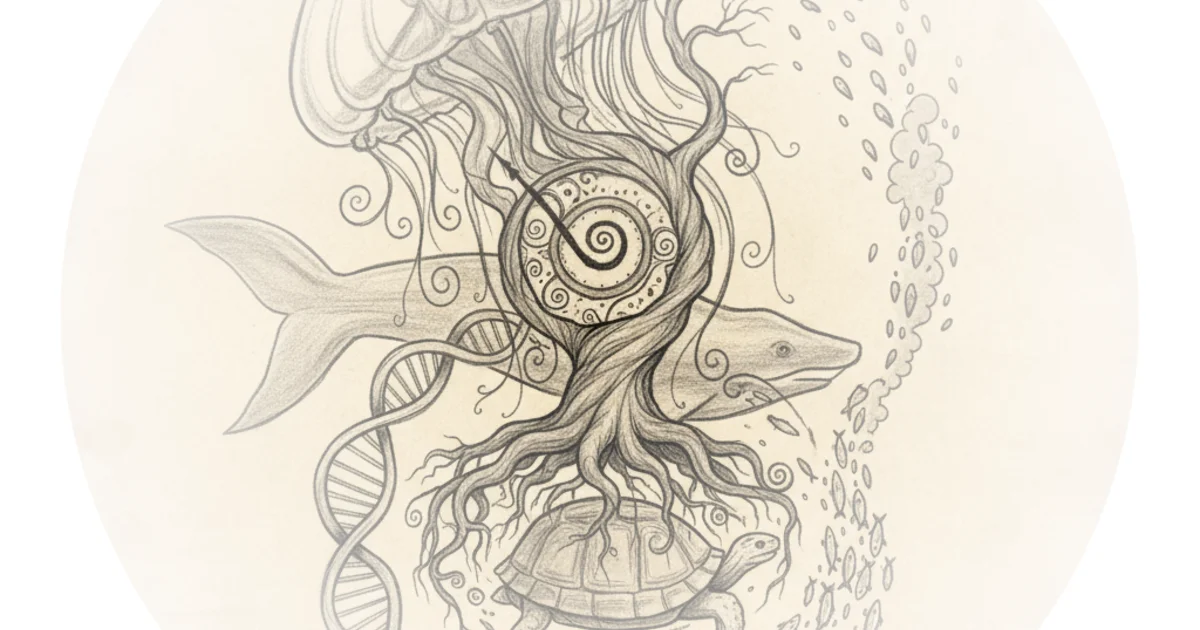
The menagerie is genuinely impressive. The Turritopsis dohrnii jellyfish can revert to its infant polyp stage under stress, theoretically cycling forever. Lobsters repair their DNA so continuously that their organs stay young for over a century. The ocean quahog clam, with its 507-year-old specimen verified by carbon dating, achieves its longevity through a metabolism so sluggish that some vegans argue it is closer to a plant than an animal. And the Greenland shark, a two-ton ambush predator that eats as seldom as once a year, has been found at roughly 400 years old.
The Metabolism Bargain
The article's most compelling thread is the relationship between metabolic rate and lifespan. Nearly every exceptionally long-lived animal shares one trait: a metabolism that burns slowly. Schrecker describes the Greenland shark's strategy with understated precision:
Such a strategy requires patience but its exceptionally slow metabolism means it needs little food, able to grow large while eating as seldom as once a year. It expends hardly any calories heating itself and can live in such cold waters because high concentrations of urea and trimethylamine oxide stop its blood from freezing.
The pattern repeats across species. Tortoises barely move. Quahog clams filter-feed in near-stillness. Even among mammals, bowhead whales and naked mole rats share this metabolic thrift. The implication is clear: burning less fuel means less cellular damage, fewer DNA replication errors, and slower aging. But Schrecker does not flinch from what this means in practice. Living like a Greenland shark or a clam is not really living at all by human standards.
The Human Exception
Where the article becomes most interesting is in its examination of why humans are already outliers. Humans live far longer than body size would predict, getting more than two billion heartbeats when most mammals get roughly one billion. The explanation lies partly in brain size and partly in social structure. Schrecker notes that post-reproductive survival, rare in the animal kingdom, makes evolutionary sense for species with complex social bonds:
Elderly humans, chimps, and elephants can help take care of children and store up and pass on useful knowledge to their family and tribe. Tigers, who usually die while still fecund, are of little use to their cubs after a few years: a tiger grandmother with four grandcubs does a disservice to her genes by staying around and competing for resources.
This is the grandmother hypothesis elegantly stated, and it highlights something the article handles well throughout: longevity is not a single biological knob to turn but a suite of evolutionary tradeoffs shaped by ecology and social structure.
The Cancer Paradox
One of the article's strongest sections addresses Peto's paradox, the observation that large, long-lived animals do not develop cancer at the rates their cell counts would predict. The explanation is wonderfully counterintuitive. Elephants carry 20 copies of the cancer-suppressing p53 gene and exhibit hyper-apoptosis, killing damaged cells before they can turn malignant. Large animals may even develop "hyper tumors," cancers of cancers that destroy malignant tissue before it can threaten the organism.
In a mouse, a two-gram tumor -- ten percent of its mass -- would kill it, likely before it developed a cancer-fighting hyper tumor. In a human, a two-gram tumor -- 0.002 percent -- would have a negligible effect unless it were in a crucial organ. In a bowhead whale, a two-gram tumor would be just 0.000002 percent of its mass.
But cancer resistance comes at a cost. The energy diverted to DNA repair and immune surveillance is energy not spent on growth, reproduction, or physical power. Schrecker pointedly includes a photo of a peacock's tail with the caption "Behold, a cancer-increasing adaptation," a reminder that natural selection optimizes for reproductive success, not longevity.
Pharmaceutical Prospects and Honest Uncertainties
The article's second half pivots to whether science can deliver what evolution would not. The discussion of telomerase is refreshingly candid. Switching on the enzyme in mice produced both better healing and more skin cancers. Only in mice already engineered for cancer resistance did telomerase activation extend lifespan. The lesson is that longevity interventions cannot be bolted on one at a time; they require a systems-level approach.
The most promising near-term candidates Schrecker identifies are metabolic drugs: rapamycin, metformin, SGLT2 inhibitors, and GLP-1 agonists like Ozempic. All were originally developed for diabetes or transplant rejection, and all appear to extend lifespan in mice by modulating the mTOR pathway or blood sugar levels. Rapamycin, administered to young mice, extended lifespan by roughly 25 percent. Even in older mice, corresponding to 60-year-old humans, it produced about a 10 percent extension.
Chronically high mTOR, usually caused by overfeeding, can accelerate aging, and inhibiting the mTOR pathway has been shown to extend lifespan in every organism tested. Fortunately, we do not have to be a gene-edited screwworm or an Italian supercentenarian to benefit from this pathway: some drugs, like rapamycin, likely inhibit mTOR.
A counterpoint worth raising: mouse lifespan extensions have a troubled history of failing to translate to humans. Caloric restriction, the most robust lifespan intervention in rodent studies, has shown far more modest effects in primates. The metabolic differences between a mouse weighing 25 grams and a human weighing 70 kilograms are not merely quantitative. Drug dosing, clearance rates, and off-target effects all scale unpredictably. The longevity field has been burned before by extrapolating from mice to people, and the article could have dwelled longer on this translational gap.
What the Article Leaves Out
Schrecker's piece is an excellent survey, but it largely sidesteps the question of healthspan versus lifespan. She acknowledges that surviving cancer or heart disease usually means "living with chronic pain and discomfort, one step closer to future danger," but the article does not deeply engage with whether adding years at the end of life is desirable if those years are spent in decline. The naked mole rat's defiance of Gompertz's law, maintaining constant mortality risk regardless of age, is presented as an ideal, but it remains unclear whether any pharmaceutical intervention could replicate this in humans rather than simply pushing the decline curve a few years further out.
There is also an underexplored tension between individual longevity and population-level consequences. If humans routinely lived to 200 or 300, the implications for resource consumption, social structures, wealth concentration, and political power would be profound. Evolution's tradeoffs are not merely biological; they are ecological. The article gestures at this with its closing line about no longer being "constrained to traits that can be coded into DNA and enable a hunter-gatherer to reproduce," but the societal dimensions deserve more than a gesture.
Bottom Line
Schrecker delivers a vivid and scientifically grounded tour of animal longevity that avoids both hype and despair. The central insight, that nature has solved the longevity problem many times over but always at a cost humans would find unacceptable, is well argued. The pharmaceutical pipeline she surveys offers genuine promise, particularly the metabolic drugs already in clinical use for other conditions. But the article is strongest as a corrective to breathless anti-aging rhetoric: the path from lobster biology to human immortality is not a straight line, and evolution's tradeoffs are a warning that there may be no free lunch when it comes to living longer.