Perun cuts through the naval hype with a single, stinging observation: asking shipyards struggling to build basic destroyers to suddenly produce a 35,000-ton super-combatant packed with non-existent technology is not a strategy, it is a fantasy. The piece is notable not for debunking the concept of a new battleship, but for exposing the dangerous disconnect between Washington's procurement announcements and the gritty reality of American industrial capacity. In an era of great power competition, this analysis forces a sobering question: is the US Navy preparing for a war it can actually fight, or just designing a weapon system for a war that no longer exists?
The Ghost of Capital Ships Past
Perun begins by grounding the reader in the historical trajectory of naval power, reminding us that the battleship was once the undisputed barometer of international strength before the aircraft carrier and missile systems rendered it obsolete. He writes, "By the early 1990s, the battleships as a class passed into history." This historical context is crucial because it frames the current proposal not as an evolution, but as a regression. The author details how the "meta quickly shifted towards ships that were lightly armored" because armor could no longer save a vessel from air power or heavy anti-ship missiles.
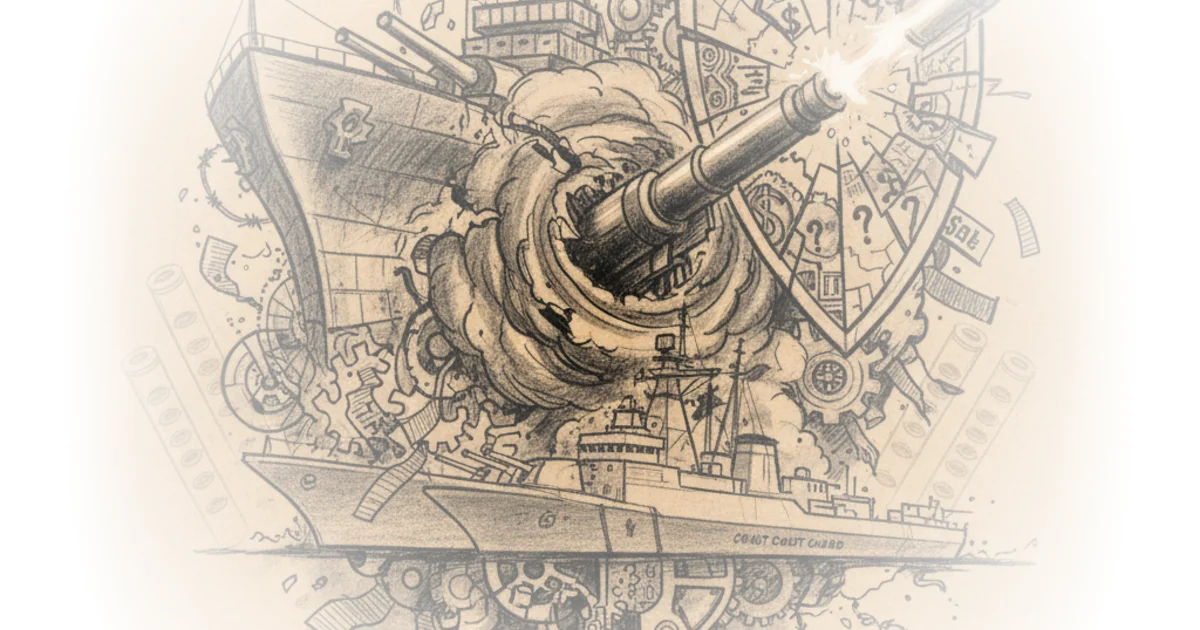
The argument gains traction when Perun highlights the economic inefficiency of the old model. He notes that an Iowa-class battleship required roughly 2,700 crew members, "roughly the same as a modern Ford-class aircraft carrier, twice the displacement, with significantly more power projection capacity." The implication is clear: the battleship was a resource hog that offered diminishing returns compared to smaller, more versatile destroyers. As Perun puts it, "Why would you want a converted World War II battleship with half a flight deck when you could build a new actual carrier?" This logic held up for decades, driven by the simple math of crew costs and automation.
"Even before the Arleigh Burke class destroyers came around, the US Navy's Iowas were coexisting with the Spruence class destroyers... the Spruence was a much better deal."
Critics might argue that the strategic landscape has changed so drastically that the old cost-benefit analysis no longer applies, particularly with the rise of hypersonic threats requiring massive kinetic interceptors. However, Perun's point remains that the fundamental trade-off between a single, massive platform and a distributed fleet of smaller ships has not fundamentally shifted.
The "Trump Class" Illusion
The commentary then pivots to the immediate news: the announcement of the USS Defiant, a concept the author dubs the "Trump class guided missile battleship." Perun is immediately skeptical of the terminology and the maturity of the design. He writes, "By modern convention, US Navy warship classes are named after the lead vessel of the class... this would make this a design for a Defiant class guided missile battleship, not a Trump class." This distinction is more than semantic; it signals a lack of procedural rigor.
The core of Perun's critique lies in the absence of a development pipeline. He points out that "there hasn't been funding for internal design work or a design competition between various ship building firms." This is a damning indictment of the proposal's feasibility. While other future projects like the SSNX or DDGX have received millions over years for pre-design work, the Defiant appears to have "basically come out of nowhere." The author suggests that what we are seeing is "much closer to being a concept for a new ship as opposed to a detailed design of one."
"Because apparently if your shipyards are already struggling to turn out enough basic destroyers to keep up in a building race with a peer competitor, the clear answer is to ask them to start turning out 35,000 ton super combatants packed with technology that strictly speaking doesn't exist yet."
This quote captures the absurdity of the situation. Perun argues that the US Navy is attempting to leapfrog the necessary steps of industrial scaling. The proposed ship relies on a 32-megajoule rail gun and other systems that are currently unproven at scale. The author asks the pressing question: "will this potentially work, what are the risks, how does the ship compare on paper to some of the possible alternatives?" The answer, he implies, is that the risks are existential to the fleet's overall readiness.
The Industrial Reality Check
The most compelling section of the piece addresses the shipbuilding sector itself. Perun notes that the US is already "overstretched" in its ability to produce basic vessels. To introduce a complex, 35,000-ton vessel that requires integrating unproven technology is to invite catastrophic delays. He writes, "And so today, we're going to look at what we know so far about what might be the largest US Navy surface combatant constructed since the Second World War."
The author contrasts this with the historical success of the "fast battleship" concept, like the Iowa class, which could keep up with carriers. However, he argues that the modern equivalent would require a level of industrial output that simply isn't there. The proposal ignores the "beam counters" that killed the battleship in the first place: cost and complexity. As Perun states, "It was hard to make them competitive with just building a new purpose-built ship."
"The leadup to World War II arguably represented the zenith of conventional battleship design... The escalation in armor, tonnage, and firepower was in some ways frankly breathtaking."
Yet, the author reminds us that this "breathtaking" escalation ended in obsolescence. The return of the battleship is framed not as a triumph of engineering, but as a political maneuver that ignores the "beam counters" of modern economics. A counterargument worth considering is that the sheer volume of fire from a railgun-equipped battleship could be a game-changer in a high-intensity conflict, justifying the cost. However, Perun's evidence suggests that the shipyard bottleneck makes this a non-starter; you cannot fight a war if you cannot build the ships.
Bottom Line
Perun delivers a necessary reality check, arguing that the proposed USS Defiant is less a viable warship and more a symptom of a procurement system disconnected from industrial reality. The strongest part of the argument is the exposure of the missing pre-design phase, which suggests the project is a political stunt rather than a military necessity. The biggest vulnerability in the proposal is the assumption that the US shipbuilding sector can simultaneously ramp up basic destroyer production and master unproven, high-tech weaponry for a massive new hull class.