Yale University delivers a startling historical pivot in this lecture, contrasting the iconic 1886 vision of the Statue of Liberty with the virulent nativism of the 1920s Ku Klux Klan. The author doesn't just recount immigration statistics; they expose a terrifyingly rapid cultural reversal where the "wretched refuse" of one decade became the target of the next. For a busy professional navigating today's polarized debates on borders, this 1890s-to-1920s case study offers a chilling mirror to our current moment, proving that the "American melting pot" was never a guaranteed destiny.
The Myth of the Open Door
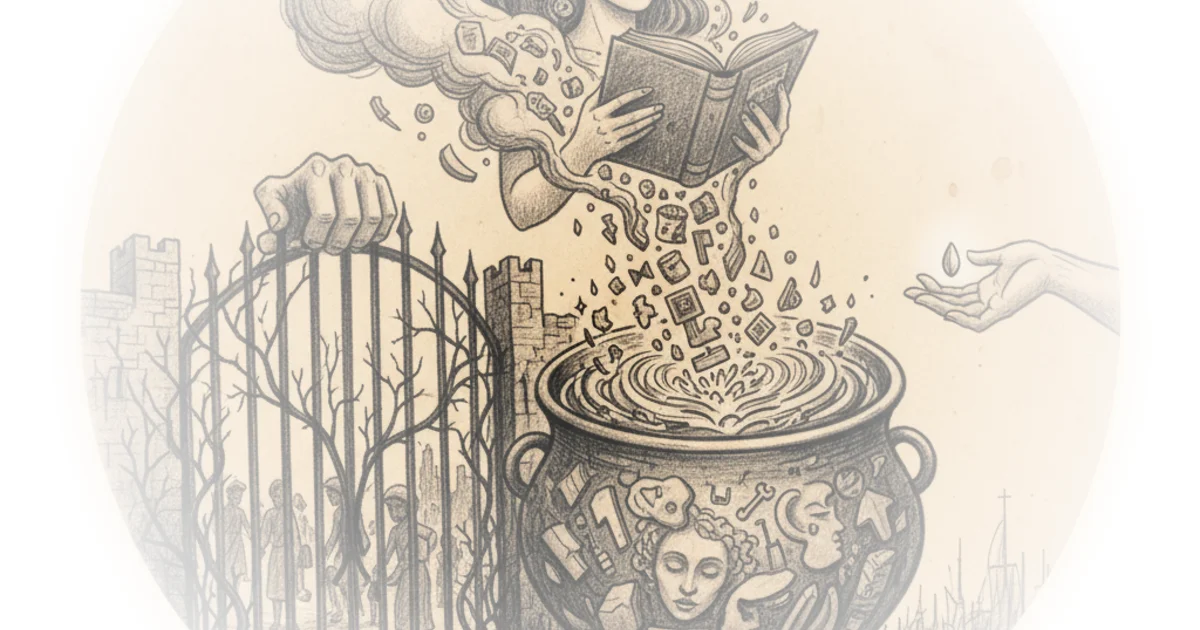
The lecture begins by dismantling the comforting narrative of the United States as an inevitable haven. Yale University writes, "This is not, of course, a narrative that has been uncontested in American history, but it is a story that has had real traction." The author effectively frames the "melting pot" not as a historical fact, but as a specific myth that gained power during the era of mass European immigration. By starting with a 1970s cartoon about the melting pot, the speaker immediately signals that these stories are constructed and often contested.
The core of the argument rests on the sheer scale of the demographic shift. Between the 1860s and the 1920s, roughly 26 to 28 million people entered the country, pushing the foreign-born population to nearly 15%. Yale University notes, "In 2025 we are once again living at a moment where those statistics look quite similar." This parallel is the lecture's most potent hook. The author suggests that the current "second Gilded Age" isn't just about wealth inequality, but about a recurring anxiety over national identity that mirrors the late 19th century. Critics might note that equating modern immigration with the early 20th century overlooks the distinct geopolitical drivers of today's migration, such as climate change and global conflict, which differ from the economic and religious persecution of the past. However, the statistical resonance remains a powerful rhetorical tool.
"The big question of this lecture today is how did we go from this moment in the 1880s and the Statue of Liberty to what's on the next slide which is from the 1920s."
From Emma Lazarus to the KKK
The lecture's emotional weight comes from the stark juxtaposition of two symbols: the Statue of Liberty and a 1920s Ku Klux Klan publication. Yale University reads the famous lines from Emma Lazarus's poem on the statue: "Give me your tired, your poor, your huddled masses yearning to breathe free. The wretched refuse of your teeming shore." This vision of the U.S. as a "place of refuge" is then immediately contrasted with the Klan's imagery, which rejected immigrants as "undesirable" and "unamerican."
The author argues that this shift wasn't gradual but resulted in a policy slam: "In 1924... the United States moved from a period of mass and relatively unrestricted immigration to basically slamming the doors shut for a generation and a half." This is a crucial point often glossed over in popular history. The lecture highlights that the political machinery of the 1920s successfully weaponized fear to overturn the very ideals the Statue of Liberty represented. The author's use of the Klan's own propaganda as a primary source is a bold move that forces the audience to confront the ugliness of the era without sugarcoating.
The Lens of Federal Power
Beyond immigration, the lecture frames the entire 20th century through the expansion of federal authority. The speaker introduces J. Edgar Hoover, the long-time head of the Federal Bureau of Investigation, as a central character. Yale University explains, "He does not have, I would say, the same moral standing in American politics that Alexander Hamilton and Frederick Douglass do. But he is a preoccupation of mine. And he's actually a surprisingly good lens into this big story about federal power in the 20th century." This is a distinctive curatorial choice. By focusing on a controversial figure like Hoover, the author avoids the hagiography often found in standard history courses and instead examines the mechanics of surveillance and control.
The argument connects the rise of the federal government to the changing meaning of citizenship. As the lecture notes, the story of the 20th century is one of "increasing expectations on the federal government and particularly... on the American presidency." This framing helps the listener understand why modern political battles feel so existential; they are rooted in a century-long struggle over the size and scope of the state. The author's personal anecdote about visiting a replica of Independence Hall in California serves as a metaphor for how American symbols are repurposed, reinforcing the idea that history is not static but constantly being rewritten by those in power.
Bottom Line
Yale University's lecture succeeds by refusing to treat the "melting pot" as a settled fact, instead revealing it as a fragile ideal that was violently contested and temporarily abandoned. The strongest element is the direct statistical and thematic comparison between the Gilded Age and the present, which makes the history feel urgently relevant. The biggest vulnerability lies in the brevity of the immigration analysis; while the shift to 1924 is clear, the complex economic drivers of the "new immigrants" from Southern and Eastern Europe are only briefly touched upon before the lecture pivots to federal power. For the listener, the takeaway is clear: the boundaries of American identity are not fixed, and the battle over who belongs is as old as the republic itself.