Daniel Parris identifies a quiet but pervasive economic engine in modern Hollywood: the transformation of fan nostalgia into a predictable, high-yield asset class. While most critics dismiss music biopics as formulaic, Parris brings hard data to the table, revealing that these films often outperform horror movies in return on investment while relying on a rigid, almost algorithmic approach to storytelling and marketing.
The Economics of Mimicry
Parris opens by framing the current cultural landscape as a trap for the uninitiated. He writes, "When enough people like something—say a movie or book—that appreciation becomes an asset." This reframing is crucial; it suggests that our emotional connection to art is no longer just personal, but a financial liability waiting to be monetized. The author illustrates this with a cynical catalog of recent adaptations, noting that if you love a specific character or song, you are now "contractually obligated" to consume the next iteration of that IP.
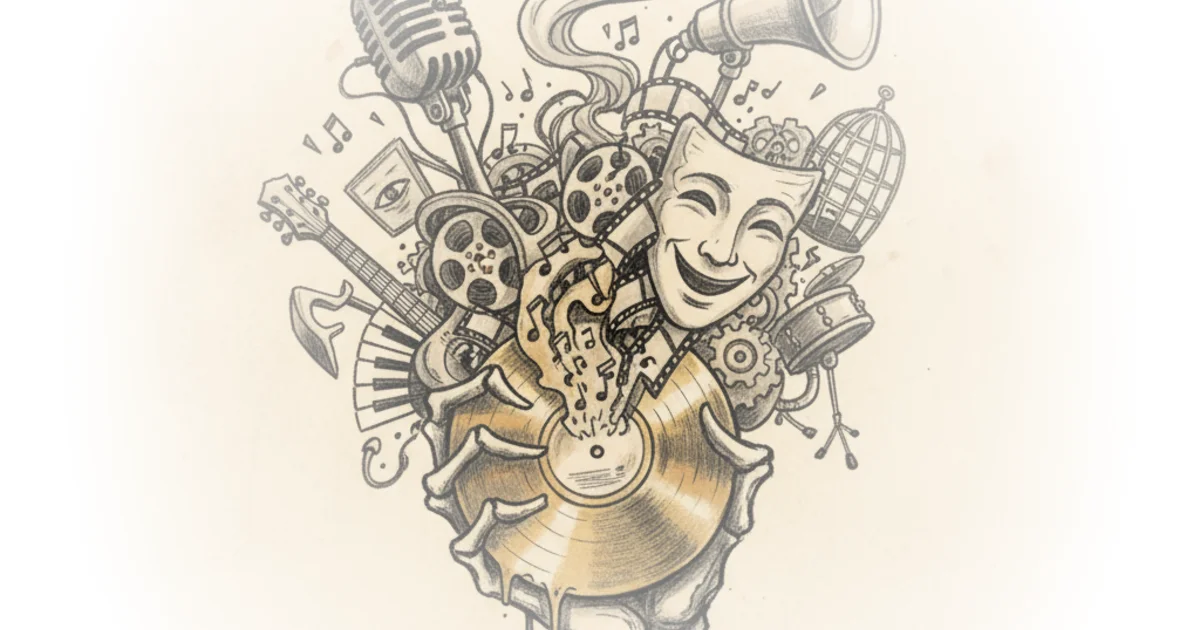
The core of Parris's argument rests on the sheer profitability of the genre. He points out that "the average music biopic has a return on investment comparable to that of a horror movie," which explains why studios churn out two to four of these films annually. This is not an artistic renaissance; it is a calculated response to market demand. The author observes that these films are uniquely successful "despite its formulaic nature," a paradox that drives the entire industry's current strategy.
"The goal of movie marketing is to make sure audiences know what they're getting. From this vantage, invoking the musician's name and art leaves little room for misinterpretation."
Parris's analysis of film titles reveals the depth of this corporate caution. He categorizes the naming conventions, finding that roughly 70% of biopics use a combination of the artist's name and a signature song. This data-driven approach strips away the mystery of art, turning a movie title into a guarantee of content. A counterargument worth considering is that some of the most acclaimed films in the genre, like Control or 24 Hour Party People, buck this trend by focusing on the artist's internal struggle rather than their hits. However, Parris suggests these are the exceptions that prove the rule of commercial safety.
The Oscar Bait and the Kidz Bop Industrial Complex
The commentary shifts to the psychological hook that makes these films so effective: the human desire for mimicry. Parris argues that "one of the enduring appeals of the biopic—musical or not—is cosplay." He notes that our "lizard brain is hard-wired to enjoy actors impersonating cultural icons," a phenomenon that translates directly into awards season success. Historically, nearly one in four of these movies receives an acting Oscar nomination, a statistic that proves the Academy is fully aware of the pattern and, as Parris puts it, "apparently don't care if they're being predictable."
This dynamic creates a feedback loop where the value of the film lies not in its narrative stakes, but in the actor's ability to replicate a voice or mannerism. Parris writes, "Clearly, mimicry trumps originality and constructed interiority." This is a sharp critique of a system that rewards imitation over invention. The author connects this to the broader concept of "Oscar bait," noting that if an actor can do a "credible M.C. Hammer impersonation," they are likely to be nominated, regardless of the film's artistic merit.
"A music biopic brought 150-year-old music into the zeitgeist."
Beyond the box office and awards, Parris highlights the tangible economic impact on the artists' estates. He cites data showing that a blockbuster biopic can boost monthly Spotify listenership by nearly 20 million. This phenomenon is not new; he references the 1984 film Amadeus, which drove classical recordings into the modern charts. However, the modern iteration is more aggressive. The author describes a meeting with a financial firm that buys and sells artist discographies, noting that they view a Hollywood adaptation as a "proven way to boost its value." This reframes the artist's life story as a financial stock, managed by estates and firms rather than the creative community.
The Terms and Conditions of Nostalgia
The most biting section of the piece addresses the exploitation of the audience's formative years. Parris argues that "most people are wistful for the world they knew during adolescence," a period of "cultural vulnerability between the ages of ten and eighteen." He posits that this vulnerability is now being systematically harvested by corporations. The author compares the experience of watching a music biopic to the "Kidz Bop Industrial Complex," where familiar songs are re-recorded with slight stylistic tweaks to satisfy a childlike impulse.
"My biggest gripe with fan service and nostalgia exploitation is that a ten-year-old did not sign up for this."
Parris suggests that the bargain of enjoying a cultural touchstone now comes with hidden terms: the obligation to consume endless sequels, spin-offs, and adaptations. He writes, "You can watch The Empire Strikes Back, and cherish this experience as a formative memory, but only if you agree to watch every Disney+ Star Wars series (in perpetuity)." This is a powerful indictment of the current media ecosystem, where the joy of discovery is replaced by the pressure of perpetual consumption. Critics might argue that fans actively seek out this content and that the "terms and conditions" are a voluntary choice. Yet, Parris's point stands that the initial emotional bond was formed before the commercial machinery was fully engaged.
Bottom Line
Daniel Parris delivers a compelling, data-backed critique of how the music biopic has evolved from a genre of artistic exploration into a mechanism for asset management. The strongest part of the argument is the connection between the "lizard brain" desire for mimicry and the financial incentives of the film industry. The biggest vulnerability is the assumption that all fans are passive victims of this machinery, ignoring the agency audiences have in rejecting these films. The reader should watch for how this model of "nostalgia exploitation" spreads beyond music into other areas of culture, turning every childhood memory into a potential revenue stream.
"Sure, this entire essay may read like a minor meltdown triggered by a mediocre biopic—but just you wait. Sooner or later, culture will come for you, too. It always does, if given enough time."
The piece serves as a warning: the next time you feel a surge of nostalgia, remember that someone is likely calculating the return on investment. The era of the soulless biopic is not a glitch; it is the feature. As Parris concludes, the only way to opt out is to realize that the bargain was never yours to make in the first place.