The Man Who Put Libertarians in Suits
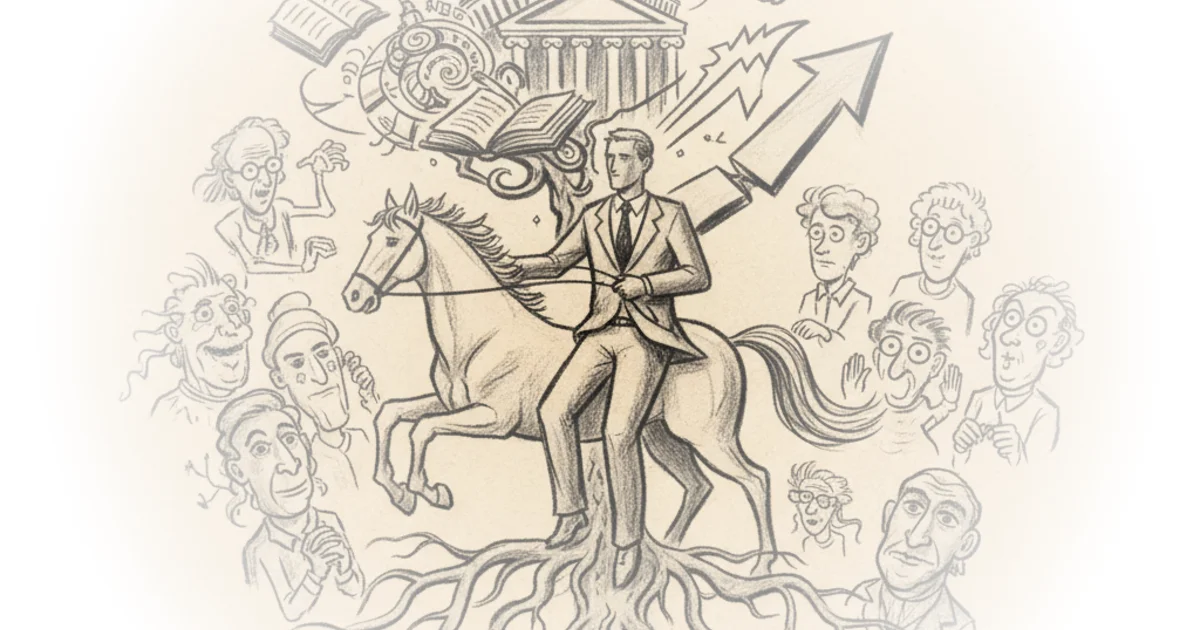
Ed Crane, who died on February 10, 2026, at the age of 81, was not a philosopher or a public intellectual. He was an institution builder -- the kind of person whose influence is felt through the organizations they leave behind rather than the books they write. As one colleague recalled, Crane liked to say "that the thing he did for libertarianism was put libertarians in suits and ties." It was a self-deprecating line, but it understated his actual achievement. Crane took a movement populated by anarcho-capitalists, Objectivists, science fiction fans, and survivalists and turned it into something that could operate in Washington.
The Bulwark's Joshua Tait traces that arc in detail, from Crane's early days as a Goldwater precinct captain in Berkeley -- where he knew every voter for his candidate, "all thirteen people" -- through his takeover of the Libertarian Party and his founding of the Cato Institute.
Building the Machine
Crane's organizational talent was evident from the start. After discovering libertarianism through Ayn Rand and the Goldwater campaign, he threw himself into party politics with a zeal that alienated as many people as it attracted. The libertarian historian Brian Doherty describes him as "an accomplished man with a professional vision for the LP who wasn't charmed for long by the peccadilloes and amateurism of many in the party -- and he wasn't shy about letting them know it." Crane himself acknowledged the cost: "I still have enemies to this day in most states in the union."
His alliance with Charles Koch supercharged the effort. Koch's money and Crane's organizational drive reshaped the libertarian landscape entirely. Koch's massive investment created what Doherty called "a bizarre gravitational shifting as Planet Koch adjusted everyone's orbits." The Koch-Crane partnership funded magazines, think tanks, student groups, and the party itself. David Koch even ran for vice president on the Libertarian ticket in 1980, partly to circumvent campaign finance laws -- a move that nicely captured the movement's blend of principle and pragmatism.
But the alliance with the grassroots was fragile. By the 1980s, party activists revolted against what they called the "Crane Machine," and the Libertarian Party's Koch-funded bubble burst.
Cato and the Art of Principled Stubbornness
Crane's more lasting achievement was the Cato Institute, founded in 1977 and relocated to Washington in 1981. Under Crane and longtime chairman William Niskanen, Cato became the leading libertarian think tank in the country, pushing drug decriminalization, deregulation, immigration, and anti-interventionism -- including opposition to both the Gulf War and the Iraq War.
What made Cato distinctive was Crane's refusal to play the usual Washington game of partisan alliance. His contempt for politicians was genuine and often hilarious. About Reagan, he wrote that "Reaganomics has not failed. Reaganomics is simply a fiction transmitted to us with unblinking innocence by the nation's media." When Newt Gingrich tried to arrange a meeting with House Republicans, Crane replied, "Tell the speaker to cut some spending," and hung up. His general assessment of elected officials was characteristically blunt: "I feel like I have to take a shower after I meet with some of these guys."
There is something admirable about this kind of principled orneriness. Crane genuinely believed that libertarian ideas should not be diluted for the sake of political convenience. The Cato Institute under his leadership maintained positions -- on immigration, on war, on civil liberties -- that made it an uncomfortable partner for both parties.
The Limits of Purity
Yet Crane's story also illustrates the costs of that approach. His eventual ouster from Cato in 2012 came after the Kochs decided they wanted the institute to coordinate more closely with their broader political operation. P.J. O'Rourke captured the irony perfectly: "In their battle against statist disease, the Kochs seem to regard Cato's individualism as too individualistic. They want a more collective effort to cure collectivism."
Crane lost that fight. And in enforced retirement, his reputation faded in the way that institution builders' reputations always do -- quickly and quietly. Credible sexual harassment allegations that surfaced in 2018 further damaged his legacy.
Tait's piece is at its most pointed when it turns from biography to the present. The question of where libertarians fit in Trump's America is not an academic one. Many remain principled and anti-Trump. But Tait identifies a deeper problem: a tendency toward "nihilistic both-sidesism" that treats left-wing and right-wing threats to liberty as equivalent, even when the evidence plainly suggests otherwise.
This is a fair criticism, though it could be pressed further. The libertarian movement's historical comfort on the right -- its willingness to tolerate conservative allies who had no real interest in liberty beyond tax cuts -- made it poorly positioned to respond when the right turned authoritarian. Decades of treating Democrats as the greater statist threat left many libertarians unable to recalibrate when the threat shifted.
Bottom Line
Crane's career is a case study in what organizational genius can accomplish and where ideological purity runs aground. He built lasting institutions and kept them intellectually honest for decades. But the movement he shaped -- one that prided itself on standing apart from both parties -- now faces a moment that demands choosing. Tait argues that libertarians who love freedom need to "break out from their familiar political enclave" and take a side. Whether the movement Crane built can do that remains an open question. The man who put libertarians in suits may have made them presentable, but presentability is not the same as adaptability.