Brad DeLong delivers a searing critique of Eric Hobsbawm, arguing that the historian's greatest strength—his unwavering belief in a Marxist teleology—is precisely what rendered him blind to the true trajectory of the twentieth century. While many celebrate Hobsbawm as the definitive voice of modern history, DeLong contends that his rigid adherence to a "Grand Narrative" of inevitable socialism turned his later work into a "Procrustean Bed," forcing complex realities to fit a failing ideological mold. For readers seeking clarity on why historical optimism often curdles into dogma, this analysis offers a necessary correction to the hagiography surrounding one of the century's most influential scholars.
The Trap of the Grand Narrative
DeLong begins by dismantling the idea that Hobsbawm was a neutral observer. Instead, he frames Hobsbawm as an advocate whose political commitments powered his early masterpieces but crippled his later analysis. "Hobsbawm's Marxist teleology made him both the greatest narrator of the 1776-1875 not-so-long nineteenth century and a spectacularly poor guide to the 1875-2010 genuinely long twentieth," DeLong writes, establishing the central tension immediately. The argument is that Hobsbawm viewed history as having a "gravitational center" moving inevitably toward socialism, a belief DeLong dismisses as fundamentally false.
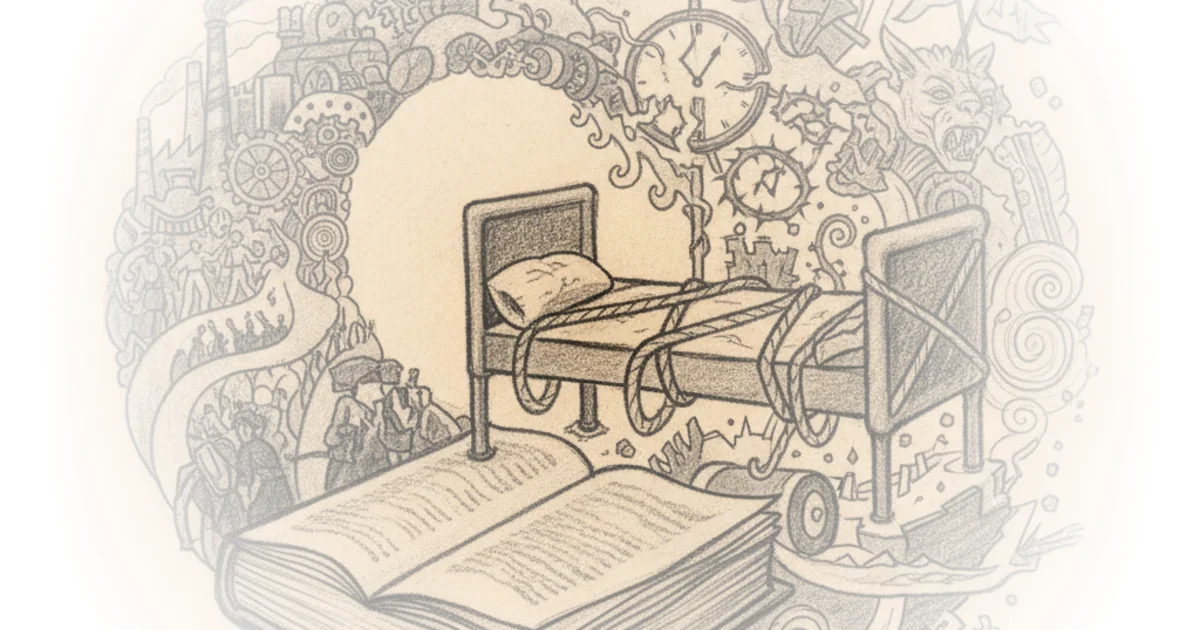
This framing is crucial because it shifts the critique from personal biography to intellectual methodology. DeLong suggests that Hobsbawm's inability to pivot when history diverged from his predictions was not just an error of fact, but a failure of moral reasoning. He notes that for Hobsbawm, "All Grand Narratives are false," yet he remained trapped in one anyway. This creates a tragic irony: the very faith that allowed him to write with such conviction about the Age of Revolution is what blinded him to the realities of the Belle Époque, where mass prosperity and nationalist insanity defied his script.
"His greatness as a historian partly depended on the very commitments that made him a failure as a moral agent, for those commitments underpin his belief in his Grand Narrative."
The comparison to the concept of the Procrustean Bed is particularly apt here; just as the mythical innkeeper forced guests to fit his bed by stretching or amputating them, Hobsbawm stretched historical facts until they fit his predetermined conclusion. Critics might argue that all historians operate with some degree of bias or theoretical framework, but DeLong's point is that Hobsbawm's specific framework was so rigid it prevented him from acknowledging when the world had fundamentally changed.
The Moral Cost of Obedience
The commentary then pivots to a darker examination of Hobsbawm's personal political life, specifically his loyalty to the Communist Party despite its catastrophic failures. DeLong describes Hobsbawm as a "strange chimerical Tory Communist," a figure who valued hierarchy and obedience above truth. He cites Christopher Hitchens, who observed that Hobsbawm's commitment was driven by "a displaced yearning for family values, religion and patriotism: the Tory virtues."
This psychological insight adds necessary depth to the historical critique. It suggests that Hobsbawm's intellectual rigidity was rooted in a personal need for belonging rather than a genuine analysis of economic conditions. DeLong highlights Hobsbawm's "uncanny obedience" during critical moments, such as accepting the Comintern's directive to undermine Social Democrats in 1932 or supporting the Ribbentrop-Molotov pact after June 1939.
The human cost of this obedience is starkly illustrated by DeLong's reference to a 1994 interview where Hobsbawm suggested that even knowing about the millions dying in the Soviet experiment, he would have "probably not have backed out." DeLong finds this stance morally indefensible: "To say that mass murder could be justified by a future utopia that never materialized is to adopt an ethical framework so remote from ordinary human concern that it becomes indistinguishable from amorality."
"He was blinded by faith, and when the faith was gone he was blinded by habit."
This section serves as a powerful warning against allowing ideology to override empirical reality. While some might defend Hobsbawm's loyalty as a complex personal choice made in a turbulent era, DeLong insists that the refusal to disavow the Leninist project even after Stalin's crimes were exposed represents a profound failure of moral agency. The "hooded, wooden language" Tony Judt noted in Hobsbawm's writing was not just a stylistic quirk; it was a shield against confronting the horror his ideology enabled.
The Dual Revolutions and Their Limits
Despite these severe criticisms, DeLong acknowledges Hobsbawm's unparalleled skill in narrating the period from 1789 to 1875. He credits Hobsbawm with correctly identifying the "twin forces of the French and Industrial Revolutions" as the engine that transformed Europe from a feudal agrarian society into an industrial capitalist world. DeLong writes, "Hobsbawm maps the moment when the modern world really begins," capturing how terms like "capitalism," "proletariat," and "nationalism" became real forces rather than abstract concepts.
However, DeLong points out a fatal flaw in Hobsbawm's methodology: his reliance on an idealized model where England provided the economic template and France provided the political one. He notes that this was a directive from Friedrich Engels, yet "there was in fact no country in the world with an economic history tracking England's and a political history tracking France's." This grafting of two distinct histories onto a single narrative allowed Hobsbawm to predict a revolution that never happened.
The argument here is nuanced; DeLong does not dismiss the Age of Revolution as worthless, but rather highlights how its success in explaining the past became a liability when applied to the future. The explosive growth in global railway mileage from 4.5 thousand in 1840 to 228 thousand in 1880 was real, but Hobsbawm's interpretation of it as a prelude to socialist triumph was a projection, not an observation.
"Taking France's political and England's industrial history as the ultimate ideal-typical underlying reality... well, that is not an easy task."
This critique resonates with the broader theme of the piece: the danger of forcing complex, messy historical data into a clean, theoretical box. While Hobsbawm successfully described what happened in the nineteenth century, his insistence on why it was happening (the march toward communism) led him to misread the subsequent era entirely.
Bottom Line
DeLong's commentary succeeds in separating Eric Hobsbawm the brilliant narrator from Hobsbawm the flawed prophet, offering a necessary corrective to the uncritical reverence often afforded to him. The strongest part of this argument is its demonstration that intellectual brilliance and moral blindness can coexist when an ideology becomes more important than the truth it claims to serve. However, the piece's greatest vulnerability lies in its potential to dismiss Hobsbawm's later works entirely; even a flawed guide can offer valuable maps if one knows where the compass is broken. Readers should watch for how contemporary historians navigate similar tensions between their theoretical commitments and the chaotic reality of the twenty-first century.