This piece reframes a stunning primary upset not as a personality clash, but as a collision between grassroots populism and a legal architecture designed to let unlimited wealth dictate outcomes. Kahlil Greene's analysis is notable because it refuses to treat the $60 million spent against Abdul El-Sayed as an anomaly; instead, he traces a direct line from 1921 Supreme Court rulings to today's super PACs, arguing that the system is functioning exactly as the courts intended it to. For the busy listener, this is a crucial distinction: the victory wasn't just about a candidate's charisma, but about a specific historical loophole that allowed the American Israel Public Affairs Committee to spend $30 million to unseat a progressive challenger.
The Legal Architecture of Exclusion
Greene anchors his argument in the 1921 case Newberry v. United States, a decision that fundamentally altered how money flows into American elections. He writes, "In 1921, the justices removed primary elections from federal regulation entirely, and Congress did not recover authority over money in primaries until 1944." This historical pivot point is often overlooked in modern coverage, yet it is the bedrock of the current crisis. By overturning Truman Newberry's conviction for overspending in a primary, the Supreme Court effectively declared that party primaries were private affairs, immune to federal campaign finance laws.
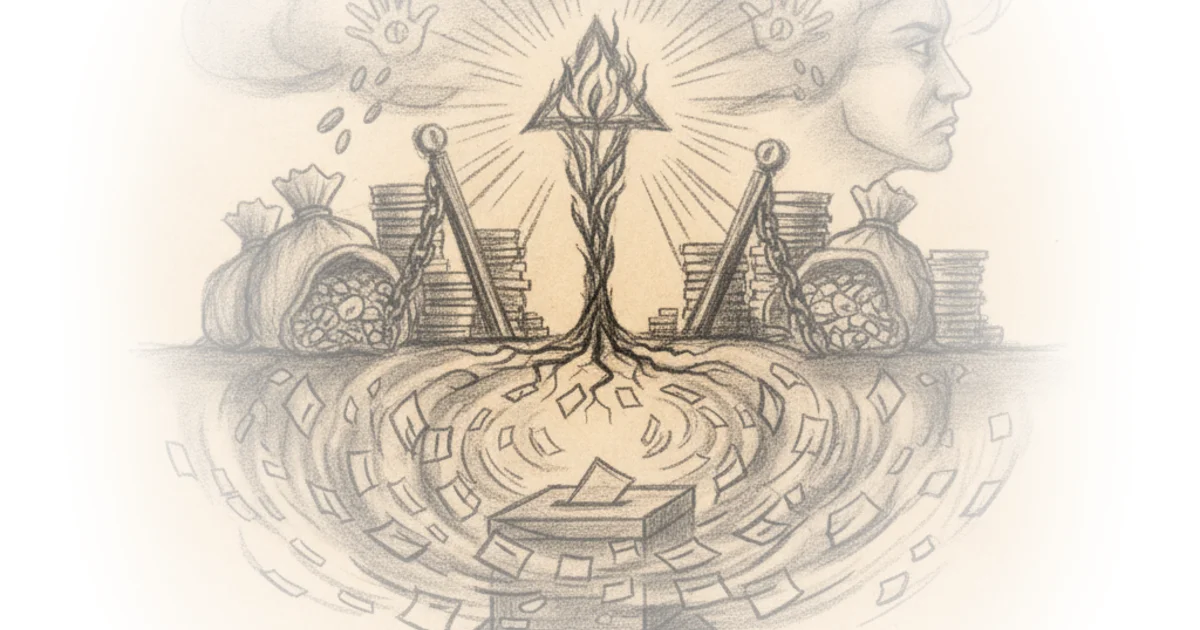
The author connects this legal vacuum to the subsequent history of voter suppression in the South. He notes that following this ruling, "Southern states charged people money to vote as well," leading to a system where the primary effectively decided elections while excluding Black voters through poll taxes and "white primaries." It is a sobering reminder that the separation of primaries from federal oversight was not a neutral legal technicality but a mechanism that once facilitated racial exclusion. While Greene focuses on the financial implications today, the historical parallel to the Nixon v. Herndon and Smith v. Allwright cases adds necessary gravity to the argument that "private" associations cannot dictate public office.
"The Supreme Court kept the first limit [on contributions] and struck down the second [on spending]. That split governs the general election in November."
The Modern Mechanics of Dark Money
The commentary shifts seamlessly from 1921 to 2026, illustrating how the Newberry logic was resurrected and expanded by Buckley v. Valeo and Citizens United. Greene points out the stark disparity in the Michigan race: "El-Sayed collected $14.5 million under those rules [direct contributions], more than Stevens collected, but outside groups still outspent his side by about eleven to one." This eleven-to-one ratio is the smoking gun of the modern system. The United Democracy Project, a super PAC directed by AIPAC, deployed over $30 million—its largest single-race expenditure ever—while operating under rules that require no donor disclosure.
As Greene puts it, "Federal law places no limit on what such groups raise or spend." This is the core of the argument: the system creates a two-tiered reality where a candidate can be heavily regulated in their direct fundraising, while their opponents are besieged by untraceable, unlimited wealth. The author highlights the irony that Democratic campaigns have historically policed their own donor bases, returning contributions from Arab American Democrats in 1984 and 1988, yet "there was little comparable scrutiny attached to the unlimited and largely untraceable spending that outside groups directed against El-Sayed this year."
Critics might argue that the sheer volume of spending by outside groups is a feature of free speech, not a bug, and that voters are capable of discerning the source of attack ads. However, Greene's evidence suggests that the opacity of these funds—where hedge fund managers and entertainment executives funnel money through social welfare nonprofits—strips voters of the context needed to evaluate the attack. The argument holds that when the identity of the spender is hidden, the democratic process is fundamentally compromised.
The Human Cost of Financial Asymmetry
Beyond the legal and financial mechanics, Greene centers the human stakes of this asymmetry. He notes that El-Sayed, an epidemiologist and the son of Egyptian immigrants, campaigned on "Medicare for All and on removing corporate money from American politics." The narrative is not just about a political loss, but about the silencing of a specific policy vision by a financial juggernaut. The author writes, "I'm fighting to document stories like this before they get dismissed or erased entirely," framing the coverage itself as an act of resistance against the erasure of grassroots movements.
The piece also touches on the broader implications for the upcoming general election, noting that "AIPAC said on Wednesday that it will spend against El-Sayed again." This signals that the primary was merely the opening salvo in a war of attrition funded by the same legal loopholes. The argument is that the system is not broken; it is working as designed by a century of judicial decisions that prioritize the speech rights of corporations and wealthy donors over the electoral equality of citizens.
"Outside groups spent every one of those dollars legally."
Bottom Line
Kahlil Greene's strongest move is connecting the 1921 Newberry decision directly to the $60 million spent in the Michigan primary, proving that today's dark money crisis is a deliberate historical outcome rather than an accident. The argument's vulnerability lies in its reliance on legal history to explain a political reality that many voters find opaque; while the legal path is clear, the political path to closing these loopholes remains blocked by the very First Amendment precedents Greene critiques. Readers should watch how the general election unfolds, as the same unlimited spending that defined the primary will likely dominate the final contest, testing whether a candidate can win against a financial tide that the law explicitly permits.