This piece from Stark Realities challenges the comfortable, simplified narrative that American support for Israel is a straightforward, finite line item in the federal budget. Instead, it constructs a terrifyingly comprehensive ledger that accounts for the hidden debts of war, the human toll of regime change, and the cyclical violence that US backing helps ignite. For a listener trying to grasp the true scale of the Middle East's entanglement with American power, this is a necessary, if harrowing, recalibration of the facts.
The Hidden Price Tag
The article begins by dismantling the common misconception that the relationship is defined solely by the $3.8 billion annual military aid package. Stark Realities reports, "that answer massively understates the true cost of the relationship, not only because it doesn't capture various, vast expenditures springing from it, but even more so because the relationship's steepest costs can't be measured in dollars." The piece argues that the financial burden extends far beyond direct grants, encompassing the debt interest on perpetual deficits and the massive operational costs of protecting Israeli interests in the region.
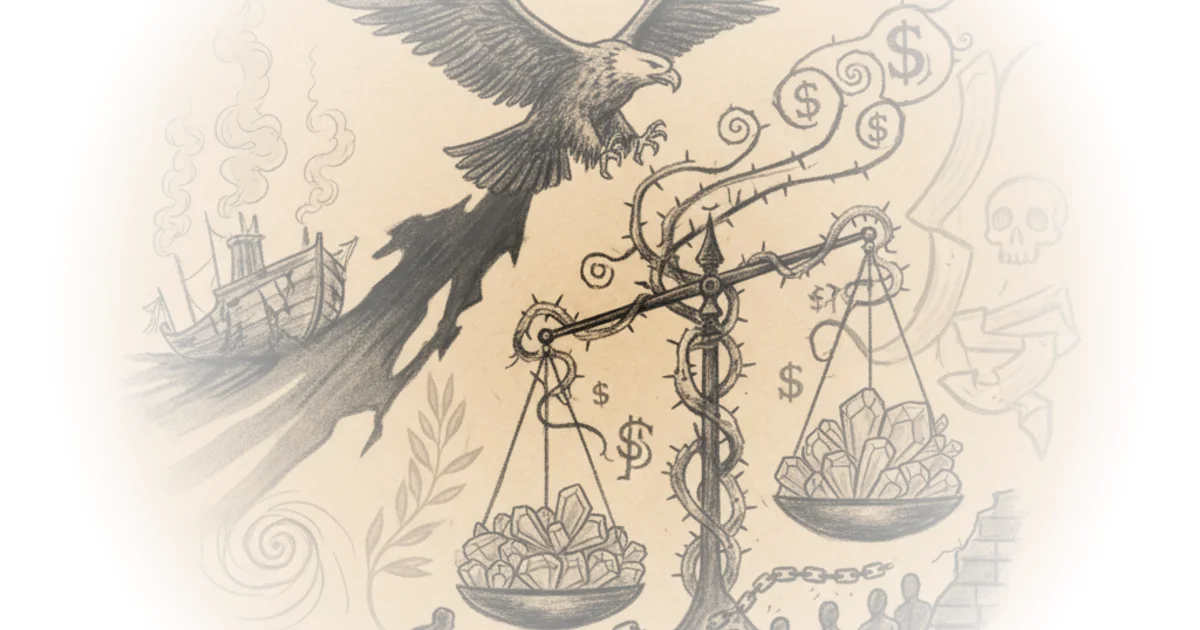
The editors highlight a stark disparity in aid distribution, noting that while Israel is among the world's wealthiest nations, it remains the largest recipient of US foreign assistance. "America gave the Zionist state $404 per person in the 2023 fiscal year, compared to just $15 per person for Ethiopia," the piece notes, illustrating the skewed priorities of US foreign policy. This framing is effective because it forces the listener to confront the reality that aid to a G7-level economy is being prioritized over assistance to some of the planet's most impoverished populations. Critics might argue that strategic alliances often transcend simple economic metrics, but the article's point stands: the sheer volume of resources directed toward one nation, regardless of its wealth, demands scrutiny.
The commentary further expands the definition of "aid" to include the indirect costs of regional stability. It points out that significant portions of US assistance to Egypt and Jordan are actually subsidies for the peace treaties those nations signed with Israel. The piece observes, "much of Egypt's take... should be chalked up to Israel too, because of ongoing US aid commitments rising from the 1978 Camp David Accords." This historical context is vital; it reveals how the 1978 agreement, often celebrated as a diplomatic triumph, locked the United States into a decades-long financial obligation that continues to drain the treasury. The argument suggests that the US is effectively paying for Israel's security perimeter through the backdoor of its neighbors' budgets.
"The relationship's steepest costs can't be measured in dollars."
The Cost of Regime Change
Moving beyond direct aid, the article tackles the astronomical costs of military interventions undertaken to secure Israel's regional dominance. Stark Realities argues that the drive to topple governments hostile to Israel has resulted in shattered states and trillions in expenses. The piece cites the 2003 invasion of Iraq, where then-Prime Minister Benjamin Netanyahu assured Congress that removing Saddam Hussein would have "enormous positive reverberations on the region." The result, as the article details, was a $2.9 trillion price tag and upwards of 580,000 dead, with the US military bearing the brunt of the casualties and long-term care costs.
The narrative connects these historical tragedies to current events, noting that the drive to sever the "Shia Crescent" led to the destabilization of Syria. The editors write, "To the contentment of the US and Israeli governments, Syria is now led by an al Qaeda alumnus who's reportedly poised to relinquish Syria's long-standing claim on the Golan Heights." This is a chilling assessment of the outcome: a chaotic, extremist-led state replacing a secular adversary, achieved at the cost of American lives and global stability. The piece suggests that the goal of "regime change" often yields a shattered state that is "seemingly just as pleasing to Israel and its American collaborators as one that spawns a functioning state."
The human cost is brought into sharp focus with references to the veterans who paid the ultimate price. The article mentions a Marine weeping at a 2005 memorial service and Infantryman Brendan Marrocco, who lost all four limbs in Iraq. These are not abstract statistics; they are the tangible results of a policy that prioritized a foreign government's security over American lives. The argument here is that the "revolving cast of Israel-favoring presidents, cabinet members, and national security officials" has consistently pushed the US into conflicts that serve Israeli interests rather than American ones.
The Cycle of Violence
Perhaps the most provocative section of the piece is its analysis of the link between US support for Israel and the motivation for terrorism against the United States. Stark Realities reports that "US backing of Israel is a principal motivator of Islamist terrorism directed against Americans," citing the 9/11 attacks as the ultimate example. The article details how Osama bin Laden explicitly cited the First Qana Massacre, where Israel killed 106 Lebanese civilians, as a justification for his declaration of war. "Muslim youth 'hold [the United States] responsible for all the killings...carried out by your Zionist brothers in Lebanon,'" the piece quotes from bin Laden's 1996 declaration.
The editors weave in the testimony of the 9/11 Commission, noting that mastermind Khalid Sheikh Mohammed's "animus toward the United States stemmed not from his experiences there as a student, but rather from his violent disagreement with U.S. foreign policy favoring Israel." This reframing is crucial; it challenges the notion that terrorism is purely ideological or religious, pointing instead to specific geopolitical grievances. The article argues that the US response to these attacks—the Global War on Terror—became a self-fulfilling prophecy, costing $2.3 trillion in Afghanistan alone and further entangling the US in the region.
The piece then turns to the ongoing war in Gaza, warning that the current destruction, carried out with US-supplied weapons like the 2,000-pound MK-84 bombs, risks generating a new wave of retaliation. "If innocent Americans are someday victimized by terrorists seeking to avenge the horror visited upon Gaza's two million men, women and children with US-supplied weapons, watch for a perverse dynamic in which the attack is cited as a reason to redouble American support of Israel," the editors warn. This cycle is described as a "boon to the State of Israel," a dark irony where the very actions meant to secure Israel's safety ultimately endanger it and its American sponsor.
The article includes a disturbing anecdote about Benjamin Netanyahu's reaction to 9/11, quoting him as saying, "It's very good... Well, not very good, but it will generate immediate sympathy." While this quote is often debated, the piece uses it to illustrate a "self-perpetuating phenomenon" where terrorism is exploited to deepen the alliance. The editors note that this logic is circular: America needs a bulwark against Iran because Iran opposes Israel, and Israel is a bulwark because it opposes Iran. Army Colonel Nathan McCormack is quoted summing up the futility of this strategy: "[Israel is] our worst 'ally.' We get literally nothing out of the 'partnership' other than the enmity of millions of people in the Middle East, Africa and Asia."
Shifting Tides
The final section of the piece suggests that the American public is finally waking up to this reality. Stark Realities notes that a majority of Americans now hold a negative view of Israel, with a particularly sharp decline in support among younger Republicans. The article cites a 2010 warning from Meir Dagan, former head of Mossad, who told the Knesset that "Israel is gradually turning from an asset to the United States to a burden." The editors conclude that "fifteen years later, Israel's status as an enormous, multidimensional burden on the American people is more evident than ever."
This shift in public opinion is presented as a potential turning point. The piece argues that as citizens scrutinize the conflict and the cost of US involvement, the political cover for unconditional support is eroding. The editors write, "That latter dimension has special resonance with countless US combat veterans who've come to the terrible realization that their sacrifices and those of their fallen comrades were ultimately made for the benefit of a foreign government." This emotional appeal to the veteran community is a powerful counter-narrative to the traditional framing of the alliance as a moral imperative.
"We get literally nothing out of the 'partnership' other than the enmity of millions of people in the Middle East, Africa and Asia."
Bottom Line
The strongest element of this argument is its relentless accounting of the hidden costs, moving beyond the $3.8 billion aid figure to reveal a trillion-dollar web of military operations, regime change, and long-term security liabilities. Its biggest vulnerability lies in its assertion that US policy is driven almost exclusively by Israeli interests, which may oversimplify the complex domestic political and strategic calculations of the US executive branch. However, the piece succeeds in forcing a necessary conversation: if the goal of US foreign policy is American security and prosperity, the current trajectory in the Middle East appears to be failing on both counts. Listeners should watch for how this growing public skepticism, particularly among younger voters and veterans, begins to reshape the political landscape in Washington.