In an era where animation is often reduced to corporate branding or algorithmic content, a fresh look at the Soviet Union's 1969 Winnie-the-Pooh reveals a masterpiece born not of commercial mandate, but of artistic rebellion. Animation Obsessive argues that this beloved character is a testament to the power of collaborative imperfection, proving that a bear with no neck and a flattened ear could capture the human condition better than any polished, market-tested design. This is not merely a nostalgia trip; it is a case study in how constraints can forge a unique visual language that still resonates fifty years later.
The Architecture of Imperfection
The piece dismantles the assumption that adaptation requires fidelity to the original illustration. Instead, it highlights how director Fyodor Khitruk and his team at Soyuzmultfilm deliberately rejected the familiar to find something new. Animation Obsessive reports, "Their goal was to make 'an absolutely new bear,' unlike any animated before." This was a radical stance in the 1960s, a time when the Disney version was already a global phenomenon, yet the Soviet team had not even seen it. They were working from a translation, free from the visual baggage of the West.
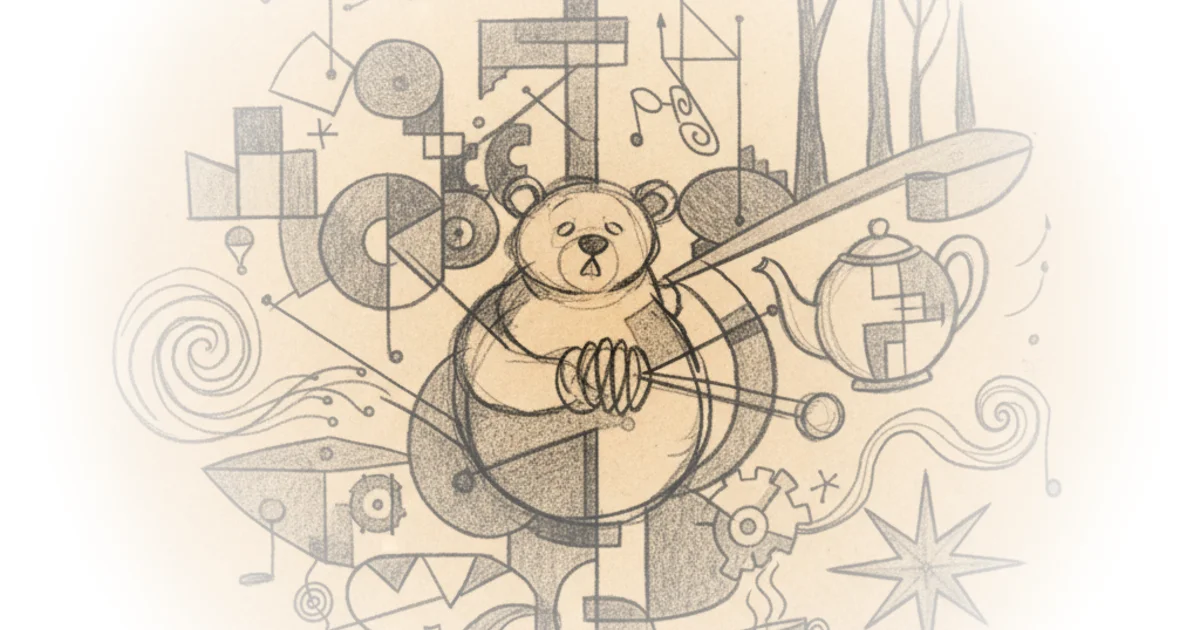
The resulting design was chaotic. Designer Vladimir Zuikov initially presented a creature that was less a bear and more a "crazed dandelion, a creature of ambiguous form: woolly, bristly, as if made from an old mop that had lost its shape." The reaction from the director was immediate: "Hell, what have you come up with?!" Yet, this initial failure was the seed of success. The team refined the concept, stripping away the neck so the head sat flat against the body, forcing the character to turn his entire torso to look around. As Zuikov explained, "No one can imagine how much trouble had to be endured at the beginning of work on Winnie-the-Pooh."
This struggle is the article's strongest point: the character's charm is inextricably linked to the difficulty of animating him. Animator Eduard Nazarov noted that the bear was "made up entirely of impossibilities," a figure who defied the laws of physics and standard movement. Rather than smoothing these edges, the team leaned into them. The famous walk, where Pooh floats on feet with no legs, was born from animator Violetta Kolesnikova's obsession with rhythm and the realization that the character needed to defy gravity to feel real. A counterargument might suggest that such stylization alienates general audiences, yet the enduring popularity of these films in Russia suggests that emotional truth outweighs anatomical correctness.
"No one can imagine how much trouble had to be endured at the beginning of work on Winnie-the-Pooh."
The Philosophy of the Dreamer
Beyond the visual design, the article delves into the philosophical core of the Soviet adaptation. Khitruk viewed Pooh not as a simple children's character, but as "a philosopher, a dreamer" who operates on a logic that is naive yet completely serious. To protect this philosophy, the team made a crucial narrative decision: they removed Christopher Robin. By eliminating the human child who usually grounds the stories, Khitruk removed the "higher authority" that could question Pooh's nonsense logic. The bear was left to his own devices, a self-contained world of thought.
The piece credits the voice actor, Yevgeny Leonov, as the final piece of the puzzle. Khitruk initially felt Leonov's voice was "absolutely... unsuitable for Pooh," until the sound editor suggested speeding up the recording. The result was a performance that transcended the script. Khitruk observed that Leonov "didn't simply recite the text... but somehow immediately and precisely picked up the character of the hero." The actor would freeze, adopt a pose, and his gaze would become pensive, providing the animators with a living reference for the character's soul. Interestingly, the animators also saw their own director in the bear. Eduard Nazarov noted, "You just have to look at how he turns around, how he moves his hands and how he puts his hands to the head, as if they were paws." This blurring of lines between creator and creation suggests that the film is as much a self-portrait of the Soyuzmultfilm team as it is an adaptation of A.A. Milne.
A Legacy of Collaboration
The article concludes by emphasizing that this masterpiece was not the vision of a single genius, but the result of a collective struggle. From the accidental arm-waving motion created by animator Maria Motruk, which became a signature of Pooh's poor coordination, to the timing charts Khitruk drew before the music was even composed, every element was a negotiation. Even the Russian translator, Boris Zakhoder, played a vital role in crystallizing the spirit of the text. The piece notes that when Khitruk later visited Disney, his version was praised by Wolfgang Reitherman, a testament to the fact that they had created something that stood shoulder-to-shoulder with the Western canon.
This narrative of collaboration offers a sharp contrast to the modern animation industry, where characters are often designed by committee and refined by data. The Soviet Pooh was born from the friction of artists pushing against each other and the material itself. As the article suggests, the character's depth came from the fact that "Pooh didn't belong to any one person who contributed to him."
Bottom Line
Animation Obsessive delivers a compelling argument that the Soviet Winnie-the-Pooh is a triumph of artistic integrity over commercial expectation, proving that the most enduring characters are often those born from struggle and collaboration. While the piece occasionally romanticizes the Soviet creative process, its core insight—that imperfection is the engine of charm—remains a vital lesson for modern storytellers. The strongest takeaway is the reminder that true innovation often requires the courage to discard the familiar, even when it means creating a bear with no neck.