Most energy debates frame electric vehicles as a burden on the grid, but Dave Borlace flips the script entirely, arguing that millions of parked cars represent the world's largest untapped battery farm. This piece stands out because it moves beyond the usual fear-mongering about blackouts to present a forensic analysis of how vehicle-to-grid technology could actually stabilize the transition to renewable energy. For the busy professional tracking the energy landscape, the data suggests we are standing at a pivotal moment where the economics of storage have finally tipped in our favor.
The Economics of the Tipping Point
Borlace begins by grounding the discussion in hard numbers, noting that the cost of battery packs has plummeted from over a thousand dollars per kilowatt-hour in 2011 to just 138 dollars in 2023. He writes, "even though modern battery packs are often more than twice the size of that original Nissan, prices for new electric vehicles are getting very close to parity with their internal combustion engine counterparts." This rapid cost decline is the engine driving the entire argument; without it, the scale of adoption required to make grid storage viable would be impossible. The author effectively uses this historical trajectory to dismiss the notion that electric mobility is a niche experiment, positioning it instead as an inevitable industrial shift.
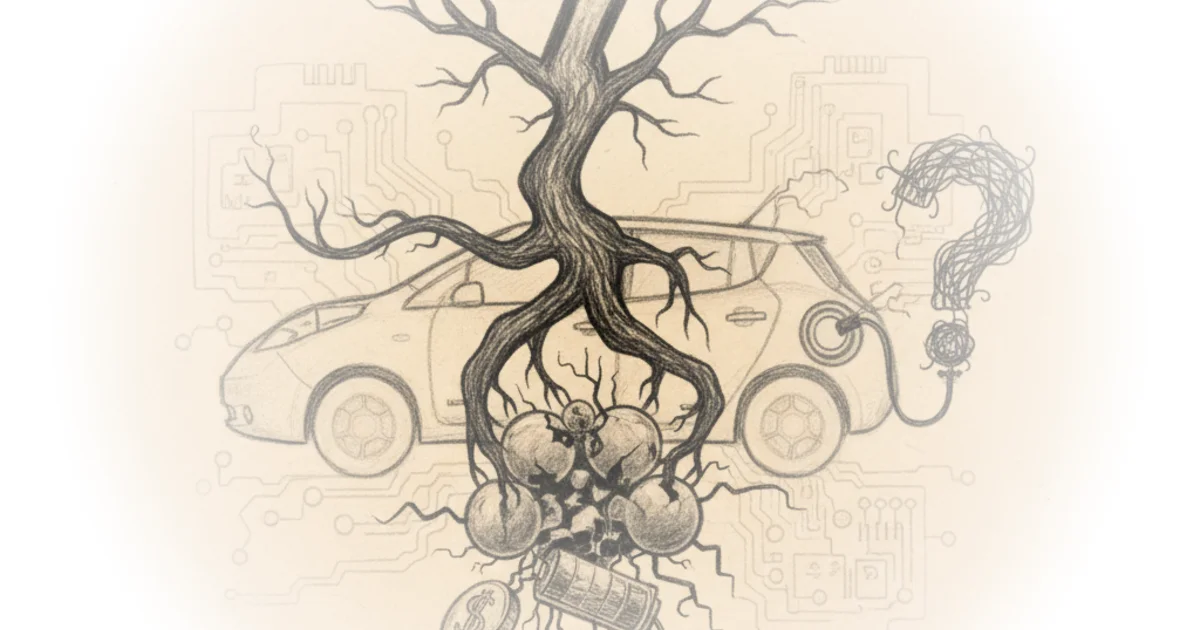
The commentary then pivots to the sheer volume of energy sitting idle. Borlace points out that a typical modern electric vehicle battery holds more than 40 kilowatt-hours, enough to power an average American household for nearly a day and a half. He highlights the Ford F-150 Lightning as a prime example, noting it "boasts the ability to fully run your home for up to three days if necessary." This framing is crucial because it transforms the car from a mere transport device into a critical piece of infrastructure. Critics might note that relying on consumer hardware for grid stability introduces significant logistical hurdles, but Borlace counters this by emphasizing that these batteries statistically spend 90 percent of their existence sitting unused, making them perfect candidates for demand response.
"We are right in the thick of it right now, and the technological revolution that's about to touch all our lives will be very similar to the one we experienced shortly after Steve Jobs held up an iPhone for the very first time back in 2007."
The Second Life and Grid Stability
The most compelling part of Borlace's analysis is his focus on the "second life" of batteries. He explains that even when a battery degrades to 80 percent capacity and is no longer suitable for driving, it remains "perfectly viable for many more years as an energy storage medium." The author cites a recent research paper that models the global technical capacity of these batteries, estimating a range between 32 and 62 terawatt-hours by mid-century. This figure is staggering, representing almost twice the total annual electricity consumption of Denmark.
Borlace argues that the fear of battery degradation from frequent charging and discharging is largely overstated. He writes, "just five percent of the theoretical available battery capacity is likely to be lost as a result of battery degradation by 2050." This conclusion is derived from complex models that account for temperature, depth of discharge, and charging speeds. The author suggests that the real threat to battery health isn't grid interaction, but rather the "obsession with longer range and faster charging times" driven by outdated internal combustion engine habits. This is a sharp insight that challenges the current consumer mindset, suggesting that slow, overnight charging—even if it involves sharing electrons with the grid—is actually the most protective strategy for the hardware.
Infrastructure and Policy Imperatives
Finally, the piece addresses the capacity of the electrical grid itself, dismantling the narrative that millions of new cars will cause societal chaos. Borlace references engineering analysis showing that grid capacity in the US grew by an average of four percent annually for forty years to accommodate air conditioning and other appliances. He notes that if this trend continues, "it'll only take about six and a half years for there to be enough extra capacity on the US grid to enable every single one of America's 230 million licensed drivers to switch over to an electric vehicle." This historical context provides a reassuring counter-narrative to the alarmist headlines often found in tabloids.
However, Borlace is clear that this future is not automatic. He warns that policymakers must avoid "epically stupid decisions" and instead implement regulations that ensure hardware integration and battery recovery. He argues that without "attractive incentives in place like decent micropayments for services to the grid," the potential of vehicle-to-grid technology will remain locked away. The argument here is that the technology is ready, but the regulatory framework is the missing link. A counterargument worth considering is whether the market can organically develop these incentives without heavy-handed government intervention, but Borlace's stance is that the stakes are too high to leave it to chance.
Bottom Line
Dave Borlace's analysis succeeds by replacing speculation with data, proving that the electric vehicle revolution is less about replacing gas engines and more about building a distributed, resilient energy network. The strongest part of the argument is the demonstration that battery degradation from grid interaction is negligible compared to the benefits of storage, while its biggest vulnerability lies in the uncertain timeline for policy implementation. The reader should watch for how governments respond to the need for smart charging regulations, as that will determine whether this battery farm becomes a reality or remains a theoretical possibility.