Rafael Holmberg delivers a provocative thesis that cuts through the noise of typical film criticism: the only way to save cinema from its own worst impulses is for the state to seize control of its budget. While most debates focus on taste or storytelling, Holmberg argues that the root cause of Hollywood's creative stagnation is purely financial, requiring a radical, anti-capitalist intervention that even the most staunch free-market proponents secretly accept in other sectors.
The Paradox of the Free Market
Holmberg begins by dismantling the myth of the self-regulating market, pointing out the hypocrisy of those who demand deregulation while relying on government bailouts to prevent collapse. He writes, "Not even the most devoted free-market, economic libertarians, including Trump himself, have been able to avoid the need for government regulation in financial markets." This framing is sharp because it forces the reader to confront the inconsistency in their own economic beliefs. If the government is necessary to stabilize banking, why is it taboo when applied to the arts?
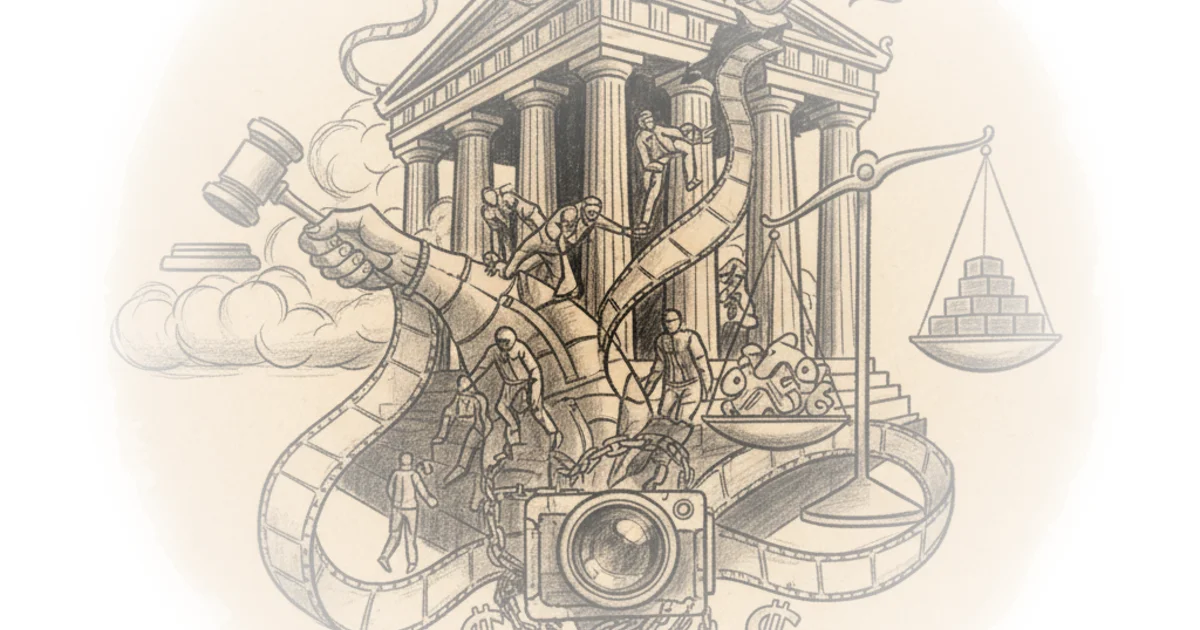
The author then pivots to the tangible evidence of this market failure: the endless parade of unoriginal blockbusters. He lists recent failures and reboots with biting precision, noting that "Jurassic World: Rebirth" required a plot absurd enough to justify using dinosaur blood to cure heart disease, while the latest "Lilo & Stitch" remake was "as interesting as a comb to a bald man." These aren't just complaints about quality; they are data points proving that the current system rewards repetition over innovation. Holmberg argues that the industry has become "too volatile, quickly aggregating massive but violently precarious concentrations of wealth and power," leaving creativity as the first casualty.
The money circulating through the film industry seems, in other words, to directly undermine anything approaching cinematic value.
The Economics of Stagnation
The core of Holmberg's argument rests on the staggering financial incentives that prioritize profit over art. He highlights that the "Big 5" film studios earned a combined $106.73 billion in 2024, a figure comparable to the GDP of a small nation, yet this wealth correlates negatively with quality. He observes that "each film is either an unwanted live-action remake or the new installation in a franchise that has already been senselessly beaten like a dead horse." This creates a cycle where financial success guarantees a sequel, regardless of artistic merit. As Holmberg notes, directors no longer hide behind artistic passion; one director bluntly admitted, "We'll see how this one performs internationally, and if it makes as much money as the fourth one, I'm sure Warner Brothers will want to make another one."
This section effectively exposes the transactional nature of modern Hollywood. The problem isn't just that studios are greedy; it's that the sheer volume of capital makes it impossible for risk to exist. Holmberg suggests that "individual consumer intentions are nowhere near powerful enough to counter broader financial structures," meaning that audiences complaining about bad movies while buying tickets are part of the problem. He draws a parallel to the broader economy, noting that even billionaires like Mark Zuckerberg admit that "no one deserves that much money," yet their actions continue to fuel the system. This paradox allows consumers to "enjoy something only by initially denouncing its exploitative economic underbelly," a state of cognitive dissonance that keeps the machine running.
Critics might argue that state intervention in art history often leads to propaganda rather than quality, a point Holmberg anticipates by distinguishing his proposal from Soviet-style censorship. He acknowledges that "Soviet control over Russian cinema... insisted that aesthetics should be State-mediated, specifically in the service of Soviet propaganda," which stifled experimental work. However, he insists his plan is different.
A New Model of Intervention
Holmberg's proposal is not about dictating plotlines or enforcing ideological conformity. Instead, he calls for a purely financial cap. "The intervention I suggest isn't simply the old forms of direct state involvement in the contents of films," he clarifies. "Instead, the interventions I would like to see are specifically financial, limiting Hollywood budgets and thereby influencing the context in which cinema is produced." By capping budgets and earnings, the state would remove the pressure to generate billion-dollar returns, allowing films to be made for their artistic value rather than their investment potential.
He argues that "great inventions emerge when profit is in fact absent, or rather when finance is reduced to an irritating background noise." This is a compelling vision: a cinema where the goal is to tell a story, not to maximize shareholder value. Holmberg writes, "Actors, directors, writers, producers and so on could of course earn a respectable living from their trade, but manufacturing wealth would no longer be the raison d'être of cinema." This reframes the role of the artist from a corporate asset to a public servant of culture.
What the film industry is suffering from is in part precisely such unmitigated financial control.
While the logic is sound, the political feasibility of such a plan is questionable. In a system where media conglomerates hold immense lobbying power, convincing a legislature to cap the earnings of the very people who fund their campaigns seems like a monumental hurdle. Holmberg admits that "the exact figures of these government regulated cuts to Hollywood budgets would be a matter of a longer legislative deliberation," but he offers no roadmap for how to overcome the entrenched interests of the "Big 5" studios.
Bottom Line
Holmberg's strongest move is reframing the crisis of modern cinema not as a failure of imagination, but as a structural failure of capital, making the case for state regulation a logical extension of existing economic principles. His biggest vulnerability lies in the political reality of implementing such a radical shift without triggering a backlash that could stifle the very creativity he hopes to protect. Readers should watch for how this argument evolves as the industry faces further consolidation and the rise of streaming algorithms that prioritize engagement over quality. The question remains: can we regulate the money without killing the art, or is the market too big to fail?