Singapore, a nation with almost no land for renewable generation, is betting its energy future on a 2,300-mile underwater cable stretching from the Australian outback. This is not merely a grid upgrade; it is a geopolitical and engineering gamble that challenges the very physics of how we move power across oceans. Asianometry dissects the feasibility of the 'Sun Cable' project, revealing that the real barrier isn't just the cost, but the sheer scarcity of the manufacturing capacity required to build it.
The Physics of Distance
The core premise is stark: ninety-five percent of Singapore's electricity currently comes from burning natural gas, and the island nation has "no room for sprawling solar or wind farms." Asianometry argues that the only viable path forward is the Australia ASEAN Power Link, a mega-project designed to pipe renewable energy from Australia's Northern Territory. The scale is difficult to grasp without context. The project proposes a solar farm occupying 12,000 hectares, but the true marvel lies in the transmission method.
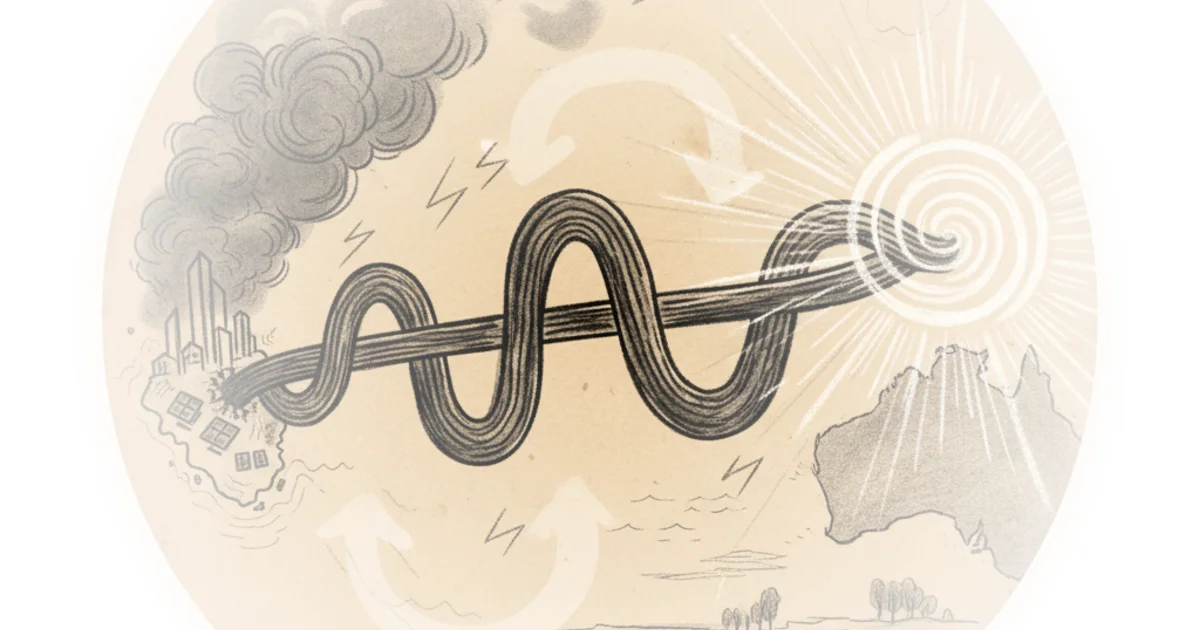
Asianometry writes, "2,300 miles or 3,700 kilometers is almost the entire width of the continental United States." To bridge this gap, the project relies on High Voltage Direct Current (HVDC) technology, a choice driven by the limitations of traditional Alternating Current (AC). While AC dominates our grids because it is cheaper to transform voltage over short distances, it suffers from the 'skin effect' over long hauls, where current flows only on the surface of the cable, increasing resistance and energy loss.
The author explains that while HVDC terminals are expensive and complex, the economics flip over long distances. "If you compare two 1,200 mile or 2,000 kilometer AC and DC lines with the same high voltage you find that the losses for the AC line are twice as high as the DC line even if it were to carry half the power." This technical nuance is critical; without HVDC, the project would bleed too much energy to be viable. The break-even point for switching to DC is roughly 62 miles, making the 2,300-mile journey a perfect, albeit extreme, candidate for this technology.
"Without HVDC, a lot of renewable energy sources like offshore wind or hydro would not be so economically tenable."
Critics might note that while the physics favor DC, the operational history of such long-distance subsea links is fraught with risk. Asianometry acknowledges this by pointing to the Basslink cable between Tasmania and Victoria, which has suffered brutal outages and expensive arbitration battles. The lesson for Sun Cable is clear: reliability is as much a financial imperative as the initial build cost.
The Engineering Nightmare
Moving from theory to the seabed reveals a landscape of significant obstacles. The proposed route traverses the Timor Sea and the Java Sea, navigating some of the busiest shipping lanes on Earth. Asianometry notes that while the shallow sections are manageable, a 700-mile section south of East Timor plunges into the Timor Trough, where waters exceed a mile in depth.
The commentary highlights a specific material trade-off required for such depths. "The Sapei's deep water cables were made of aluminum rather than the more traditional copper... Aluminum is cheaper and more plentiful than copper but it is not as good at conducting electricity so that maybe is a wash but since aluminum cable is also lighter than copper you can carry and lay more of it." This detail underscores the delicate balance engineers must strike between conductivity, weight, and cost when operating in extreme environments.
Beyond the deep water, the shallow waters of the Java Sea present a different threat: human interference. The region is crisscrossed by fishing trawlers and pipelines. Asianometry warns that "engineers will likely have to trench or bury the cable some two to five feet deep to protect the cable from being dredged up by fishing nets or damaged by boat anchors." The risk of blackouts triggered by a single dropped anchor is a tangible threat to the project's stability.
The Bottleneck: Manufacturing Capacity
Perhaps the most surprising revelation in the piece is not the engineering challenge, but the supply chain constraint. The project requires two cables, each 3,200 kilometers long. Asianometry points out a startling fact: this requirement exceeds the total annual output of all HVDC cable manufacturers in Europe combined.
"The Sun Cable as currently proposed uses two cables of 3,200 kilometers each more than the total annual output of all the HVDC cable manufacturers in Europe so additional time and money a span of three to five years maybe needs to be set aside to build up capacity from multiple manufacturers all over the world." This supply bottleneck suggests that the 2027 target date might be optimistic, regardless of funding availability. The sheer niche nature of HVDC cable manufacturing creates a single point of failure that could delay the project for years.
The financial implications are equally staggering. The subsea cable portion alone is projected to cost $5.6 billion, with the majority going to the cable itself. When combined with the solar farm and battery storage, the total project is likely to run beyond $10 billion. Asianometry suggests that the funding model will likely rely on multi-decade service agreements, similar to the 25-year deal that underpinned the Basslink project, to attract private investors seeking regular dividends.
A New Energy Paradigm
Despite the hurdles, the strategic implications for the region are profound. For Australia, the project offers a way to monetize its vast solar irradiation potential without relying solely on fossil fuel exports. "Australia has more to offer than its carbon in wallabies its northern territory is larger than egypt but has less than 250,000 people living in it." For Singapore, it provides a path to decarbonize without sacrificing energy security. For Indonesia, the cable passes through its waters first, offering a potential new revenue stream and access to clean energy.
Asianometry frames this as a shift in regional dynamics: "The Sun Cable explores a new and exciting energy export paradigm it will help cement better relationships with the southeast asian countries and will help wean the country off its uncomfortable dependence on certain exports to certain areas." The project transforms Australia from a mere supplier of raw materials into a supplier of clean power, fundamentally altering its economic relationship with its neighbors.
"The mega project sheer size and immense costs make it likely that they break up the thing into multiple chunks and milestones over many years."
Bottom Line
Asianometry's analysis effectively strips away the sci-fi veneer of the Sun Cable project to reveal a rigorous, albeit precarious, engineering and economic reality. The strongest part of the argument is the identification of the global manufacturing bottleneck, a constraint that could derail the timeline regardless of political will. The biggest vulnerability remains the operational risk of a single point of failure across a 2,300-mile subsea link in a geopolitically complex region. Readers should watch not just for the construction start date, but for the signing of the long-term power purchase agreements that will finally unlock the capital needed to build the world's longest power line.