Tom van der Linden makes a provocative claim that America's most notorious filmmaker is not a provocateur, but a radical humanist whose "boredom" with cinema was actually a catalyst for expanding the art form itself. This piece reframes a career often dismissed as shock value into a coherent, decades-long pursuit of "radical honesty," arguing that the director's chaotic aesthetic is the only way to capture the truth of marginalized lives. For the busy listener, this is not just a film review; it is a necessary correction to the cultural narrative that has spent thirty years misunderstanding the work of Harmony Corine.
The Myth of the Shock Jock
Van der Linden begins by dismantling the assumption that Corine's early work was merely cynical. He notes that while critics initially "despised" his debut at the Telluride Film Festival, legendary director Werner Herzog saw something profound, calling it the "most audacious debut" and labeling Corine the "last foot soldier in the army." This anecdote is crucial because it establishes that Corine's transgressive style was recognized by a master of cinema as a legitimate evolution of the medium, not a gimmick. The author argues that Corine's apparent detachment—his claim that he was "bored" and that the screen was "dead"—was actually a rejection of traditional narrative structures that he felt failed to reflect reality.
"I never remember plots. I can't stand plots. I don't feel like there's life has any plots. What I remember from films is are scenes and characters. So I I thought I thought why not just make a movie that consists entirely of of that."
This rejection of plot is the core of Corine's philosophy, and van der Linden uses it to explain the disjointed nature of his films. By weaving in the context of Kids, the 1995 film Corine wrote for Larry Clark, the author highlights a pivotal turning point. While Kids was a commercial success, Corine viewed it as a "commissioned work" that was too traditional for his vision. This distinction is vital; it shows that even in his breakout moment, Corine was already looking for a way to break the mold, a trajectory that would lead to the experimental chaos of Gummo. Critics might argue that this retrospective glosses over the genuine exploitation present in Kids, but van der Linden's focus remains on Corine's internal artistic evolution rather than the external reception of that specific film.
Radical Honesty in the Ruins
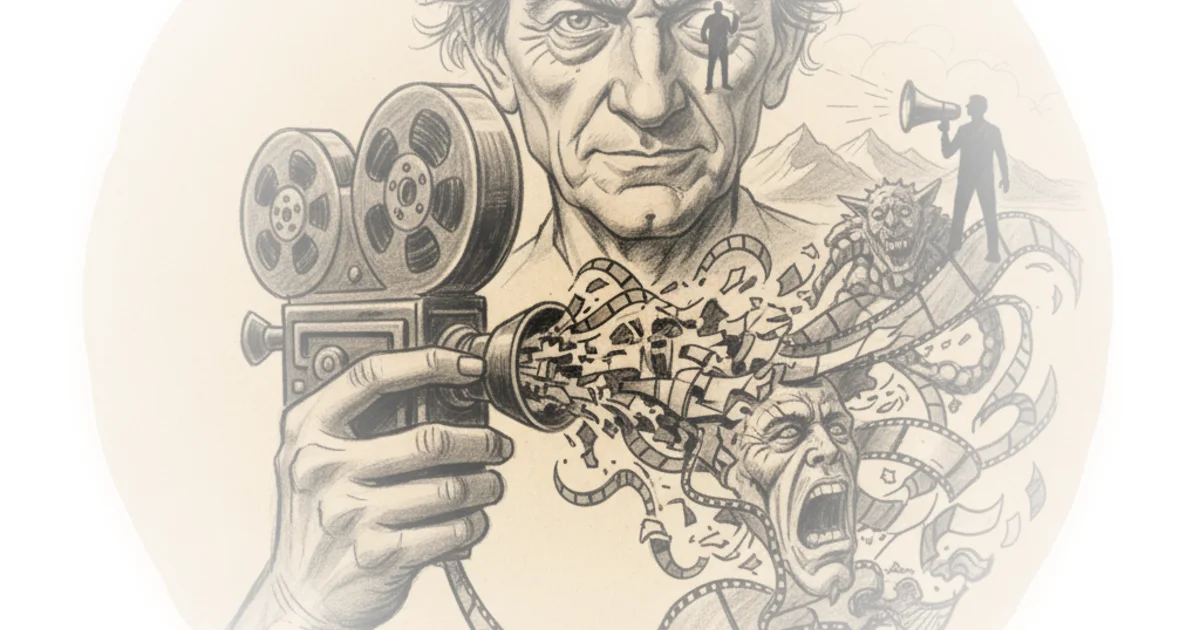
The commentary shifts to Gummo, the film that truly defined Corine's aesthetic. Van der Linden describes the movie as a "disruptive reminder that human beings are often not so noble," challenging the Hollywood tendency to portray poverty as a noble struggle. The author draws a fascinating parallel between Corine's visual style and the reality TV show Cops, noting that Corine loved the show because it allowed viewers to see the "inside of people's houses" in a way that felt "really honest."
"It asks us not to offer sanctimonious disdain or pity, but rather to glimpse the turmoil of their rich interiority."
This quote, attributed to film critic Carlos Aguila in the text, perfectly encapsulates van der Linden's argument: the film's power lies in its refusal to judge. The author points out that the characters in Gummo were often real people Corine grew up with in Nashville, blurring the line between documentary and fiction. By filming on video and transferring to film, Corine achieved a grainy, impressionistic look that mirrored the distorted reality of his subjects. The author suggests that this technical choice was not just aesthetic but ethical, allowing the camera to be hidden and capturing moments that felt "stolen" rather than staged. This approach forces the audience to confront the humanity of people they would otherwise dismiss, a point that resonates deeply in a polarized cultural landscape.
The Horror and the Humanity
Moving to Julien Donkey-Boy, van der Linden argues that the film does for mental illness what Gummo did for class. The author highlights Corine's personal connection to the subject matter, noting that the protagonist was based on Corine's uncle, a man with schizophrenia. The commentary emphasizes Corine's desire to avoid the "cute, lovable, eccentric" trope often found in cinema, instead choosing to show the "horror of schizophrenia" with unflinching brutality.
"I wanted to show a guy with blood in his underwear hitting himself in the head, jumping out of windows. I wanted to show what it was really like and um the horror of schizophrenia."
This raw depiction is presented not as gratuitous shock, but as an act of fidelity to the lived experience of mental illness. The author notes that the film's production techniques—hiding cameras on actors to blur the line between staged and real—served to deepen this sense of authenticity. While some critics might find the film's structure impenetrable or its content too disturbing, van der Linden frames these elements as essential to the film's mission. The piece suggests that Corine's work is a testament to the idea that cinema is still in its infancy, capable of articulating complexities that traditional storytelling cannot reach.
"An artist who doesn't just have a remarkably keen sense of the trajectory of our radically progressing culture, but also a profound connection to the deeper humanity that always lies hidden within each of its strange turns."
Bottom Line
Tom van der Linden's analysis succeeds in recontextualizing Harmony Corine's career from a series of shocks to a coherent, decades-long pursuit of cinematic truth. The strongest part of the argument is the connection drawn between Corine's "boredom" with traditional plot and his commitment to capturing the chaotic reality of marginalized lives. The biggest vulnerability is the potential for readers to conflate Corine's artistic intent with the ethical implications of filming real people in distress, a tension the piece acknowledges but does not fully resolve. For the listener, the takeaway is clear: Corine is not a cynic, but a visionary who forces us to see the beauty in ugliness and the truth in absurdity.