Musa al-Gharbi cuts through the noise of standard election analysis by proposing a single, uncomfortable truth: the American political divide is no longer about money or geography, but about who wins and loses in the knowledge economy. While most pundits scramble to explain the gender or education gaps as separate phenomena, al-Gharbi argues they are merely symptoms of a deeper fracture between the professionals who run our institutions and the vast majority of Americans left behind by the very systems those professionals champion.
The Great Realignment
The core of al-Gharbi's argument rests on a startling historical shift. He notes that "professionals have moved from being the most Republican class in the 1950s, to the second most Democratic class by the late 1980s and the most Democratic class in 1996." This isn't just a voting trend; it represents a fundamental restructuring of the Democratic coalition. As al-Gharbi details, the party has become the political home for those in "knowledge economy" industries—academia, law, tech, and media—who now dominate its donor base and primary electorate.
The data supports this consolidation. In 2016, roughly 9 out of 10 political donations from activists, artists, and journalists went to Democrats. By 2020, the party's highest contributions came from sectors like securities, education, and health professionals. Al-Gharbi points out that this has inverted the party's socioeconomic profile: "Today, the richest 20 percent of congressional districts... tilt Democrat by nearly 5:1." This shift has profound consequences. When the party's base becomes increasingly affluent and highly educated, the policy priorities naturally drift away from the economic anxieties of the working class and toward the cultural concerns of the professional elite.
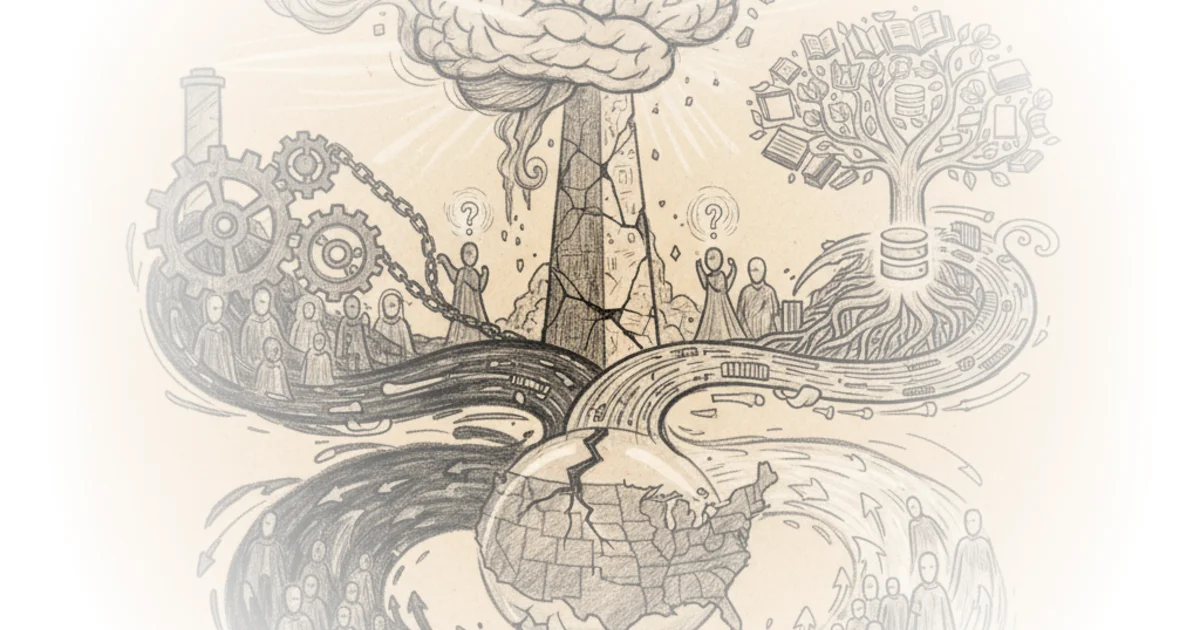
The key schism that lies at the heart of dysfunction within the Democratic Party and the U.S. political system more broadly seems to be between professionals associated with 'knowledge economy' industries and those who feel themselves to be the 'losers' in the knowledge economy.
This framing is powerful because it moves beyond the tired debate of "identity politics" versus "economic populism." Al-Gharbi suggests that for the knowledge elite, cultural liberalism and economic conservatism often go hand-in-hand. They support free markets and globalization because these systems lower the cost of their premium services and affirm their cosmopolitan values. Meanwhile, they often view the working class's skepticism of these same systems as backward, failing to see that the "upsides" of automation and immigration are not shared equally.
The Blind Spot of the Elite
Perhaps the most biting critique al-Gharbi offers is the psychological disconnect of the professional class. He argues that highly educated Americans suffer from a unique form of self-deception regarding their own political leanings. Citing economist James Rockey, al-Gharbi writes, "Higher levels of education are associated with being less likely to believe oneself to be right-wing, whilst simultaneously associated with being in favour of increased inequality." This paradox explains why many voters in the knowledge economy feel like radical leftists while their actual policy preferences—such as supporting deregulation or opposing unionization—align more closely with economic conservatives.
This disconnect manifests in how the elite engage with social justice. Al-Gharbi observes that these professionals "tend to be much more critical of capitalism in principle than many other Americans," yet they rarely translate this critique into action. Instead, they often retreat into a posture of futility, arguing that "there is no ethical consumption under capitalism" and that individual sacrifice is pointless. This allows them to maintain their high-status lifestyles while rhetorically condemning the very system that enables them.
Critics might note that al-Gharbi's focus on the "knowledge economy" risks oversimplifying the motivations of working-class voters, who may be driven by genuine cultural grievances or local community concerns rather than just economic calculation. However, his evidence suggests that the perception of being left behind is the primary driver, regardless of the specific economic metric.
The Occupy Illusion
Al-Gharbi uses the Occupy Wall Street movement as a case study for how the professional class co-opts class-based rhetoric to obscure their own privilege. He challenges the popular narrative of Occupy as a broad-based uprising, pointing out that "participants of Occupy demonstrations in New York were overwhelmingly non-Hispanic white" and "roughly three quarters (72 percent) of participants came from households above the 2011 New York City median."
Instead of a movement of the 99 percent, al-Gharbi argues it was a "PMC elite formation" focused on procedural purity rather than tangible policy. He quotes sociologist Catherine Liu to describe how the movement's obsession with "progressive stack" techniques and consensus management "suppressed real discussion of priorities or politics." The result was a movement that was "intensely academic" and "hostile to politics per se," focusing on villainizing the top 1 percent while ignoring the massive wage premium that knowledge economy professionals themselves enjoy.
The rhetoric of 'We are the 99 percent' has in fact been dangerously self-serving, allowing people with healthy six-figure incomes to convince themselves that they are somehow in the same economic boat as ordinary Americans, and that it is just the so-called super rich who are to blame for inequality.
This analysis forces a reckoning with the nature of modern activism. If the primary drivers of social justice movements are the very people benefiting from the current economic order, the movements risk becoming performative rather than transformative. Al-Gharbi suggests that until the Democratic Party and its allied movements acknowledge that they are no longer the champions of the working class, but rather the champions of the professional class, the political dysfunction will only deepen.
Bottom Line
Al-Gharbi's most compelling contribution is his identification of the "knowledge economy" as the true axis of American political conflict, a lens that explains the alienation of working-class voters across racial and geographic lines. The argument's greatest vulnerability lies in its potential to understate the genuine cultural and identity-based anxieties that also drive the electorate, which cannot be reduced solely to economic winners and losers. For the reader, the takeaway is clear: the path forward requires a party that stops pathologizing voters and starts addressing the structural realities of who benefits from the current economic order.