Andrew Henry doesn't just recount the miracles of Fatima or Lourdes; he dissects the very architecture of belief, revealing how a vision of a glowing woman can upend the hierarchy of the Catholic Church. While many accounts stop at the supernatural spectacle, Henry's analysis of the "Marian Age" exposes a profound shift: the divine is no longer speaking through bishops, but through shepherd children and indigenous peasants. This is a crucial distinction for anyone trying to understand why these stories persist in a secular age.
Defining the Unseen
Henry begins by rigorously defining what scholars actually mean when they use the term "apparition," stripping away the mysticism to find a specific phenomenological category. He writes, "An apparition involves a figure outside the normal range of perception, someone or something that the visionary would not ordinarily see." This precision is vital because it separates these events from dreams or the common trope of a weeping statue. As Henry puts it, "The figure appears during waking life, often vividly, though some experiences do involve translike states or altered states of consciousness."
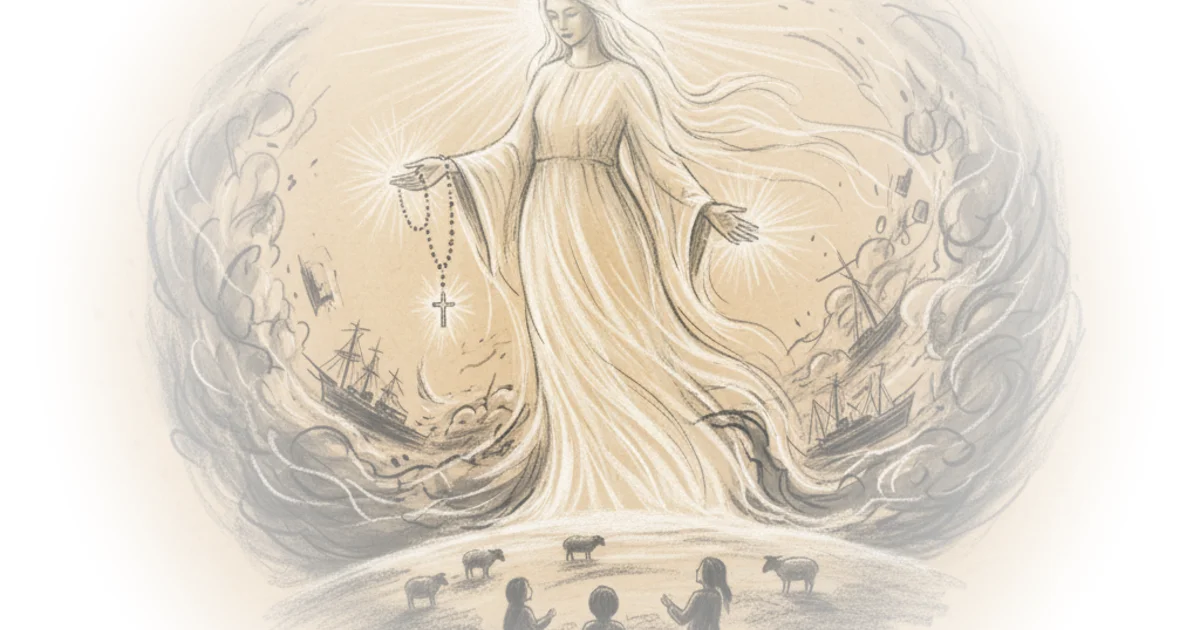
The author's insistence on the lack of a physical cause is the linchpin of his definition. "There's no projector hidden in the bushes, no lights, no tricks, at least not any that can be verified," he notes. This framing is effective because it acknowledges the skepticism of the modern observer while validating the intensity of the experience for the believer. Critics might argue that this definition is too narrow, excluding cases where the "miracle" is a psychological projection rather than an external event, but Henry's goal is to categorize the claim, not necessarily the ontological reality. He clarifies that his aim is not to debunk, stating, "On this channel, I do examine religion from a naturalistic perspective, but that does not mean we're out to prove or disprove anyone's vision."
The Power of the Crowd
The narrative then pivots to the social dynamics of these events, moving from the private to the spectacular. Henry highlights the 1917 Fatima event, where a crowd of 70,000 witnessed what was described as the sun dancing. He captures the collective intensity when he writes, "The rain stopped, the clouds parted, and Lucia cried, 'Look at the sun.'" The subsequent description of the phenomenon—"the sun trembling and dancing, casting waves of colored light over the fields"—serves as a perfect example of what social psychologists call "collective effervescence."
Henry doesn't shy away from the ambiguity of these mass sightings. He notes that while skeptics offer explanations like retinal effects or unusual weather, the sheer scale of the belief is undeniable. "For the tens of thousands who stood in that field and for the millions who have since made pilgrimage to Fatima, the event remains what the children first said it was, a Marian apparition." This is a powerful observation: the truth of the event is less about the physics of the sun and more about the shared reality constructed by the witnesses. The author also touches on the Zetun apparitions in Cairo, where an anthropologist, Dr. Cynthia Nelson, observed the crowd's reaction. Henry quotes Nelson's account of how "observers expectations turned ambiguous lights into the virgin herself," a reminder that the human mind is eager to find patterns in chaos. This insight is particularly relevant today, as it suggests that the medium of the vision is often the community itself.
Divine truth is not the monopoly of the elites. Instead, it can erupt into the lives of ordinary people.
The Shift in Authority
Perhaps the most compelling part of Henry's coverage is his historical analysis of who gets to see Mary. He traces a clear line from the medieval period, where visions were the domain of monks and clergy, to the modern era, where they are the province of the marginalized. "During the 11th and 12th centuries, reported sightings of Mary started to increase in Western Christianity," he explains, noting that these were often linked to established figures like St. Dominic. However, the landscape changed dramatically in the 19th and 20th centuries.
Henry points out that modern apparitions are characterized by "serial apparitions," where the figure appears repeatedly to the same person, often on a schedule. He writes, "Remember at Fatima, the three kids reported that the Virgin Mary appeared to them on the 13th day of each month from May through October of 1917." This repetition builds momentum and legitimacy that a single, fleeting vision cannot. Furthermore, the shift in the visionary's identity is profound. "Modern apparitions generally visited non-clergy, including lay people who are not particularly religious or even appearing to non-Christians," Henry observes. He cites Cardinal Joseph Ratzinger's theory that children are chosen because their "souls are not yet disturbed," but Henry offers a more sociological take: these visions redistribute religious authority.
The case of Juan Diego in 1531 serves as the ultimate example of this dynamic. Henry describes how an indigenous man was told to build a church, only to be dismissed by a bishop until a miraculous sign of out-of-season roses proved the message's validity. "When Mary is said to appear to someone without education, wealth, or clerical standing, the message to everyone else is pretty clear," Henry argues. This is the core of his argument: the apparition is a mechanism for the powerless to bypass institutional gatekeepers. While some might argue that the Church eventually co-opts these movements to reinforce its own authority, Henry's focus on the initial rupture of power is a compelling lens for understanding why these stories resonate so deeply.
Bottom Line
Andrew Henry's coverage succeeds by treating Marian apparitions not as supernatural puzzles to be solved, but as cultural phenomena that reveal the shifting tides of religious power. His strongest move is reframing the "miracle" as a social event where the marginalized claim a direct line to the divine, bypassing the elite. The argument's only vulnerability is its reliance on the accounts of the believers themselves, which, while compelling, leaves the question of objective reality intentionally unanswered. For the busy reader, this piece offers a clear, sophisticated map of how faith is constructed, maintained, and challenged in the modern world.