Kahlil Greene cuts through the celebratory noise of a massive New York City gathering to ask a question that feels uncomfortable but necessary: is the current hype around mixed-race identity actually a new form of progress, or just an old hierarchy wearing a fresh mask? While the event in Central Park was marketed as a "wasian wonderland," Greene argues that the specific branding and aesthetics of this movement quietly replicate the same colorist exclusions that have plagued racial discourse for a century. This is not a dismissal of mixed-race joy, but a sharp forensic audit of who gets to define that joy and who gets left out of the frame.
The Aesthetics of Exclusion
Greene opens by describing the scene: thousands of people in Sheep's Meadow, a DJ, and a surge of TikToks tagging a fictional country called "Wasia." Yet, the author immediately pivots from the party atmosphere to the structural implications of the movement. "The point isn't to render a verdict on anyone's identity," Greene writes, "It's to ask whether some very familiar machinery is humming underneath a brand-new aesthetic." This framing is crucial; it prevents the critique from becoming a personal attack on attendees while maintaining a rigorous focus on the systemic patterns at play.
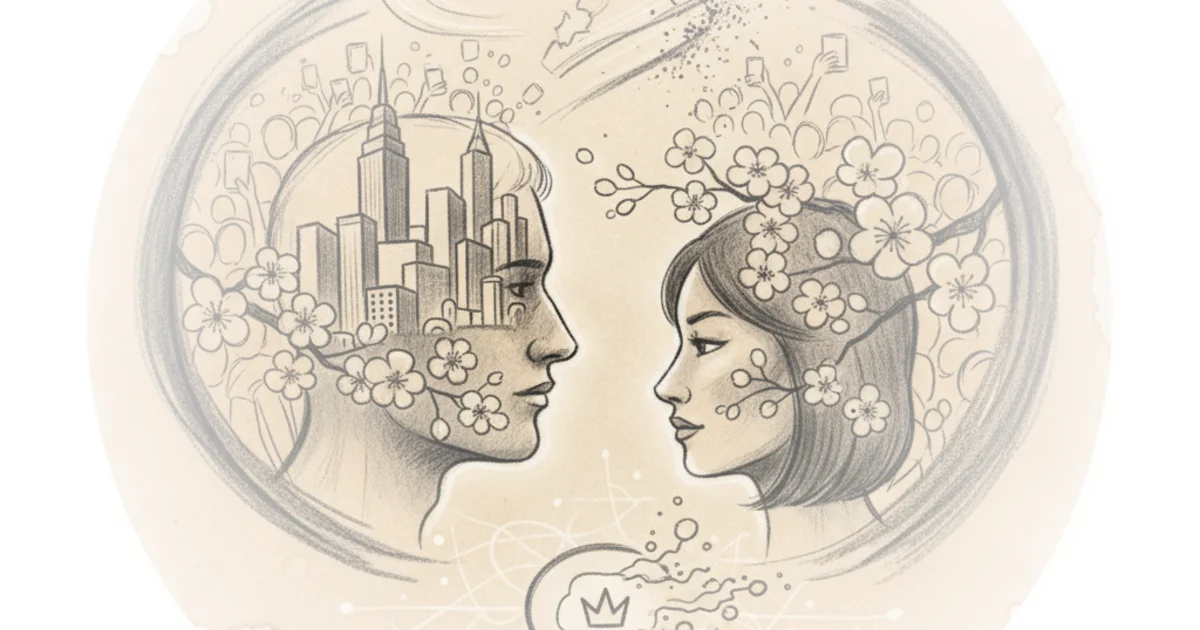
The author highlights a specific linguistic shift that signals this deeper issue. Citing creator Aki Lee Camargo, Greene notes that "you cannot be Wasian without the hard 'W.'" The label, Greene explains, is built in proximity to whiteness, whereas older, more radical terms like "Hapa" or "Asian American" were constructed in opposition to it. This distinction matters because it suggests that the new terminology isn't just a synonym for mixed heritage; it is a rebranding that centers white features as the default standard of beauty and belonging. As Greene puts it, "if Wasian identity begins and ends with aesthetics, that's eugenics."
"if Wasian identity begins and ends with aesthetics, that's eugenics."
This charge is heavy, but Greene supports it with historical context that many readers may overlook. The author draws a direct line to the early 20th-century concept of la raza cósmica, or the "cosmic race," which promised a universalist future but in practice operated alongside blanqueamiento (whitening). Just as that historical movement encouraged populations to "improve the race" by diluting Indigenous and African ancestry, the modern "Wasian" moment often rewards lightness while stigmatizing darker features. Greene argues that the "harmony" sold today is just as selective as the "harmony" sold a hundred years ago.
The Engineering of Whiteness
The commentary becomes particularly potent when Greene examines the real-world consequences of this aesthetic preference, moving from theory to the biology of reproduction. The author points to the case of figure skater Alysa Liu, whose father, Arthur Liu, publicly admitted to intentionally selecting Caucasian egg donors for his children to ensure a "diverse gene pool." Greene does not shy away from the implications of this choice. "The decision to engineer whiteness into a child's genome in the name of a 'diverse gene pool' is the cosmic race pitch translated into the language of fertility clinics," the author writes.
This section effectively uses the specific example to illustrate a broader trend: the commodification of mixed-race identity where whiteness is the premium ingredient. Greene notes that this isn't just about individual choices but about a cultural script that equates "mixed" with "light." A counterargument worth considering is that parents simply want their children to have the best opportunities, and in a racist society, lighter skin can indeed offer a shield. However, Greene's point is that framing this as "progress" or "diversity" obscures the fact that it is still a hierarchy where one set of features is valued over another. The author asks, "Pride in what beauty, exactly?" forcing the reader to confront the specific, narrow definition of beauty that dominates this new "wonderland."
The Hollywood Filter
The argument extends naturally into the entertainment industry, where Greene identifies a pattern of "ethnically ambiguous" casting that serves as a substitute for genuine diversity. The author observes that Hollywood has moved from yellowface to casting mixed Asian actors whose features read as "exotic but not too foreign." This shift, Greene argues, allows gatekeepers to claim they are representing the diaspora while actually narrowing the beauty standard. "By casting Wasian actors as lead Asian roles, Hollywood does not have to reckon with the broader mixed Asian diaspora, the darker-skinned, the non-East Asian, the non-white-adjacent," Greene writes.
This critique is bolstered by the observation that the "Wasian" label itself reinforces the Black-white binary that has long organized American racial hierarchy. As Greene notes, terms like "Wasian" and "Blasian" split mixed people along the country's oldest fault line, ignoring the vast complexity of mixed identities that include Black, Latino, Native, or Middle Eastern heritage. The author cites Katie Gee Salisbury, who asks how mixed Asians who are also Black or Latino are supposed to read their absence from this newly minted pantheon. The silence of the industry on these excluded groups speaks volumes about who the "Wasian" brand is actually designed to serve.
"The branding sleight of hand goes deeper than the merch. 'Half-Asian' is the funding pitch. 'Wasian' is the actual product."
Greene also touches on the organizational mechanics behind the Central Park meetup, noting that the group "Half Asia Spring" marketed the event exclusively as a "Wasian" gathering, despite claiming a broader mission. This discrepancy between the inclusive language of the mission statement and the exclusive reality of the marketing materials serves as a microcosm for the larger cultural issue. The author argues that the event was not a failure of organization but a success of branding: it delivered exactly what the "Wasian" product promised—a space for light-skinned, white-adjacent mixed people to celebrate their proximity to whiteness.
Bottom Line
Kahlil Greene's analysis is a necessary corrective to the uncritical celebration of mixed-race visibility, exposing how the "Wasian" trend often functions as a modern vehicle for colorism and whitening. The piece's greatest strength is its ability to connect a viral cultural moment to deep historical precedents like la raza cósmica and the brown paper bag test, proving that the machinery of exclusion is remarkably durable. However, the argument risks alienating readers who see their personal joy in these gatherings as genuine and unproblematic, potentially missing the nuance that individual happiness can coexist with systemic critique. The reader should watch for how this specific branding evolves: if the "Wasian" label continues to dominate, it may further fracture the mixed-race coalition by centering whiteness as the only acceptable form of mixed identity.