Most historical accounts of the Mongol Empire focus on the sheer scale of destruction, but Kings and Generals frames the narrative around a specific, terrifying innovation: the systematic transformation of a fractured tribal confederacy into a meritocratic war machine. This piece is notable not just for its chronological sweep, but for its insistence that the Mongols' success was a calculated administrative feat rather than mere barbarism. For the busy listener, the value lies in understanding how a society built on hospitality and brutal efficiency conquered the known world in a single generation.
The Architecture of Loyalty
Kings and Generals opens by establishing the harsh environment as the crucible for this empire, noting that "hard places often breed hard people and Mongolia is one of the most inhospitable lands in the world." This sets the stage for a story of survival that transcends simple tribal warfare. The author argues that the pivotal moment was not a battle, but a social restructuring. When Temujin rose to power, he rejected the traditional aristocracy. As Kings and Generals puts it, "he gave positions of power to capable people outside his tribe." This shift from bloodline to skill was revolutionary for the steppe.
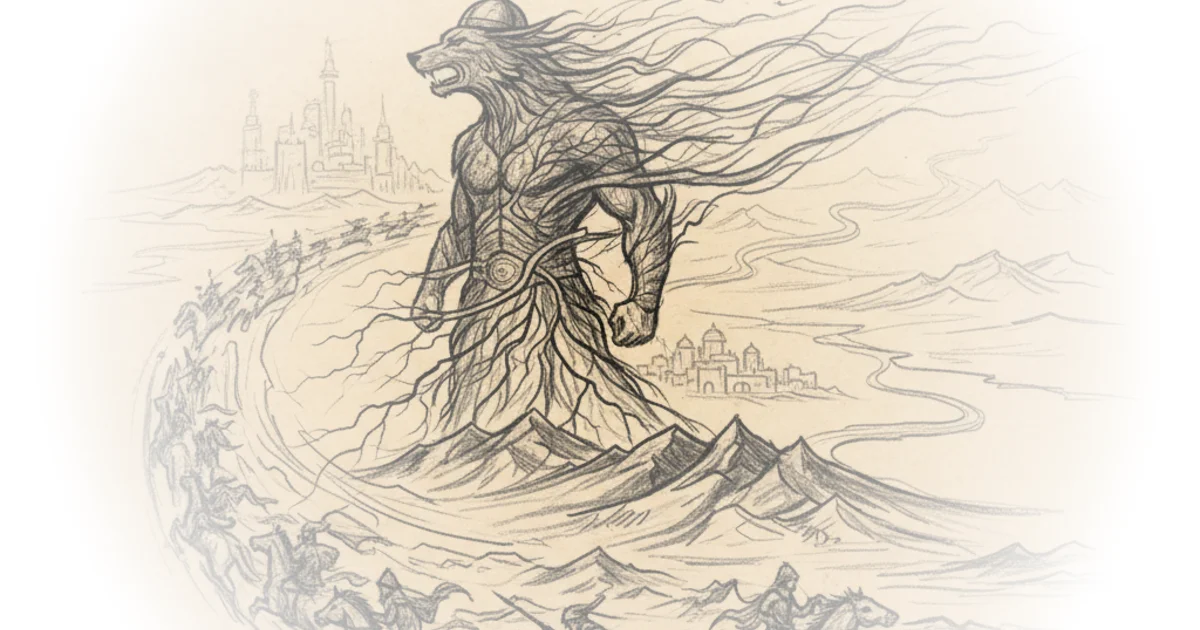
The commentary highlights the implementation of the decimal system as the engine of this new order. The text explains that "the army was divided into tens, hundreds, thousands and ten thousands," creating a rigid chain of command where desertion meant the execution of the entire unit. This structure ensured that "every able-bodied man had to be part of this structure." The author effectively demonstrates that the Mongol military wasn't just a horde; it was a highly disciplined organization where "commanders were chosen by their men except for the commanders of the ten thousands." This balance of bottom-up loyalty and top-down control allowed for sophisticated maneuvers that larger, more rigid armies could not match.
Temujin revolutionized the step world each victory brought more warriors to his side and he reformed the Mongols into an army.
Critics might argue that this focus on military structure overlooks the role of luck or the specific weaknesses of the Jin dynasty, but the evidence of the decimal system's longevity suggests a deliberate, replicable strategy. The narrative makes it clear that the "feigned retreat" tactic, often dismissed as a trick, was actually a disciplined maneuver executed by units that trusted their chain of command implicitly.
The Calculus of Conquest
The coverage shifts to the invasion of the Jin dynasty, where the author contrasts the massive, untrained infantry of the Chinese with the mobile, highly trained Mongol cavalry. Kings and Generals writes, "the Jin had a massive population and mobilized around 800,000 infantry most of which were untrained peasants with low morale." In contrast, the Mongols possessed a "ninety thousand strong cavalry army" that could bypass the Great Wall and strike deep into enemy territory. The author details how the Mongols used psychological warfare and siege engineering to break fortified cities, noting that "the surrounded city slowly succumbed to starvation and diseases."
A crucial distinction is made regarding the treatment of populations. The text states, "engineers, artisans, merchants, doctors, teachers, priests and administrators were spared and asked to join the Mongol horde," while others were used as "meat shields." This selective brutality was not random; it was a strategic calculation to preserve human capital while terrorizing resistance. Kings and Generals argues that "the massacres were committed without religious or cultural reasons and they wanted everyone to know it as a method to prevent resistance." This reframes the violence from senseless cruelty to a cold, calculated tool of statecraft.
The narrative also touches on the internal family dynamics that would eventually fracture the empire. When Genghis Khan's son, Jochi, attempted to negotiate with a city to avoid damage, his brothers argued against it. The author notes that "Genghis removed his oldest son from command and appointed his third son... who in turn ordered the city to be destroyed." This decision, the text suggests, "would have a significant impact on the Mongol Empire in the following decades as it forever alienated Jochi from the rest of the family." The coverage implies that the very discipline that built the empire contained the seeds of its future disintegration.
The Westward Expansion
The final section covers the invasion of the Khwarazmian Empire, triggered by a diplomatic crisis. The author explains that the Shah's governor arrested a Mongol caravan, and when Genghis sent ambassadors to demand their release, "the merchants along with one of the ambassador's were executed." Kings and Generals emphasizes that "the rules of hospitality which Genghis Khan considered sacred were broken," framing the subsequent war as a matter of honor and law rather than simple expansionism.
The strategy employed here was one of total separation and encirclement. The text describes how Genghis "created a plan involving separating his army into three columns," with one force crossing the "impossible" terrain of the Kyzylkum Desert to strike from behind. The result was the total annihilation of major cities like Samarkand and Bukhara. As Kings and Generals writes, "the city's inhabitants numbering around 100,000 were slaughtered." The author concludes that this level of devastation was designed to ensure that "the Mongols never allowed their enemy to raise an army."
The Mongols couldn't control such a vast population so they used practical brutality as their primary method to subjugate a nation.
A counterargument worth considering is whether this level of destruction was sustainable or if it merely delayed the inevitable collapse of the empire by creating a vacuum of power. However, the piece successfully argues that for the Mongols, the goal was not administration but the absolute prevention of future threats.
Bottom Line
The strongest element of this coverage is its refusal to treat the Mongol conquests as a chaotic rampage, instead presenting them as a highly organized, meritocratic, and psychologically astute military campaign. The biggest vulnerability in the narrative is the reliance on traditional sources that may exaggerate the scale of massacres, though the strategic logic remains sound. Readers should watch for how this model of meritocracy and terror influenced later empires, as the Mongol legacy was not just in the land they conquered, but in the administrative systems they left behind.