Brad DeLong doesn't just critique a speech; he dismantles a national mythology. While others focus on the immediate political fallout of Secretary Rubio's recent address, DeLong digs into the historical bedrock—or lack thereof—of the "Western alliance" narrative. He argues that the current administration's attempt to revive a "Plato-to-NATO" tradition is not just historically illiterate, but actively dangerous because it ignores the true, pragmatic origins of American power and the specific moral covenants that once defined it. For a reader trying to understand why the West feels so fractured today, this deep dive into the gap between political fable and historical reality is essential listening.
The Myth of Markets and the Reality of Containment
DeLong begins by taking aim at the economic justification often used to explain the post-WWII alliance. He challenges the view that the United States needed Europe primarily as a market for its goods, a theory he traces back to flawed imperialist arguments from the Belle Époque. "This phrase here is a badly thought a contemporary intellectual echo of a not-very-good theory of Belle Époque imperialism," DeLong writes, dismissing the idea that American prosperity was the primary driver of the Marshall Plan. Instead, he points out that while Keynesian arguments about markets were used to sell the policy to an isolationist public, they were merely a "tertiary add-on" to a strategy driven by geopolitical necessity.
The core of DeLong's argument here is that the alliance was forged in the fire of existential threat, not trade deficits. He notes that the Soviet Union was not merely an "erstwhile ally" but an "aggressive super-genocidal totalitarian dictatorship ruled by paranoid psychopathic madman." This distinction matters because it reframes the alliance not as a marriage of convenience for profit, but as a desperate, strategic bulwark against annihilation. Critics might argue that economic interests always play a larger role in foreign policy than historians admit, but DeLong's insistence on the primacy of the security threat holds up under the weight of the Cold War's immediate post-1945 chaos.
The triumphantly ascendant United States needed Europe as a market for its wares and a bulwark against its erstwhile Soviet ally.
The Lost Covenant of the City on a Hill
Perhaps the most striking part of DeLong's commentary is his re-examination of the American founding myth. He argues that Secretary Rubio fundamentally misunderstands the "City upon a Hill" concept, treating it as an invitation to share bonds with the Old World when, in fact, John Winthrop's original sermon was about breaking away from it. DeLong quotes Winthrop directly to show that the American experiment was designed as a radical separation: "We are entered into [a] covenant with Him for this worke... If we shall... fall to... prosecute our carnal intentions... the Lord will surely break out in wrath against us."
DeLong suggests that the modern political desire to reconnect with Europe through a shared, invented history ignores this foundational impulse to create something entirely new. He notes that while the "eyes of all people are upon us," as Winthrop warned, the current administration seems to have forgotten the "strict performance" required to maintain that covenant. This framing is powerful because it shifts the critique from mere policy disagreement to a failure of national identity. The administration's approach, DeLong implies, is not just politically unwise but spiritually incoherent with the very text it claims to honor.
Inventing Tradition vs. Facing History
DeLong concedes that mythmaking is a necessary tool for politics, citing his teacher Judith Shklar on the utility of creating a "good West" to immunize future generations against fascism. "Picking out heroes from the past whom you admire, retrospectively adopting them as your ancestors, and then trying hard to live up to their virtues is a very human practice," he writes. However, he draws a hard line at mythmaking that serves a fascist cause or obscures the brutal realities of the past.
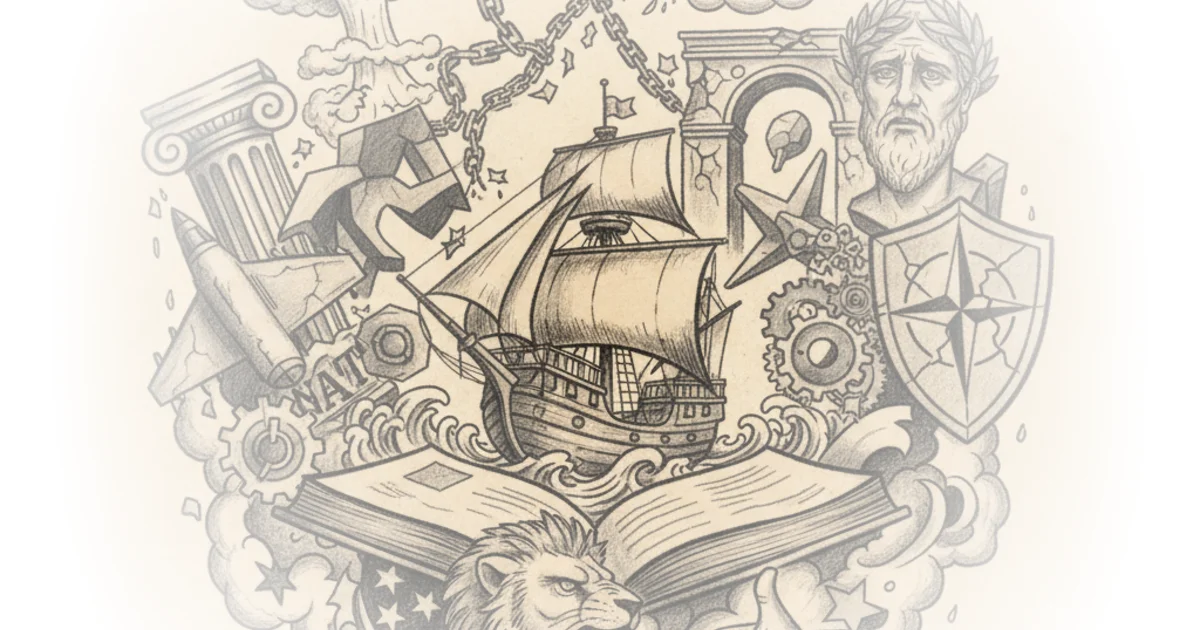
He argues that the "Plato-to-NATO" arc is a convenient fiction invented by propagandists to contain the Soviet Union, one that conveniently skips over the fact that the alliance was a pragmatic, post-1945 construction rather than an ancient destiny. "Mythmaking in a good cause is a different human social practice than history, but it is a useful (and valid?) social practice," DeLong observes, but he warns that politicians must balance this carefully. When the administration demands fealty from allies while proving itself "completely untrustworthy and unreliable," the myth collapses, leaving only the abyss of realpolitik.
Mythmaking in a good cause is a different human social practice than history, but it is a useful (and valid?) social practice. Historians do the second. Politicians are supposed to balance off the two.
The British Hand and the American Blind Spot
Finally, DeLong offers a provocative historical twist: the idea that the United States was effectively reabsorbed into the British Empire's sphere of influence by 1939, a move orchestrated from Westminster rather than Washington. He suggests that the policy choices made in the U.S. were often the result of Britain revealing "hidden wired aces" that allowed them to win the great power politics of the 20th century. This challenges the standard narrative of American exceptionalism and unilateral action.
He notes the irony that the Jacksonian elite who once loathed Britain had, by the mid-20th century, become the most powerful part of a reconstituted Anglo-American alliance. "Step back, and it is valid historically to interpret U.S. foreign policy from 1939 to 1953 as largely made in the Palace of Westminster," DeLong argues. This perspective adds necessary depth to the discussion, suggesting that the "West" was never a monolithic block of shared values, but a shifting coalition of interests managed through complex, often unspoken, imperial dynamics. A counterargument worth considering is that this view might understate the agency of American leaders, but it serves as a crucial reminder that international alliances are rarely as organic as politicians claim.
Bottom Line
Brad DeLong's commentary succeeds by stripping away the rhetorical veneer of the current administration's foreign policy to reveal a hollow core of historical revisionism. The strongest part of his argument is the rigorous distinction between the pragmatic, security-driven origins of NATO and the invented "Plato-to-NATO" tradition now being peddled. The biggest vulnerability, however, is his reliance on a specific, somewhat idealized reading of Winthrop that may not resonate with a modern audience disconnected from those theological roots. Readers should watch for how this disconnect between myth and reality plays out as the administration continues to demand loyalty from allies who remember the U.S. as an unreliable partner.
The triumphantly ascendant United States needed Europe as a market for its wares and a bulwark against its erstwhile Soviet ally.