Dr Michael John-Hopkins delivers a chillingly precise diagnosis of the current American political moment, arguing that we are not witnessing a finished fascist regime, but rather a dangerous, unstable hybrid that could slide either way. The piece's most striking claim is that labeling the current administration's actions as "fascism" too early might actually blind us to the specific, functional mechanisms of authoritarianism that are already at work. In an era of political fatigue, this distinction is not academic; it is the difference between despair and effective resistance.
The Function Over the Form
The core of Dr Michael John-Hopkins's argument rests on a rigorous redefinition of fascism, stripping away the rhetoric of style to focus on structural function. He writes, "Fascism, in his account, is not simply extreme nationalism, authoritarian leadership, or contempt for liberal norms and institutions. It is a specific response to a crisis, deployed when capitalism can no longer rule through democratic mediation." This framing is essential because it moves the debate away from personality clashes and toward the material conditions that allow such movements to thrive. The author suggests that the current political climate is fertile ground because of the "erosion of mediation," where trade unions and civic structures have been hollowed out, leaving a vacuum filled by personalized, antagonistic politics.
"If everything is fascism, nothing is urgent. If fascism is treated as inevitable, resistance collapses into despair or symbolic protest."
This insight lands with particular force. By treating the threat as a sliding scale rather than a binary switch, Dr Michael John-Hopkins forces readers to confront the reality that the danger lies in the process of delegitimization, not just the final outcome. He notes that the administration's sustained attacks on electoral integrity and the press follow a trajectory where courts are portrayed as "partisan obstacles" and journalists as "enemies of the people." Critics might argue that this analysis underestimates the sheer speed at which democratic norms can be dismantled in the digital age, but the author's insistence on analytical precision remains a vital safeguard against strategic paralysis.
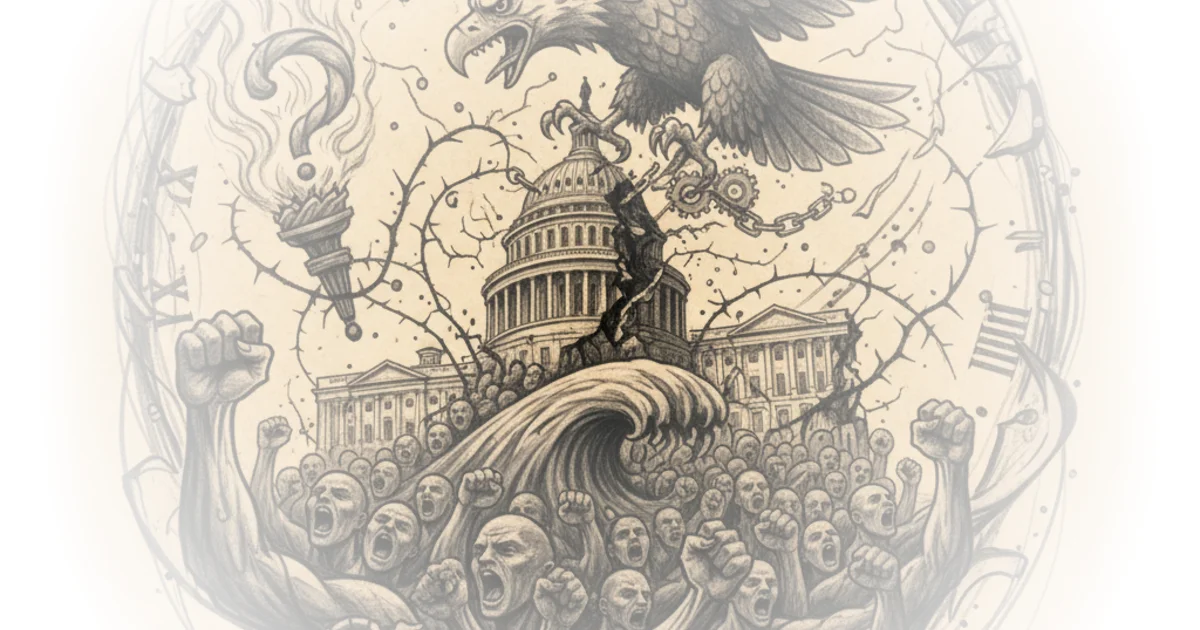
The Bonapartist Trap
Where the analysis becomes most provocative is in its refusal to simply apply the "fascist" label to the current executive branch. Instead, Dr Michael John-Hopkins proposes a more nuanced historical lens: Bonapartism. He explains that this model arises "when class forces are deadlocked and the executive claims to stand above society, arbitrating between classes while concentrating power." This distinction is crucial. It suggests that the current leadership style, reliant on executive action and personal authority, is a "parasitic formation" that is hostile to institutions yet dependent on them for survival.
The author points out that the owners of production and finance have not yet concluded that democracy is a threat to their accumulation. "For Trotsky, a regime that tolerates such institutional pluralism, however strained, would not yet qualify as fascist," he writes. This is a sobering reminder that the ultimate check on authoritarianism may not be moral outrage, but the self-interest of capital itself. The failure of the January 6th events to fully fracture the state, according to this view, was not a sign of resilience but a "warning signal of a deeper crisis that had not yet resolved itself."
"Fascism today may arrive functionally before it arrives formally."
Digital Accelerants and Foreign Interference
The piece also grapples with the ways modern technology and foreign actors have altered the traditional playbook of authoritarianism. Dr Michael John-Hopkins notes that "digital capitalism has altered these mechanisms profoundly," allowing for leaderless massification and distributed coercion that bypasses the need for paramilitary formations. The argument here is that "polarisation is amplified as a business model rather than a political strategy," creating authoritarian effects without a unified command structure.
Furthermore, the author highlights a paradoxical international dimension: a nationalist movement that is actively abetted by foreign state actors seeking to weaken the United States. He writes, "US intelligence assessments... concluded that Russian state organs... conducted influence campaigns aimed at denigrating Biden, supporting Trump, undermining public confidence in the electoral process." This external acceleration complicates the internal class analysis, suggesting that the crisis is being weaponized from abroad to exploit domestic fractures. While some might argue that focusing on foreign interference distracts from domestic agency, the author correctly identifies these operations as "external accelerants" that deepen the very divisions the administration exploits.
Bottom Line
Dr Michael John-Hopkins's strongest contribution is the warning that misdiagnosing the current political moment as either "safe" or "already fascist" leads to strategic failure; the truth is a volatile, unstable Bonapartism that demands precise, targeted resistance. The argument's greatest vulnerability lies in its reliance on the rational self-interest of capital to check authoritarian drift, a bet that history suggests can be a dangerous gamble. Readers should watch for whether the "parasitic" relationship between the executive and democratic institutions holds, or if the pressure to destroy pluralism finally outweighs the benefits of the status quo.