More Perfect Union exposes a startling financial inversion: the act of flying a passenger now costs airlines more money than the ticket price, with the entire industry's valuation resting on a $25 billion loyalty program that functions as a secret currency. This isn't just a complaint about legroom; it is a forensic accounting of how deregulation, consolidation, and algorithmic greed transformed a public utility into a predatory loyalty trap. For the busy traveler wondering why their flight feels like a humiliation ritual, this piece offers the missing link between 1970s policy and today's $25 billion scam.
From Public Utility to Free Market Frenzy
The author begins by contrasting the glamour of 1970s air travel with the current reality, noting that "Transparency means we don't dream up ways we can trick you into paying more." Under the old regulatory framework, the federal government treated aviation like water or electricity, setting routes and prices to ensure service even on unprofitable lines. Because airlines couldn't compete on price, they competed on quality, resulting in "a race to the top for who could provide the best service."
More Perfect Union argues that the 1978 Airline Deregulation Act was intended to lower prices through competition but instead triggered a "period of unbelievably cutthroat competition" that resembled "the Hunger Games." The author effectively dismantles the myth that deregulation was a pure win for consumers, pointing out that while prices dropped for popular routes, rural areas were abandoned. "Toledo, Ohio went from having service from five carriers under regulation to having no major carrier service today," the author notes, illustrating how "cream skimming" left small communities without access.
The regulators made sure that no airline got too many of the good routes or too many of the duty to serve roots.
This shift created "Fortress hubs," where a single carrier controls at least 70% of an airport, effectively killing local competition and driving up prices. The author's analysis of the hub-and-spoke model is particularly sharp, explaining how scale became the only path to survival, leading to a market where "only four airlines control 80% of the market." Critics might argue that the hub model is necessary for connecting distant cities efficiently, but the author's evidence suggests the efficiency gains are now captured entirely by the airlines in the form of higher fares and reduced service quality.
The Loyalty Program as a Secret Asset
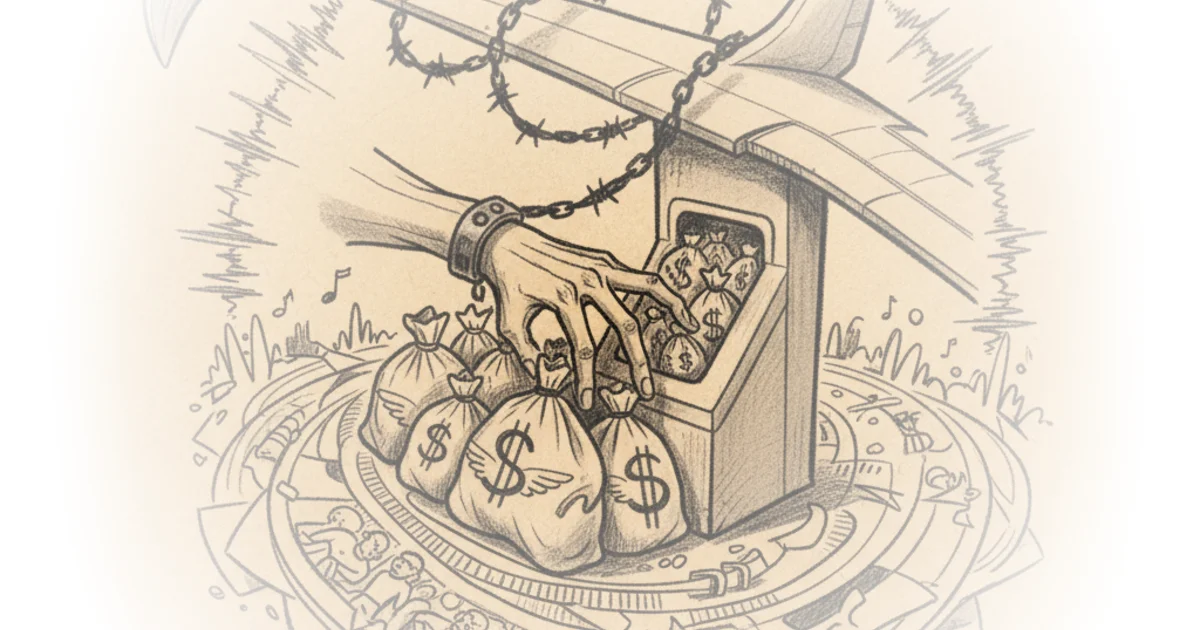
The most devastating part of the investigation is the revelation that the core business of flying is now a loss leader. "American Airlines own earning reports show that it does indeed cost more on average to fly a passenger around than the passenger pays the airline," More Perfect Union writes. The real money isn't in the ticket; it's in the loyalty points, which have been revalued as a massive financial asset.
The author traces the evolution of frequent flyer programs from a simple "quaint coffee shop punchcard type of strategy" to a complex financial instrument. By partnering with credit card companies, airlines began selling miles to banks for cash, which the banks then distributed to consumers as rewards for spending. "Today there are about 26 of them," the author notes, highlighting how this system allows airlines to generate revenue from purchases unrelated to travel. The result is a bizarre economic reality where "the flying part of their business actually has negative value."
Airlines invented the algorithmic pricing that we now see in grocery stores and on delivery apps.
The piece also touches on the rise of "dynamic pricing" and "unbundling," where fees for bags and seat changes have become a primary revenue stream. The author argues that this is not accidental but a deliberate strategy to squeeze every dollar from the passenger, turning the flight experience into a series of micro-transactions. "Airline revenue from baggage fees and other penalties has soared since 2007," the text states, underscoring how the industry has shifted from selling transportation to selling penalties.
The Illusion of Value
The author concludes by framing the loyalty program as a form of currency that airlines can create "out of thin air." This currency is not backed by actual flights but by the promise of future value, which the airline can devalue at will. "Points are currency that airlines can create out of thin air, as much as they want," the author asserts, revealing the fragility of the system. The loyalty program is no longer a reward for customers; it is the primary asset that keeps the airlines afloat, while the actual service of flying has become a loss-making distraction.
At this point, a flight ticket is like the $1 Costco hot dog that lures you into the store so you then impulse buy a $4,000 barrel steam sauna.
This analogy perfectly captures the current state of the industry: the flight is merely the bait, and the real product is the financial engineering behind the loyalty points. The author's investigation suggests that until the regulatory framework changes, the incentives for airlines to improve service will remain non-existent, as their profits depend on extracting value from credit card users, not from the travelers themselves.
Bottom Line
More Perfect Union delivers a compelling indictment of the modern airline industry, proving that the decline in service is not an accident but a feature of a business model built on financial engineering rather than transportation. The strongest part of the argument is the revelation that flying itself is a loss leader, a fact that fundamentally changes how we should view airline loyalty programs. The biggest vulnerability is the lack of a clear path forward, as the political will to re-regulate the industry seems distant, leaving travelers trapped in a system designed to extract value rather than provide service.