Brad DeLong delivers a sobering autopsy of a conflict that was sold as a swift victory but has devolved into a costly stalemate, arguing that the United States is effectively paying war indemnities to reopen global oil lanes. The piece's most disturbing revelation isn't just the diplomatic gymnastics required to end hostilities, but the stark economic reality: the U.S. military industrial base is burning through expensive, slow-to-produce interceptors against cheap, mass-produced drones, creating an unsustainable exchange ratio that mirrors a historical catastrophe in the making.
The Architecture of Defeat
DeLong frames the current situation not as a triumph of negotiation, but as a "perpetual pause" where the administration is forced to subsidize the very adversary it sought to destroy. He cites Ian Bremmer's assessment of the likely outcome: "expected outcome of us/iran agreement: strait opens and blockade dropped immediately... qatar transfers $6 billion of iranian assets to iran, the united states says it has nothing to do with that transfer (call it a coincidence)." This framing strips away the rhetoric of "maximum pressure" to reveal a transactional reality where the U.S. is paying for access to its own supply chains.
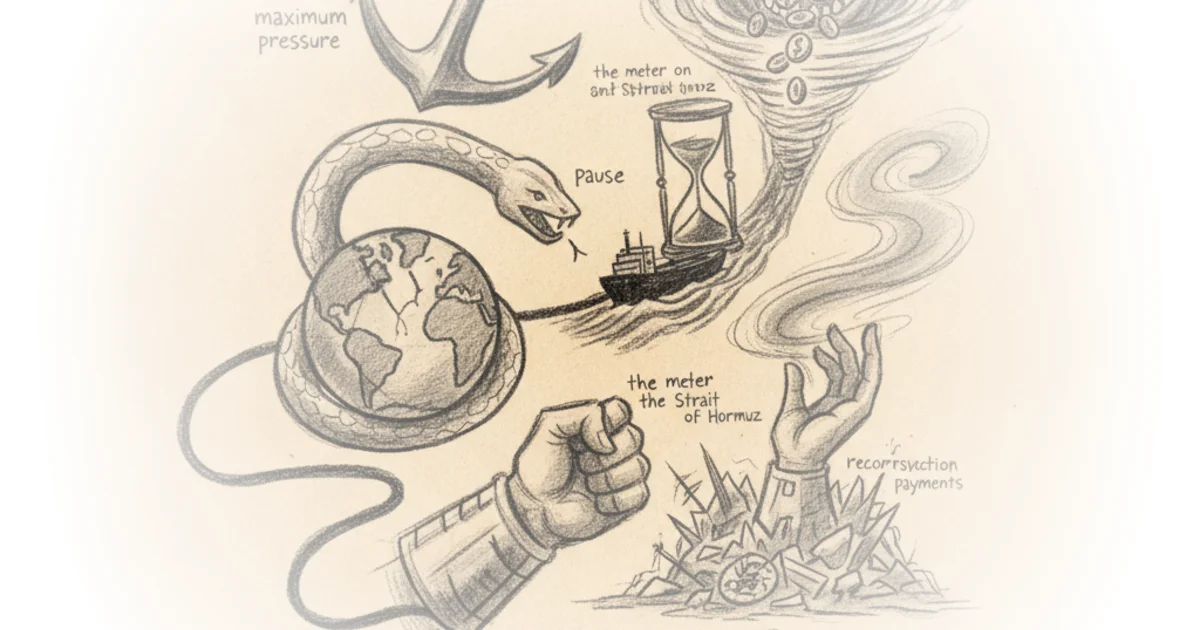
The author argues that the administration's narrative of victory is crumbling under the weight of financial absurdity. As DeLong notes, referencing Noah Smith: "'LOL, Trump started a war with Iran, and then ended up paying Iran a war indemnity. Pathetic... You can look at as: the United States paying $6 billion in order to open the Strait of Hormuz—to oil shipping for 60 days.'" This is not merely a diplomatic setback; it is a strategic inversion where the aggressor becomes the payer, effectively turning reconstruction funds into reparations for the damage inflicted by the U.S. bombing campaign.
The United States paying Iran $6 billion in reparations for its reverse Pearl Harbor attack. Both are valid. Both are true.
DeLong expands on this by highlighting the sheer scale of the proposed financial settlement, which dwarfs the initial indemnity. He points to reports of a draft plan involving an international "investment fund" valued at "$300 billion," described by Iranian officials as a "'reconstruction program'" that the U.S. would help facilitate. This suggests a long-term entanglement where American taxpayers are indirectly funding the rebuilding of infrastructure damaged by the very war they were told was necessary to prevent nuclear proliferation. The administration's insistence on avoiding direct payments is revealed as a semantic trick, allowing for "other countries paying Iran money" while the U.S. manages the flow.
The Industrial Trap and Human Cost
The commentary shifts from diplomatic futility to the grim mechanics of modern attrition warfare. DeLong draws a parallel between the current U.S. military posture and the Prussian army in 1806, which was optimized for the tactics of Frederick the Great but utterly unprepared for Napoleonic maneuver and mass mobilization. He argues that "the U.S. military as it is currently constituted is well behind the latest revolution in military affairs," trapped by a doctrine that values exquisite, high-cost platforms over mass production.
The evidence presented is chillingly specific regarding the economics of death. DeLong cites Julian Barnes noting that the U.S. has fired more than 1,200 Patriot interceptors—each taking up to 36 months and $4 million to build—"often to knock down 35,000 dollar Shahed drones." This disparity creates a "precise mass" dynamic where Iran can sustain losses that would bankrupt the American defense industrial base. As DeLong writes, quoting Anthony Scaramucci: "'The world's largest military budget has produced an industrial base that cannot sustain a serious war... the system is not designed to produce military capability. It is designed to produce contracts.'"
This mismatch has profound human consequences that are often obscured by the focus on hardware exchange ratios. The Pentagon admits to spending $29 billion, but DeLong suggests the real cost includes the "civilian-megadeath scale" threats made by the executive branch and the reality of strikes hitting troop housing, fuel reserves, and radar systems across 15 U.S. locations. While the article focuses on military assets, the implication is clear: a war fought with such inefficient economics inevitably drags out, prolonging the suffering of civilians in the region who are caught between drone swarms and missile defenses. Critics might argue that the Prussian analogy oversimplifies the geopolitical complexities of the Middle East, but DeLong's point about institutional rigidity remains potent; the U.S. is fighting a 21st-century war with a 20th-century industrial mindset.
The Illusion of Victory
The piece concludes by dissecting the political incentives that keep this "pause" alive despite its failure. DeLong observes that the administration must claim victory to survive politically, even as the facts suggest otherwise. He notes that while the regime in Tehran may feel it has won by simply surviving, the broader strategic picture is one of American impotence. The author writes: "'Trump's final hope is one of trying to extract something from the peace agreement with Iran that he can claim to his American supporters is a victory... But the claim will be an empty one.'"
The reliance on "deliberate ambiguity" and the extension of ceasefires every 60 days for another "$100 million a day opening of Hormuz payment" suggests a future where war is not ended, but merely paused until the next round of negotiations. The article warns that without China's involvement to enforce credible control over nuclear facilities, the cycle of violence will likely resume. As DeLong puts it, "For Trump, this will be a war he will want to forget... It has displayed his own and America's impotence."
Negotiations will achieve credible control over Iran's nuclear facilities, uranium stocks and weapons ambitions only if China agrees to become involved. China is the only country that can consider itself a winner.
The tragedy highlighted here is not just the loss of life or money, but the erosion of strategic clarity. The U.S. finds itself in a position where its military superiority is neutralized by economic asymmetry and industrial lag. The "victory" narrative is exposed as a necessary fiction to mask the reality that the United States has been outmaneuvered not by superior tactics, but by a cheaper, more adaptable adversary and an obsolete domestic production model.
Bottom Line
DeLong's analysis provides a devastating critique of a conflict driven by political posturing rather than strategic logic, exposing how the U.S. is forced to pay reparations to secure basic economic interests. The argument's greatest strength lies in its unflinching examination of the industrial exchange ratios that make modern attrition warfare unsustainable for the United States. However, the piece leaves readers with a sobering question: if the military cannot win and diplomacy requires paying the adversary, what is the actual exit strategy?