Cass Sunstein resurrects the Alger Hiss-Whittaker Chambers saga not merely as a historical curiosity, but as a mirror reflecting the deepest fractures in modern American political identity. In this Substack, Sunstein argues that the drama of the mid-20th century offers a crucial key to understanding today's polarized landscape, where elite credibility and populist suspicion collide with terrifying familiarity.
The Golden Boy and the Outcast
Sunstein begins by dismantling the visual and social stereotypes that defined the conflict. He paints Alger Hiss as the archetype of the establishment: "Alger Hiss was handsome, eloquent, and charming. He was tall and thin. He was boyish. He was winning, with a shy smile." This description is not just biographical; it is analytical. Sunstein suggests that Hiss's very appearance made him a target for a public increasingly wary of the Ivy League and the State Department. The author notes that Hiss "stood for the elite" and was viewed by many as a "domestic enemy" precisely because he embodied the institutions that were losing their grip on the national narrative.
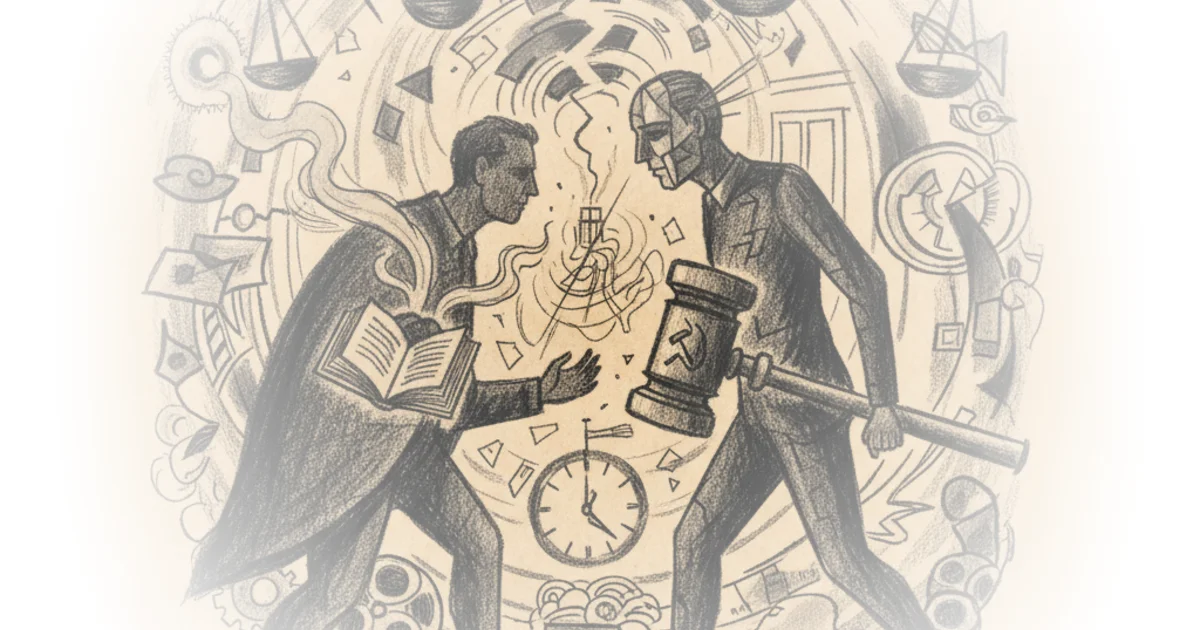
In stark contrast, Sunstein describes Whittaker Chambers as a man who seemed physically unimpressive yet intellectually formidable. "Whittaker Chambers was short and overweight. He had terrible teeth. He tended to sweat. He was a mess." Yet, Sunstein insists, "the man was smart, really smart, and gosh could he write." This juxtaposition is central to Sunstein's thesis: the conflict was not just about espionage, but about who gets to define truth in a democracy. The elite, represented by Hiss, relied on charm and pedigree; the outsider, represented by Chambers, relied on a visceral, almost religious conviction.
"Hiss stood for the elite. He was seen, by a lot of the country, as a domestic enemy. He was seen, by a lot of the country, as disloyal. He was seen, by a lot of the country, as Harvard, and that was seen, by a lot of the country, as very bad."
This framing is powerful because it strips away the legal technicalities to reveal the cultural war beneath. However, a counterargument worth considering is that Sunstein may slightly overstate the role of class resentment in 1948, potentially underestimating the genuine fear of Soviet expansion that fueled the era's anxiety. The fear was not just about Harvard; it was about a superpower actively seeking to dismantle the American way of life.
The Theater of Accusation
The narrative accelerates when Chambers brings his accusation before the House Un-American Activities Committee (HUAC) in August 1948. Sunstein captures the surreal nature of the hearings, where Hiss's initial denial was so absolute it seemed to seal his innocence. "I am not and never have been a member of the Communist Party," Hiss declared, adding, "To the best of my knowledge, I never heard of Whittaker Chambers until 1947." Sunstein notes that Hiss was a "terrific witness," disarming the committee with his charm.
The turning point, as Sunstein details, was the intervention of a young congressman who refused to let the story die. "He didn't like Hiss' answers; he thought that they were cagey. Actually he took an intense dislike to Hiss. His name was Richard Nixon, and he was both smart and dogged." Nixon's persistence forced a confrontation that Hiss tried to manage with a bizarre improvisation: claiming he knew Chambers only as a freeloader named "George Crosley." Sunstein highlights the absurdity of this moment, where Hiss claimed he needed to examine Chambers' teeth to make an identification. "Ultimately he made an identification: This was indeed the man, the freeloader, that Hiss had known as Crosley."
This section of Sunstein's analysis is particularly sharp in its focus on the psychological interplay. The author suggests that Hiss's attempt to reframe the relationship as a casual acquaintance was a desperate maneuver that ultimately backfired. As Sunstein writes, "Was it a brilliant improvisation on Hiss' part? Was it preposterous? If it was false, a made-up tale concocted under desperation, when did Hiss think of it, and how and why did he think of it? Was Hiss a cornered rat?"
Critics might argue that Sunstein leans too heavily into the dramatic interpretation of Hiss's behavior, potentially ignoring the possibility that memory fades or that Hiss was genuinely confused by the passage of time. Yet, the weight of the evidence Sunstein presents—the detailed knowledge Chambers possessed about Hiss's private life—suggests that the "Crosley" story was indeed a fabrication.
The Weight of Evidence and the Enduring Mystery
The saga took a definitive turn when Chambers produced the "Pumpkin Papers," secret State Department documents hidden in a pumpkin on his farm. Sunstein describes this as a "huge" bombshell. "Chambers produced secret State Department documents that, he said, proved that Hiss had engaged in espionage. Some of those documents were in Hiss' own handwriting." The existence of these documents, typed on a machine that could be traced to Hiss, shifted the debate from character to concrete evidence.
Sunstein points out the tragic irony of Chambers' testimony regarding the espionage itself. Chambers admitted he had lied about Hiss's involvement in spying, claiming he did so to protect his old friend. "He admitted that in so saying, he had been lying. Why? To protect his old friend Hiss! He did not want Hiss to go to jail." This confession adds a layer of moral complexity that Sunstein finds compelling. It suggests that even the accuser was bound by a twisted sense of loyalty, blurring the lines between justice and personal tragedy.
The author also reflects on the long shadow of the case. "For all of his life, Hiss insisted on his innocence. He tried hard to win in the court of public opinion. He tried to clear his name." Sunstein notes that Hiss's confidence was "contagious," and that his charm never fully faded, even after conviction. This persistence of belief, even in the face of overwhelming evidence, speaks to the enduring power of narrative over fact.
"The story has spread that in testifying against Mr. Hiss, I am working out some old grudge, or motives of revenge or hatred. I do not hate Mr. Hiss. We were close friends, but we are caught in a tragedy of history."
Sunstein uses this quote to underscore the depth of the tragedy. It was not a simple case of good versus evil, but a collision of two men who once trusted each other, now destroyed by the political currents of their time. The author draws a parallel to the Venona project, which later decrypted Soviet cables and confirmed the existence of the spy ring, yet even that technological proof could not fully silence the doubts of Hiss's supporters.
The Legacy of the Hiss-Chambers Saga
The article concludes by connecting the historical drama to the present day. Sunstein argues that the Hiss-Chambers saga "says more than a lot about the current right, and it says something, too, about the current left." The division over Hiss's guilt or innocence was a proxy for a larger ideological battle. "Many people on the left thought that Hiss was innocent, and that he had been railroaded as part of the Red Scare... Many people on the right thought that Hiss was guilty, and that his guilt told us a lot about the magnitude of the Communist threat and also about the nature of liberalism and the left."
Sunstein suggests that this dynamic persists. The skepticism toward elites, the suspicion of institutions, and the reliance on personal conviction over institutional authority are all themes that echo from 1948 to today. The author writes, "The drama set the stage for, and helps explain, a lot of what we are seeing today." This is the core of Sunstein's argument: history does not repeat, but it rhymes, and the Hiss-Chambers case is a particularly loud echo.
Critics might note that drawing a direct line from the Red Scare to modern politics risks oversimplifying the unique geopolitical context of the Cold War. The existential threat of nuclear war and the specific nature of Soviet espionage created a pressure cooker that may not have a perfect modern equivalent. However, Sunstein's focus on the sociology of the conflict—the way people choose to believe what fits their worldview—remains a valid and potent lens for analysis.
Bottom Line
Cass Sunstein's analysis succeeds in transforming a dusty legal case into a living lesson on the fragility of truth in a polarized society. The strongest part of the argument is the demonstration of how personal charisma and institutional bias can obscure factual reality, a dynamic that remains dangerously relevant. The biggest vulnerability is the potential for the piece to be read as a moral equivalence between the two sides, when the evidence of espionage is now widely accepted. Readers should watch for how the themes of elite distrust and the weaponization of personal history continue to shape the current political discourse, proving that the trial of the 20th century is far from over.