In a polarized moment where higher education is often framed as a battleground between competing ideologies, Yascha Mounk offers a startling reframing: the rise of "Civic Thought" programs and the fall of Diversity, Equity, and Inclusion (DEI) initiatives are not opposing forces, but rather two sides of the same coin. The piece's most distinctive claim is that true American patriotism requires an embrace of diversity as a foundational project, not a concession to modern political trends. For busy readers navigating the noise of campus culture wars, Mounk provides a historical roadmap that suggests the solution isn't choosing between tradition and inclusion, but realizing they are inextricably linked.
The Historical Anchor
Mounk begins by dismantling the conventional wisdom that Civic Thought is merely a conservative project to homogenize American heritage. Instead, he argues that "when you focus on American foundations, you find that America is, inescapably, a diversity project—an experiment in diverse identities coming together to build a greater whole." This framing is powerful because it grounds the argument not in abstract theory, but in the specific, often overlooked actions of the nation's founders. To strengthen this point, Mounk weaves in deep historical context, referencing Roger Williams, who was banished from the Puritan theocracy in 1635 for his diverse opinions and subsequently built Rhode Island on the principle that people of "other worships" could be "peacable and quiet Subjects."
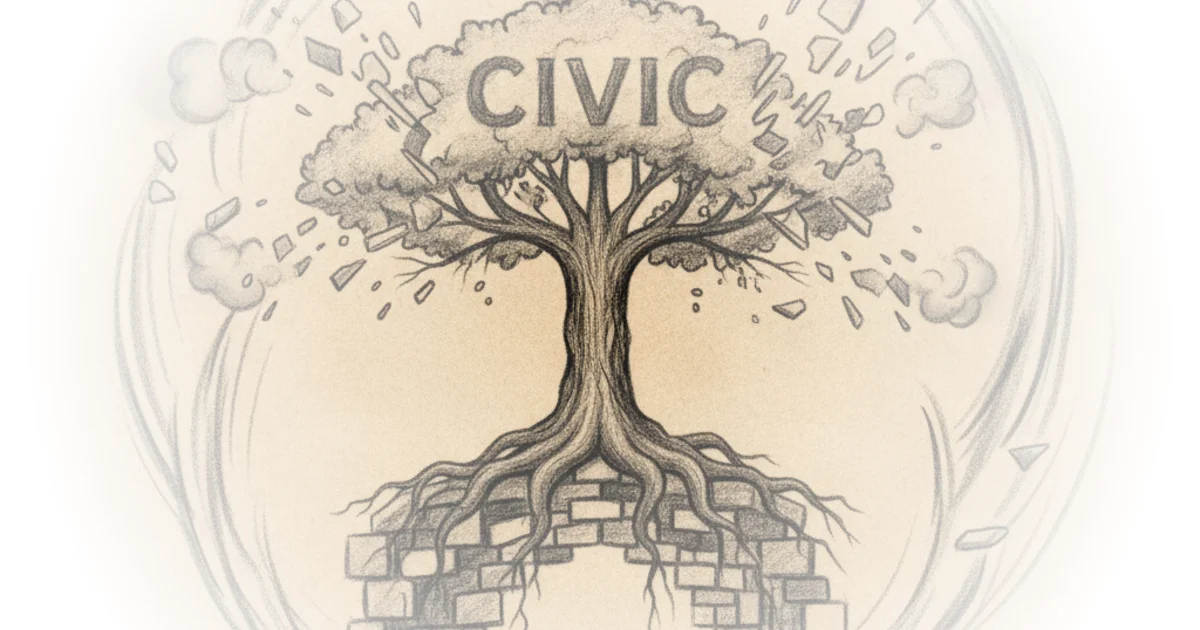
He further illustrates this by citing the 1657 Flushing Remonstrance, where Calvinist citizens defied Director General Peter Stuyvesant to demand religious liberty for Quakers, Jews, Turks, and Egyptians. Mounk notes that these signatories wrote: "The law of love, peace and liberty in the states extends to Jews, Turks and Egyptians... our desire is not to offend one of his little ones." By anchoring the modern debate in these specific 17th-century documents, the author effectively argues that pluralism is not a recent invention but a centuries-old American imperative. This historical depth adds necessary weight to the claim, moving it beyond partisan talking points.
America is inescapably a diversity project.
The Three Pillars of Pluralism
Moving from history to political theory, Mounk defines pluralism through three distinct pillars: welcoming diversity in a way that recognizes identity as vital to democracy; accepting deep disagreement as inevitable; and cultivating an ethos where people who do not think alike can still act together. He leans on the philosopher John Rawls to frame the central challenge of a diverse society: "How is it possible for there to exist over time a just and stable society of free and equal citizens, who remain profoundly divided by reasonable religious, philosophical, and moral doctrines?"
The argument here is that distinct identity groups are not threats to national unity but rather what Edmund Burke called the "little platoons" of society. Mounk suggests that these communities teach the essential building blocks of democracy, from organizing meetings to inspiring volunteers. However, a counterargument worth considering is whether this idealized view of "little platoons" holds up in an era where identity groups are increasingly siloed and antagonistic toward one another. While Mounk's historical examples show cooperation, current trends suggest that without active intervention, these groups often retreat into echo chambers rather than forming a harmonious whole.
Reclaiming the Narrative from DEI
Perhaps the most provocative section of the piece is Mounk's critique of how Diversity, Equity, and Inclusion programs have been implemented. He concedes that "the problem with DEI programs is not that they champion diversity efforts; it's that they run entire campus regimes in a diversity framework that demonizes so-called majority groups." He argues that these programs often ask minorities to "constantly demean themselves through victim narratives" and divide the population into rigid camps of oppressor and oppressed.
Mounk proposes that Civic Thought programs should not abandon diversity work but rather recover its deeper purpose. He envisions a curriculum where students learn from Frederick Douglass's "What To The Slave Is The Fourth of July" alongside the Founding Fathers, integrating sharp critiques of American failures with the nation's ideals. As Mounk puts it, universities must "initiate students into the conflicts inherent in a diverse democracy and prepare them to articulate and navigate those disagreements in a reasonable way." This approach seeks to replace the policy-heavy, often performative nature of recent DEI mandates with a robust intellectual tradition that fosters genuine civil discourse.
Critics might note that this synthesis is incredibly difficult to achieve in practice. The very mechanisms that made DEI programs effective at highlighting systemic inequities—such as mandatory bias training and specific diversity statements—are the same tools Mounk argues created public distrust. Bridging the gap between acknowledging historical injustice and fostering a unified civic identity remains a formidable challenge for any institution.
Bottom Line
Mounk's strongest contribution is his insistence that pluralism is not a modern political compromise but the original American experiment, supported by a rich tapestry of historical precedent from Roger Williams to Abraham Lincoln. However, the argument's biggest vulnerability lies in its optimism about the ability of universities to simultaneously champion sharp critiques of systemic racism and foster a unified civic ethos without triggering the same backlash that doomed previous DEI initiatives. Readers should watch for whether this "pluralist manifesto" can translate into actual curriculum changes or if it remains an elegant but unattainable ideal.