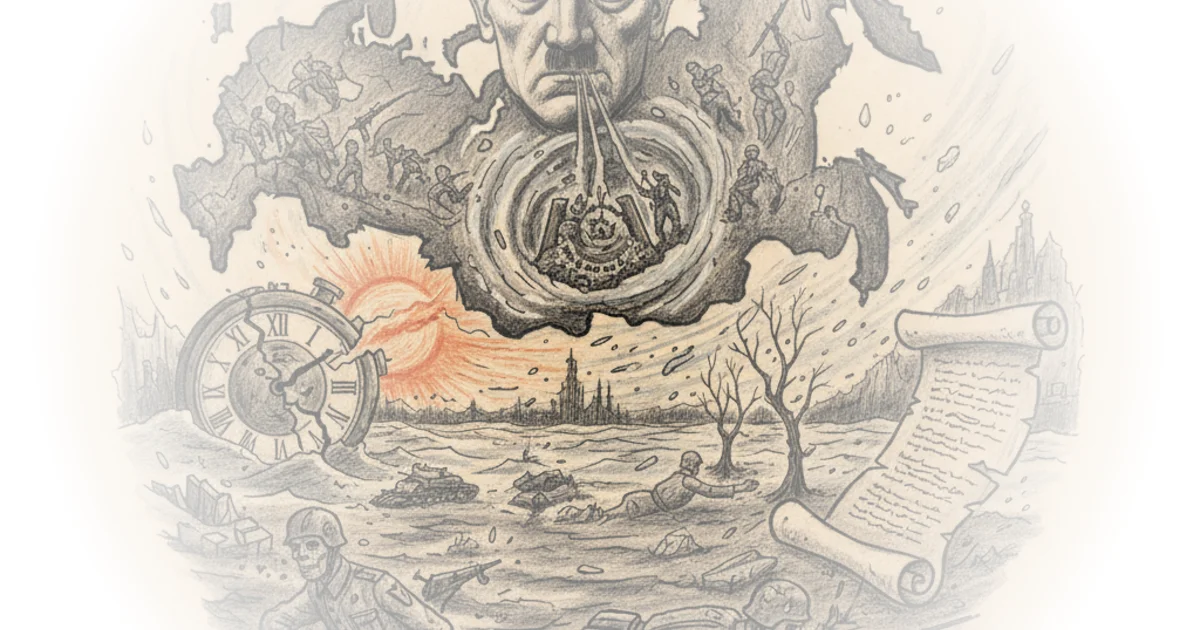
Nachman Oz dismantles the romanticized myth of the Eastern Front, arguing that Germany's defeat was not a result of a single blunder or a harsh winter, but the inevitable collapse of a military machine that fundamentally misread the enemy's scale, industry, and will. While popular history often fixates on Hitler's tactical meddling or the freezing of the German army, Oz presents a chilling case that the invasion was a catastrophic miscalculation from the very first day, doomed by a profound ignorance of the Soviet Union's demographic and industrial depth.
The Architecture of Hubris
Oz begins by grounding the German failure in a series of stark, terrifying quotes from the era's own observers, illustrating a leadership blind to reality. He cites General von Greiffenburg, who described the Russian climate not as a season, but as "a series of natural disasters" that rendered the land impassable for half the year. Yet, the author argues, the weather was merely the final nail in a coffin already filled with strategic errors. The core of Oz's argument is that the German high command operated on a fantasy of Soviet fragility, believing that a quick blow would shatter the state as it had France.
"The economic foundation of Operation Barbarossa remains one of the most tenuous in military history."
Oz leans heavily on historian David Stahel to underscore this point, noting that the Wehrmacht entered the conflict with virtually no reserves. In a devastating comparison, the author highlights that while Germany had exhausted its pool of trained replacements within months, the Soviet Union possessed 14 million trained reservists against Germany's 321,000. This disparity was not just a number; it was a strategic reality that the German planners refused to acknowledge. Oz writes, "We have to win this war. We must not lose our courage. If others win the war, and if they do to us only a fraction of what we have done in the occupied territories, there won't be a single German left in a few weeks." This quote, drawn from Antony Beevor's account of the war's end, serves as a grim reminder of the existential stakes that the German leadership ignored until it was too late.
Critics might argue that Oz underplays the sheer ferocity of the initial German Blitzkrieg, which did indeed decimate the Red Army's front-line forces in 1941. However, the author effectively counters this by pointing out that these losses were absorbed by a system designed for attrition, not a system on the verge of collapse.
The Industrial Colossus
The piece shifts to a powerful analysis of industrial capacity, challenging the narrative that the Soviet Union survived only due to American aid. Oz meticulously details how the Soviet Union tripled its production of key armaments in the second half of 1941, even while moving its entire industrial base eastward. The author argues that the German assumption that the Soviet economy would crumble under pressure was as flawed as their assessment of the manpower pool.
"The Soviet Union could afford to lose four men for every German and still conjure an army equivalent to what the Germans attacked her in the first place."
This demographic and industrial resilience is presented as the true turning point of the war. Oz notes that by 1941, the Soviet Union produced more tanks than Germany, a fact that contradicts the German belief in their technological superiority. The author points out that the T-34 tank, initially a surprise to German forces, was upgraded and produced in such numbers that the loss ratio shifted from 6 or 7 Soviet tanks for every German one to a 1:1 ratio by late 1944. This section of the commentary is particularly effective because it moves beyond the "great man" theory of history to focus on the grinding machinery of total war.
"Germany lost when it attacked and failed to defeat the Soviet Union in its opening gambit."
Oz makes the bold claim that the war was effectively lost in the first few months, not at Stalingrad or Moscow. The argument is that the German offensive stretched its supply lines to the breaking point against a foe that simply refused to die. The author writes, "Stalin was no military genius, but he could see no sense in Hitler striking east in June with only a few weeks of combat weather remaining... He projected onto Hitler his own sense of what was possible." This insight into Stalin's rationality, contrasted with Hitler's delusion, reframes the opening of the war not as a Soviet blunder, but as a German madness.
The Human Cost of Miscalculation
While the article focuses on strategy and logistics, Oz does not shy away from the horrific human cost of these miscalculations. The text recounts the brutal reality faced by soldiers on both sides, from the SS soldier forced to play the piano for sixteen hours before being executed, to the millions of Soviet prisoners of war who died of starvation and exposure. The author uses these anecdotes to ground the high-level strategic analysis in the visceral reality of the conflict.
"It became so quiet in that carriage that one could have heard a pin drop."
This moment of silence, described by Beevor, captures the terrifying realization among the German elite that their war of annihilation had failed. Oz emphasizes that the German leadership's belief in the "subhuman" nature of the Slavic population led to a war of extermination that only hardened Soviet resistance. The author notes that while the Germans had over a million Soviet citizens fighting for them initially, their own brutality turned these potential allies into partisans, further straining the already overextended German lines.
Critics might suggest that Oz's focus on the inevitability of the Soviet victory risks downplaying the agency of the German military, which did achieve stunning victories and nearly captured Moscow. Yet, the author's evidence suggests that these victories were pyrrhic, consuming resources that could never be replenished.
Bottom Line
Nachman Oz delivers a compelling, if grim, verdict: the Eastern Front was not a contest of wills but a collision between a delusional aggressor and an industrial and demographic titan that could not be broken by conventional means. The piece's greatest strength is its refusal to let the reader off the hook with easy explanations like "the winter" or "Hitler's orders," instead forcing a confrontation with the sheer scale of the German miscalculation. The biggest vulnerability lies in its near-total dismissal of the possibility of a different outcome, leaving little room for the chaos and contingency that often define war. For the busy reader, the takeaway is stark: underestimating an opponent's capacity to absorb pain and regenerate power is not just a tactical error; it is a strategic suicide.