Tom van der Linden makes a provocative claim: Christopher Nolan's Oppenheimer is not a historical biography, but the inevitable culmination of a decades-long obsession with how human identity is constructed through imitation. While most critics dissect the film's nuclear physics or political maneuvering, van der Linden argues that the movie's true subject is the psychological mechanism of "mimetic desire"—the idea that we do not want things because we value them, but because others value them. This reframing transforms a three-hour epic about the atomic bomb into a claustrophobic study of the self, suggesting that the film's enigmatic nature is not a flaw, but a deliberate reflection of the "inner void" that drives us all.
The Blueprint of Identity
The essay begins by dismantling the assumption that Oppenheimer is a standard biopic. Van der Linden writes, "More than a year after its release, the movie remains as enigmatic as the tormented character at its center." He posits that the film's difficulty in being engaged with stems from its refusal to fit into a pre-existing mold of historical storytelling. Instead, the author suggests that the movie is an "invitation to peer into my soul," a project that only makes sense when viewed as the final piece of a puzzle Nolan has been assembling since his student days.
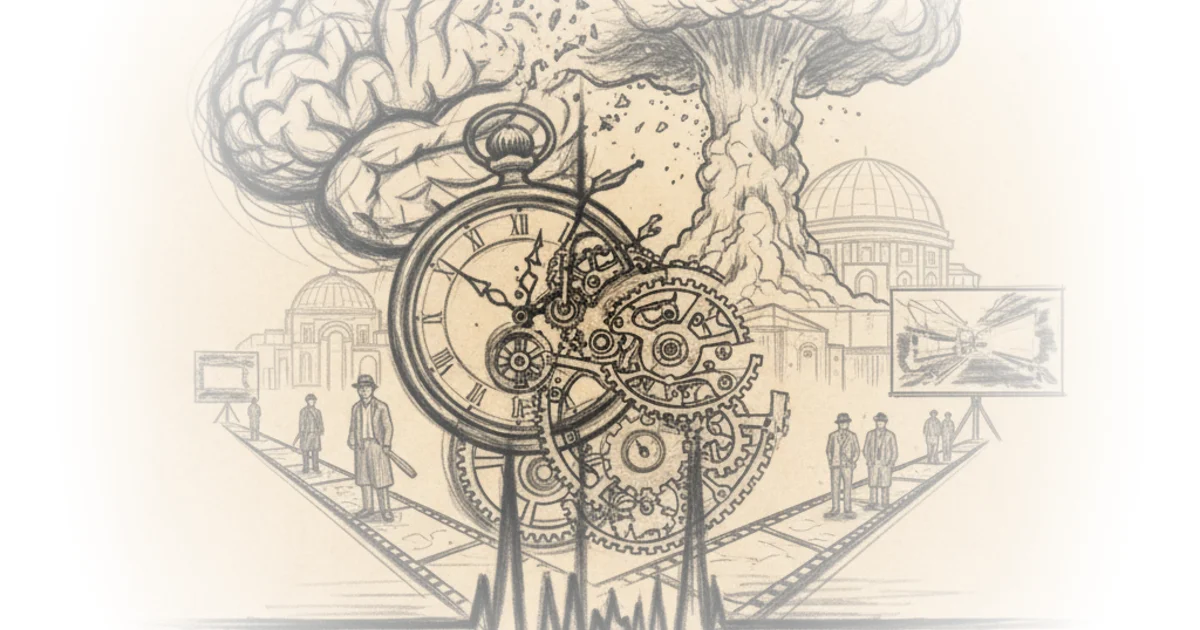
To prove this, van der Linden takes the reader back to Nolan's 1998 debut, Following. This low-budget noir, often dismissed as a mere stepping stone, is re-examined here as the thematic DNA of Nolan's entire career. The author introduces the philosophical framework of René Girard's mimetic theory to explain the film's plot: we are not autonomous individuals but creatures who constantly imitate the desires of others to fill an undefined "hunger for being." As van der Linden puts it, "We are always taking cues from the behaviors and beliefs from the people around us that we then try to imitate to emulate."
This analysis is compelling because it connects the dots between a tiny indie film and a global blockbuster. The protagonist of Following, an unnamed man named Bill, obsessively follows a charismatic thief named Cobb, not out of curiosity, but because Cobb represents the "complete person" Bill aspires to be. The author notes that Cobb exploits this dynamic, manipulating Bill into committing crimes by planting the idea that Bill should desire what Cobb desires. "From Bill's perspective... Cobb became the aspirational model for his own identity," van der Linden explains. This is the seed of what Nolan would later call "inception" in his 2010 sci-fi thriller, but here it is stripped of special effects and presented as a raw, psychological vulnerability.
"The box is the perfect symbol for that secret being that others have and that Bill is searching for."
The Trap of Rivalry
The commentary deepens as van der Linden explores the darker side of this imitation: rivalry. When the imitator begins to succeed, the model often feels threatened, leading to a "double mediation" where the two become locked in a destructive cycle. The author points out a specific moment in Following where Cobb, who never truly cared for the woman Bill seduced, becomes genuinely jealous. "In double mediation, it's not that one wants the object, but that one does not want to see it in someone else's hands," the author writes, quoting Girard.
This theoretical framework is then applied to Nolan's later work, The Prestige, where two magicians become entangled in a violent rivalry over the secrets of their craft. Van der Linden argues that these films reveal a "false promise of wholeness." The characters believe that by stealing the other's identity or secrets, they will become whole. Instead, they discover that the "image of self-sufficient being and happiness" they projected was merely a mask for an "inner torment of a self that was either joyless and empty... or fragmented."
Critics might note that applying a specific philosophical theory to every film in a director's filmography risks forcing a square peg into a round hole, potentially ignoring the unique genre constraints of each project. However, van der Linden's evidence is strong because he traces the evolution of specific symbols, such as the "secret box," from a physical prop in Following to the metaphorical diaries in The Prestige, showing a clear through-line in Nolan's artistic vision.
The Aesthetics of Constraint
Beyond the philosophy, the piece offers a fascinating look at how Nolan's early constraints shaped his aesthetic. Van der Linden argues that the "no-budget" nature of Following was not a limitation to be overcome, but a creative catalyst. The decision to shoot in black and white, for instance, was a strategic choice to make the film look "artsy" rather than amateurish. "The reason following was shot in black and white is because it's easier to make that look better with low-budget materials," the author writes. This economic necessity birthed a stylistic signature that Nolan would carry forward: the use of black and white to denote objective reality, contrasted with color for subjective memory or dream states.
The author highlights how Nolan used borrowed equipment, like a dolly for interrogation scenes, to create a sense of "deliberateness" that contrasted with the handheld, chaotic camera work of the rest of the film. This technical analysis supports the broader argument that Nolan has always been obsessed with the tension between objective truth and subjective perception. The film's non-chronological structure, which can be confusing to viewers, is framed here not as a gimmick, but as a necessary tool to mirror the fragmented nature of memory and identity.
Bottom Line
Tom van der Linden's analysis succeeds in shifting the conversation from the spectacle of Oppenheimer to its psychological core, arguing that the film is a masterclass in the dangers of mimetic desire. The strongest part of this argument is the seamless connection drawn between a forgotten student film and a modern masterpiece, proving that Nolan's themes have been consistent for over two decades. The biggest vulnerability lies in the density of the philosophical theory, which may alienate readers looking for a simpler narrative summary. Ultimately, this piece is essential for anyone who wants to understand not just what Nolan's movies are about, but why they feel so strangely familiar in their depiction of human longing.
"Because what I think you need to understand first and foremost about Oppenheimer is that this is not some journeyman's account of the creation of the nuclear bomb. No, this is a Nolan movie."
The Evolution of a Vision
The essay concludes by emphasizing that Oppenheimer cannot be fairly understood in isolation. It is the "culmination of a cinematic vision that Nolan has been aspiring to for many years." The author suggests that the film's enigmatic quality is a sign that it is "still waiting to be truly understood," resisting the urge to be forced into a pre-existing mold. By viewing the film through the lens of Nolan's entire body of work, the reader is invited to see the atomic bomb not just as a historical event, but as the ultimate symbol of a desire that consumes the self. As van der Linden writes, "The closer we got, the more obscure the picture became, like a newspaper photograph becoming incoherent on magnification." This final image captures the essence of the piece: the more we look for a simple answer, the more we realize that the complexity of the human condition is the only story worth telling.