The Death of Alternatives
Boaventura de Sousa Santos offers a sweeping diagnosis of Western decline that refuses the comfortable narrative of external threat. His argument centers on petrification — a civilization that no longer responds creatively to challenges, that suppresses innovation from within and destroys alternatives from abroad. The piece demands attention not for its conclusions, but for its insistence that Western stagnation is self-inflicted.
Civilization Theory's Return
Santos anchors his analysis in a century of civilizational thought. Oswald Spengler, Arnold Toynbee, and Pitirim Sorokin dominated early debates about how civilizations rise and fall. Samuel Huntington's Clash of Civilizations revived the framework at century's end, though for very different purposes. Santos writes:
"Despite all their differences, these studies shared a central idea: competition, rivalry, and succession between civilizations. And the West was always at the center of attention."
The contemporary twist, Santos argues, is that civilization now defines itself through its relationship with nature — a theme that seemed irreversible until recent political shifts resurrected the older framework of civilizational rivalry. As Boaventura de Sousa Santos puts it, "the theme of civilization/nature relations has disappeared again and, in its place, the theme of rivalry between civilizations has returned to the political agenda."
Petrification as Internal Decay
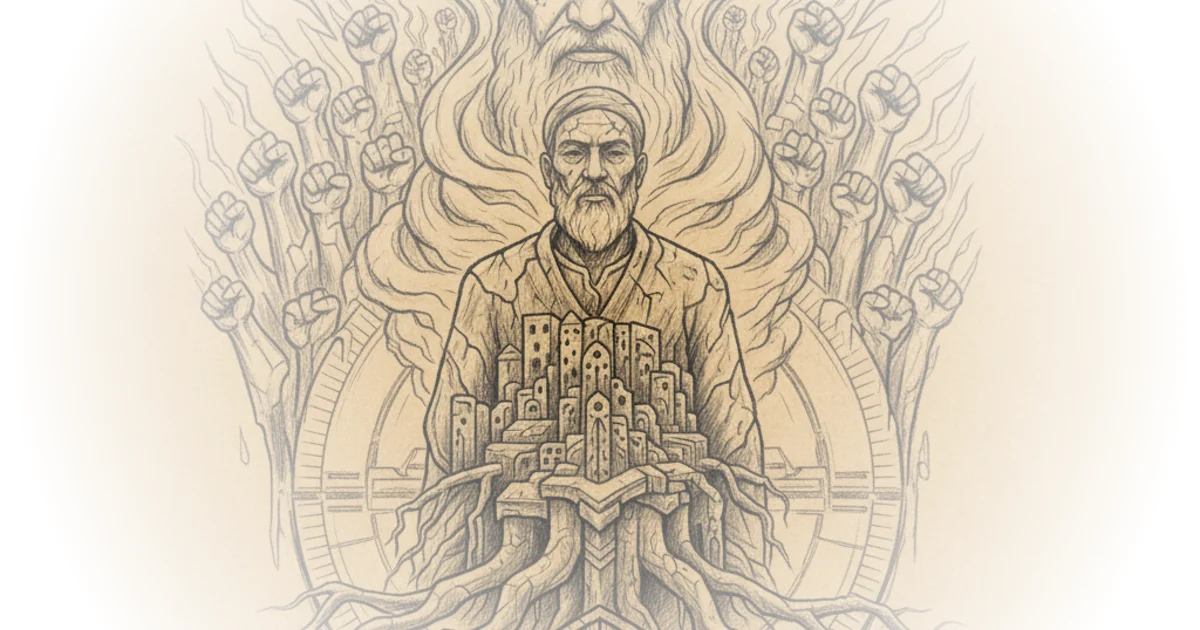
The core concept borrows from Toynbee's lifecycle model but updates it for the present. Petrification is not collapse — it is prolonged decline where creative energy freezes into rigid hierarchy. Santos writes:
"Stagnation is not the result of immobility. Rather, it is the result of a fierce struggle between the remaining civilizational energies and the barbaric energies that civilization itself has created."
This internal barbarism operates like cancer. The ancient Greek playwright Menander offered the definition Santos favors: "things rot because of evils that are inherent in them." Innovation is eliminated not by external enemies, but by minorities in power who perceive threats where none exist.
"The smaller the minority, the more likely it is to see great threats in actions that are not threats, or, if they are, they are challenges that a non-petrified civilization would respond to creatively."
Five Suppressed Alternatives
Santos marshals five cases where political innovations were neutralized by external forces. Each represents an attempt to build alternatives to neoliberal orthodoxy.
Cuba (1959-present) began as a revolutionary democratic alternative before transforming into a socialist project. Santos notes Cuba's contributions to African independence movements and education. But US sanctions began in 1962 and tightened across decades. He writes:
"US imperialism now wants to make life on the island impossible, condemning its inhabitants to darkness, hunger, and death from preventable disease through a total blockade that includes the supply of oil."
Chile (1970-1973) offered a democratic path to socialism through Salvador Allende's elected government. Henry Kissinger promised to "make the Chilean economy scream" in response to copper nationalization. As Boaventura de Sousa Santos observes:
"If the American liberal ideology were sincere, there would be nothing to object to, since the Chilean socialist project came to power through the ballot box."
Allende fell on September 11, 1973, after CIA infiltrations and military indoctrination brought the country to a standstill.
Iran (1979) freed itself from the Shah, installed by a 1952 CIA coup. The revolution brought Ayatollah Khomeini to power after fourteen years of exile. Santos argues that whatever one's assessment of the theocracy, its evolution was blocked by external interference:
"It is now known that many of the deaths of protesters were caused by agents of MI6, Mossad, and the CIA."
Venezuela under Hugo Chávez implemented policies that improved lives for the majority while creating regional cooperation institutions independent of US dominance. After Chávez's death, sanctions cost the country millions in emigration. Santos writes:
"With no concern for Venezuelan democracy or the fate of emigrants scattered across the continent, [recent US policy] ordered the arrest of the legitimate president of a sovereign country and had him taken to New York to be tried under US law."
Gaza (2006-present) saw Hamas win free and fair elections, then be reduced to controlling what Santos calls "the world's largest concentration camp." Israel controlled every detail of life, defining a "humanitarian minimum diet" that calculated calories needed for survival. As Boaventura de Sousa Santos puts it:
"The only talk was of the normalization of Israel's relations with Arab countries through the Abraham Accords. No one spoke of the Gaza concentration camp."
The Common Thread
What unites these cases is the impossibility of implementation without adverse external interference. Santos repeats: "we do not necessarily have to agree with them. But we also cannot disagree with them because, in fact, they have never been put into practice."
"Imperial minorities are always right because they (almost) always have the power to transform reality in order to prove themselves right."
The rhetorical force here is considerable. Santos asks what difference exists between razing Gaza's buildings and making life impossible in Cuba through starvation and blockade. The repression creates the rigid forms that petrification demands.
Counterpoints
Critics might note that Santos's framework treats all external interference as equally illegitimate, regardless of whether the suppressed projects involved democratic backsliding, human rights abuses, or authoritarian consolidation. Cuba's record on political freedom, Iran's treatment of women and minorities, Venezuela's economic collapse under Chávez's successors, and Hamas's founding charter all complicate the narrative of pure innovation suppressed. Santos acknowledges this — "one does not need to agree with it" — but the acknowledgment sits uneasily with the moral weight the piece assigns to external interference alone.
Critics might also observe that petrification theory risks becoming self-sealing: if every alternative is destroyed before it can prove itself, the theory cannot be falsified. The civilizations that survive may do so not because they are more creative, but because they are more ruthless.
"The repression of any innovation that poses a threat to the minorities that dominate the world creates the rigid forms of hierarchy that petrification demands."
Bottom Line
Santos's petrification thesis offers a provocative lens for understanding Western decline as self-inflicted rather than externally imposed. The five cases demonstrate a pattern of suppression that cannot be dismissed. But the argument's strength — its moral clarity about external interference — becomes its weakness when it refuses to weigh the internal failures of the suppressed alternatives themselves. Petrification may describe the West's condition. It does not automatically sanctify every alternative the West destroyed.