Alex O'Connor doesn't just ask if you are still you when you lose a hand; he asks what happens when you lose your memory, your heart, or even your entire human body. In this conversation with Michael Stevens, O'Connor dismantles the intuitive idea that personal identity is a fixed physical object, replacing it with a startlingly fluid definition based on potentiality rather than substance. For the busy mind seeking a quick intellectual breakthrough, this piece offers a rare clarity: the reason we fear death isn't the loss of the body, but the permanent silencing of what we could have done.
The Paradox of Amputation
O'Connor begins by dismantling our physical attachment to identity through the lens of "folk philosophy." He argues that we intuitively understand that identity survives massive physical alteration. "If I were to cut off your hand you'd still be there... similarly it feels like I could sort of just just get rid of the lower half of your body," O'Connor observes. He pushes this to the extreme, noting that even if you "cut a brain in half," a conscious agent often remains. This approach is effective because it bypasses complex neurology and taps into our immediate, pre-theoretical intuitions. We don't need a medical degree to feel that a person is still "there" after losing a limb.
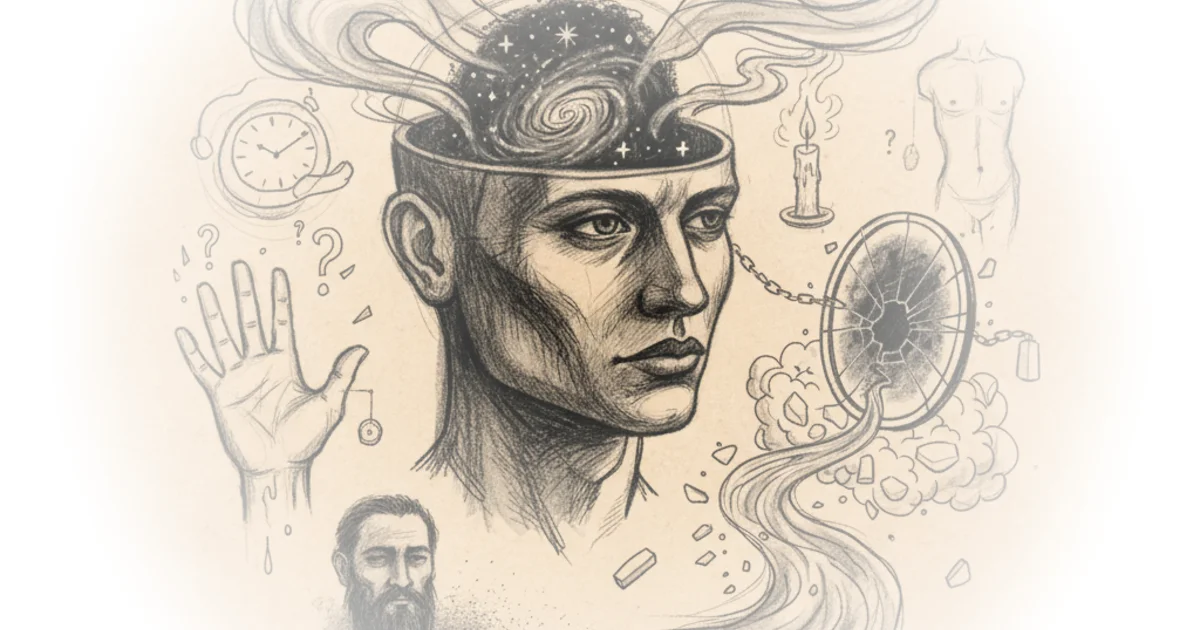
However, the argument hits a wall when O'Connor introduces the case of Clive Wearing, a man with a seven-second memory. Here, the physical brain is damaged, yet the person remains. O'Connor suggests that we still refer to him as a unified "he," not a collection of fragments. "There's still a person who's unified across that time," he notes, despite the lack of psychological continuity. This is a bold claim. Critics might note that without memory, the "self" is arguably a hollow shell, a biological machine running on autopilot rather than a conscious agent. Yet, O'Connor's point holds weight: our social and linguistic practices refuse to declare a person "gone" until the potential for action is irretrievably lost.
When you die, you will never do anything that you could have done but didn't.
The Heartbeat as the Final Threshold
The most surprising turn in the discussion is the distinction between brain death and cardiac death. O'Connor points out a deep cultural intuition: families often accept loss only when the heart stops, not when the brain is damaged. "Deep inside of us we think of the heart as being once the heart's gone. It's over," he explains. He argues this isn't just an outdated belief but a recognition of potentiality. A brain-damaged person can still recover or change; a heart-stopped person cannot. "When you're asleep, you can still do some stuff later, but when you're dead, you can't," O'Connor writes. This reframes death not as a biological state of the brain, but as the total cessation of future possibility.
This perspective challenges the medical definition of death, which prioritizes brain function. O'Connor suggests that our emotional acceptance of death is tied to the finality of lost potential, a nuance that clinical definitions often miss. It forces the reader to reconsider why we mourn the heart's stoppage more than the brain's failure: it is the moment the story of "what could be" is permanently edited out.
The Worm and the Torture Switch
The conversation takes a darker, more philosophical turn when O'Connor and Stevens explore the "body swap" thought experiment. If a doctor swaps your memories with your enemy's, who gets tortured? "I want you to torture my body containing his experience," Stevens replies, realizing that identity follows the memory, not the flesh. O'Connor uses this to probe the nature of revenge and justice. If a clone of Hitler remembers being Hitler, does punishing the clone satisfy our sense of justice? "It wouldn't feel very satisfying," O'Connor admits, even though the clone "thinks that they really are Hitler."
This section exposes a crack in the materialist view of consciousness. If consciousness were purely a product of the brain's physical matter, swapping memories should be impossible without swapping the brain itself. Yet, we can easily imagine our consciousness moving into a worm or a computer. "Consciousness is the thing that doesn't change for Phil in Groundhog's Day," O'Connor asserts, defining it as the interiority that persists despite external changes. This is a powerful, if unsettling, conclusion: we are not our bodies; we are the continuous narrative of our experiences.
Critics might argue that this view is dangerously solipsistic. If identity is purely about memory and potential, then a person who forgets a crime is no longer the criminal, and a clone of a murderer is innocent. O'Connor acknowledges this, suggesting that punishment should become purely preventative rather than retributive. "We still need to separate them from society, but make sure that they're happy," he concludes, stripping justice of its vengeance and leaving only safety.
Bottom Line
Alex O'Connor's strongest move is reframing personal identity as a function of potentiality rather than physical continuity, a distinction that elegantly resolves the paradox of why we fear death more than amputation. The argument's biggest vulnerability lies in its reliance on intuition; while our gut feelings about the "heart stopping" are compelling, they may not hold up against the hard logic of neuroscience. Readers should watch for how this definition of identity reshapes our understanding of justice, moving us toward a future where punishment is about safety, not retribution.