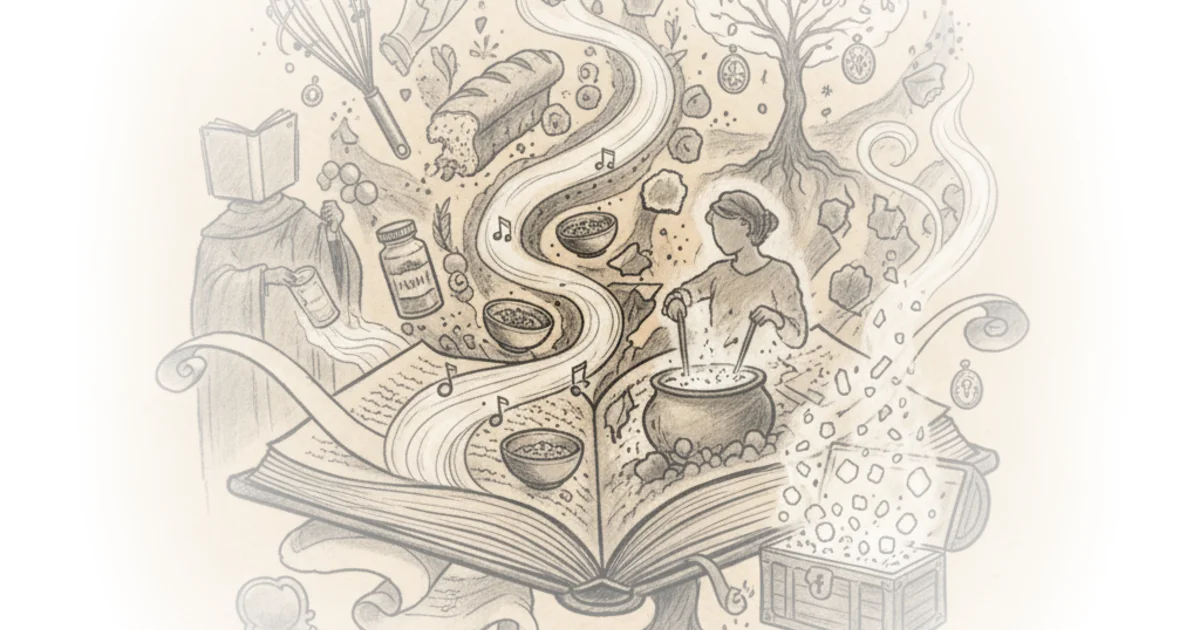
Paula Forbes challenges a quiet assumption in literary publishing: that recipes in memoirs are merely decorative or that they relegate serious nonfiction to the "food writing" ghetto. Instead, she argues that a recipe can be a radical act of historical preservation, a political metaphor, or a bridge between the author's internal world and the reader's physical reality. This is not a review of cookbooks; it is a forensic examination of how the imperative mood—"Boil," "Chop," "Serve"—disrupts the passive act of reading and forces a conversation about memory, scarcity, and power.
The Architecture of Memory
Forbes begins by dissecting how recipes function as more than instructions. She traces her own intellectual journey from Ruth Reichl's Tender at the Bone to Anya von Bremzen's Mastering the Art of Soviet Cooking. In Reichl's work, the recipes are playful interruptions that invite the reader to cook along, creating a shared sensory experience. But Forbes finds something darker and more profound in von Bremzen's approach. The author describes von Bremzen's childhood memories as "poisoned madeleines," a direct subversion of the Proustian ideal where food unlocks happy nostalgia. Instead, von Bremzen uses the absence of food or the inclusion of ration cards to symbolize the famine and political repression of the Soviet era.
"The recipes act as symbols, their creation not unlike writing metaphors."
This observation is crucial. Forbes suggests that when an author includes a recipe for a dish they never actually ate, or an image of a ration card instead of ingredients, they are using the form of a cookbook to tell a story about loss. The recipe becomes a vessel for what cannot be consumed. Critics might argue that this blurs the line between utility and art, potentially frustrating a reader looking for practical advice. However, Forbes convincingly demonstrates that in narrative nonfiction, the utility of the recipe is secondary to its symbolic weight. The recipe is not there to be cooked; it is there to be felt.
Artifacts of Power and Exclusion
The commentary shifts to a more critical examination of who gets to write these stories. Forbes turns to James Beard's Delights and Prejudices and Vertamae Smart-Grosvenor's Vibration Cooking to highlight the stark contrast in how recipes document history. While Beard's work offers a glimpse into the abundance of early 20th-century Oregon, Forbes notes that his descriptions often obscure the virulent racism of the time, including the Chinese Exclusion Act. In contrast, Smart-Grosvenor's work is described as a "vibrational" force that refuses to shrink in the face of systemic oppression.
"Food is a currency of love."
Forbes highlights how Smart-Grosvenor's inclusion of recipes serves as an act of resistance, reclaiming Black Geechee cooking from the margins and placing it at the center of the narrative. The argument here is that the presence or absence of recipes is never neutral; it is a political choice that either reinforces or dismantles existing power structures. The inclusion of a recipe can validate a community's survival strategies, while the exclusion of one can erase a culture's contribution to the culinary landscape. This framing is effective because it moves the discussion from "taste" to "justice."
The Ethics of Omission
Not every narrative demands a recipe. Forbes explores this through an interview with Gina Rae La Cerva, author of Feasting Wild. La Cerva explains her decision to exclude recipes from her book on foraging and indigenous food practices. The reasoning is twofold: the ingredients are often impossible to source for the average reader, and including them might violate the ethical stance of the book regarding wild food harvesting.
"Maybe more pertinent—was that the ingredients I write about (wild foods) are not very easy to source and much of the book is about the ethics of eating wild, so it didn't entirely fit."
This is a vital counterpoint to the idea that recipes are always necessary. Forbes uses this to argue that the decision to omit a recipe can be just as powerful as including one. It forces the reader to confront the distance between their reality and the subject's reality. It prevents the commodification of sacred or fragile practices. The author's choice to leave the recipe out respects the integrity of the subject matter, refusing to turn a complex ecological relationship into a simple list of instructions.
The Human Cost of Scarcity
The piece takes a somber turn when Forbes discusses Ada Smailbegović's The Cloud Notebook, which includes a recipe for "Cottage Cheese Made Out of Rice" from a 1994 Zagreb cookbook. This recipe was born out of a siege in Sarajevo, where people had to improvise survival with humanitarian aid. Forbes connects this historical artifact to the current crisis in Gaza, asking the reader to consider what people are eating in the face of modern sieges.
"I could almost taste it—this rice pudding that is not sweet, this cottage cheese that is not cheese."
Here, the commentary centers the human cost of conflict. The recipe is not a metaphor for abundance or nostalgia; it is a testament to the desperate ingenuity required to stay alive. Forbes's framing is unflinching, refusing to let the reader look away from the reality of starvation. The inclusion of this recipe transforms the book from a literary exercise into a document of survival. It reminds us that in times of war, the most basic instructions for cooking become acts of defiance against annihilation.
Recipes don't belong everywhere, but they could play meaningful roles in more places than we currently imagine.
The Marketing of Myth
Finally, Forbes addresses the commercial realities of publishing. She notes that Anya von Bremzen admitted her decision to include recipes in Mastering the Art of Soviet Cooking was partly a marketing strategy to reach a broader audience, whereas her later book, National Dish, excluded them because the project was about national mythos rather than personal memory. This revelation adds a layer of cynicism to the genre, suggesting that even the most profound literary choices are often influenced by market forces.
"Food writing from its beginning was exclusive, uninterested in the experiences and dishes of poor people."
Forbes argues that the history of cookbooks is rooted in exclusivity, written by and for the upper class. The inclusion of recipes in memoirs today can either challenge this history by amplifying marginalized voices or reinforce it by packaging poverty as a consumable aesthetic. The argument is that readers must be vigilant, interrogating not just the food on the page, but the power dynamics behind why that food was written down in the first place.
Bottom Line
Forbes's analysis successfully reframes the recipe from a mere instructional add-on to a complex narrative device that can carry the weight of history, politics, and trauma. The strongest part of her argument is the demonstration that the absence of a recipe can be as meaningful as its presence, particularly when discussing ethics or scarcity. The biggest vulnerability lies in the tension between artistic intent and market reality; while authors may choose recipes for symbolic reasons, publishers often demand them for sales, a dynamic that Forbes acknowledges but cannot fully resolve. Readers should watch for how future memoirs navigate this balance, particularly as the genre expands to include more diverse voices and difficult histories.