In a media landscape saturated with apocalyptic warnings about an imminent insurance collapse driven by climate change, Roger Pielke Jr. offers a jarringly different narrative: the industry isn't dying; it's printing money. This piece cuts through the alarmism by presenting a stark contradiction between the dire headlines and the record-breaking profitability of the property and casualty sector. For busy professionals tracking economic stability, the revelation that the so-called "crisis" is actually a lucrative boom for insurers, fueled by unreliable risk models rather than actual climate devastation, demands immediate attention.
The Profit Paradox
Roger Pielke Jr. begins by dismantling the prevailing narrative that the insurance industry is on the brink of financial ruin due to climate change. He points to data from the National Association of Insurance Commissioners (NAIC) showing that despite heavy catastrophe losses, the U.S. property and casualty industry recorded its best mid-year underwriting gain in nearly 20 years. The author writes, "For U.S. P/C insurers, it just doesn't get any better than this... the U.S. property/casualty insurance industry had its best quarter in at least a quarter of a century." This framing is crucial because it forces the reader to confront a logical inconsistency: if the industry were truly collapsing under the weight of climate disasters, how are they generating such unprecedented returns?
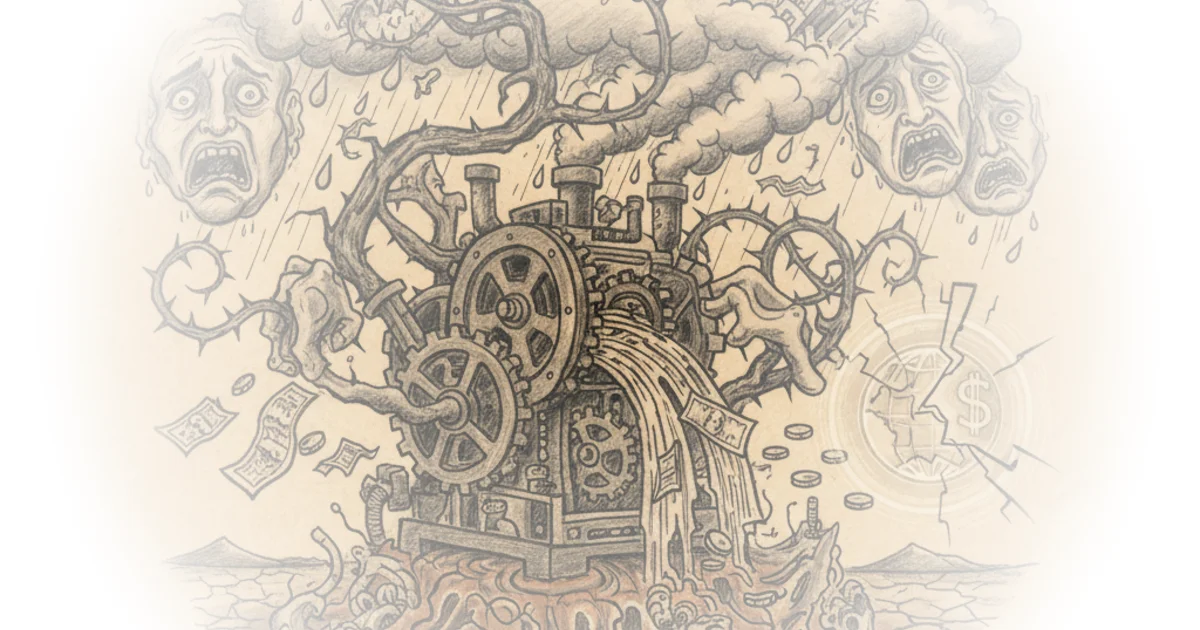
The commentary suggests that the narrative of collapse serves a specific function. Pielke Jr. argues that a "climate-risk industrial complex" has emerged, where the "virtuous veneer of climate advocacy serves to discourage scrutiny and accountability." This is a provocative claim, suggesting that the urgency of the climate crisis is being leveraged to justify rate hikes that benefit corporate balance sheets. The evidence presented—net income nearly doubling year-over-year—supports the idea that the "crisis" is a feature of the business model, not a bug.
Critics might argue that high profits in a single year do not negate long-term structural risks, especially as extreme weather events become more frequent. However, Pielke Jr. counters this by looking at the historical trend of underwriting returns, which show volatility but no downward trajectory indicative of a systemic failure.
"If there is a P/C insurance crisis, it may be in figuring out how to explain its impressive returns at the same time that the climate lobby is telling everyone that the industry is collapsing."
The Mechanics of the Boom
To understand why insurers are so profitable, Pielke Jr. revisits the fundamental economic model of the industry, famously articulated by Warren Buffett. The author explains that insurers operate on a "collect-now, pay-later" model, holding vast sums of money known as "float" which they invest for profit. The core of the argument is that the industry seeks to break even on underwriting and make its money on investments. Pielke Jr. notes, "The time series shows lots of ups and downs, but no trend — by design, as Buffet explained." This historical context, reinforced by data from the Insurance Information Institute, suggests that the current profitability is not an anomaly but a return to a healthy, well-managed state.
The piece effectively uses this economic history to reframe the conversation. Instead of a story about climate-induced insolvency, it becomes a story about capital efficiency. The author writes, "There are certainly no signs of an underwriting crisis, much less indications of a coming collapse. The P/C industry looks both well-managed and healthy." This perspective is vital for investors and policymakers who might otherwise panic over sensationalist reporting. It shifts the focus from existential dread to operational reality.
However, this analysis may underplay the specific regional vulnerabilities where insurers have already withdrawn from markets like Florida and California. While the national aggregate looks strong, the local picture can be far more dire, a nuance that the broad industry data might obscure.
The Model of Uncertainty
The most striking part of Pielke Jr.'s argument is his dissection of the "climate risk" assessment industry. He traces the origin of this sector to a 2015 speech by Mark Carney, then Governor of the Bank of England, who warned that modeled losses could be undervalued by as much as 50%. This warning sparked a regulatory wave, leading to the creation of a new class of vendors promising to model future climate risks. Pielke Jr. writes, "The climate-risk industry was born circa 2019," highlighting how a theoretical concern was rapidly institutionalized.
The author then delivers a devastating critique of these new models. Citing a 2025 study by the Global Association of Risk Professionals (GARP), he reveals that there is "absolutely no consensus across vendors about 'climate risk' in terms of either physical risks or risks of loss." The data shows that for the same property and the same event, different vendors can model total loss or zero loss. Pielke Jr. puts it bluntly: "Risk adverse insurers have incentives to price at the most extreme modeled loss. Model inaccuracies, uncertainties, spread, and ambiguity are features not flaws when it comes to making money."
This is a powerful indictment of the current regulatory and market environment. It suggests that the skyrocketing insurance prices are not a reflection of actual physical risk, but rather a reflection of the chaotic and unverified nature of the models used to justify them. The author notes that "the difference between a modeled 10% loss ratio and a 40% loss ratio... might result in a 10x increase in insurance rates." This creates a perverse incentive where uncertainty becomes a revenue generator.
A counterargument worth considering is that in the face of genuine climate uncertainty, relying on a range of models is a prudent risk management strategy. However, the sheer magnitude of the disagreement between vendors, as highlighted by the GARP study, suggests that the models are currently too unreliable to serve as a sole basis for such drastic price increases.
"Model inaccuracies, uncertainties, spread, and ambiguity are features not flaws when it comes to making money."
The piece concludes by bringing in data from Verisk, a legacy catastrophe modeling firm, which estimates that only about 1% of year-on-year loss increases are attributable to climate change. Pielke Jr. writes, "Such small shifts can easily get lost behind other sources of systematic loss increase discussed in this report, such as inflation and exposure growth." This final point serves to ground the debate in hard numbers, stripping away the hyperbole to reveal that inflation and population growth are likely the primary drivers of higher premiums, not a climate apocalypse.
Bottom Line
Roger Pielke Jr. delivers a compelling, data-driven challenge to the dominant narrative of an insurance collapse, exposing a lucrative boom for the industry fueled by unreliable risk models. While the argument effectively highlights the disconnect between industry profits and doom-mongering headlines, it risks oversimplifying the localized realities of market withdrawals in high-risk zones. The most critical takeaway for the reader is to scrutinize the "science" behind rate hikes, recognizing that in the current climate-risk industrial complex, uncertainty is often monetized rather than managed.