Economics Explained doesn't just explain the 2025 Nobel Prize; they reframe the last two centuries of human prosperity as a fragile anomaly rather than an inevitable trend. The piece argues that the industrial revolution wasn't a simple accumulation of tools, but a specific societal collision between theory and practice that we are now dangerously close to losing. For busy listeners trying to decode the AI revolution, this historical lens offers a stark warning: progress isn't automatic, and the very mechanisms that built our wealth could be the ones that stall it.
The Engineering Without Mechanics
The author challenges the romanticized view of pre-industrial history, noting that innovation was common but stagnation was the rule. "The first misconceptions that this year's Nobel laureates challenged was that technological innovations rarely happened before the industrial revolution," Economics Explained writes. The piece correctly identifies that while ancient empires had inventors, they lacked the scientific framework to iterate. Joel Mochier, the half-prize winner, is credited with showing that pre-industrial societies were stuck in a loop of trial and error. As the author poetically summarizes Mochier's finding: "Before the industrial revolution, it was a world of engineering without mechanics, iron making without metallurgy, farming without soil science."
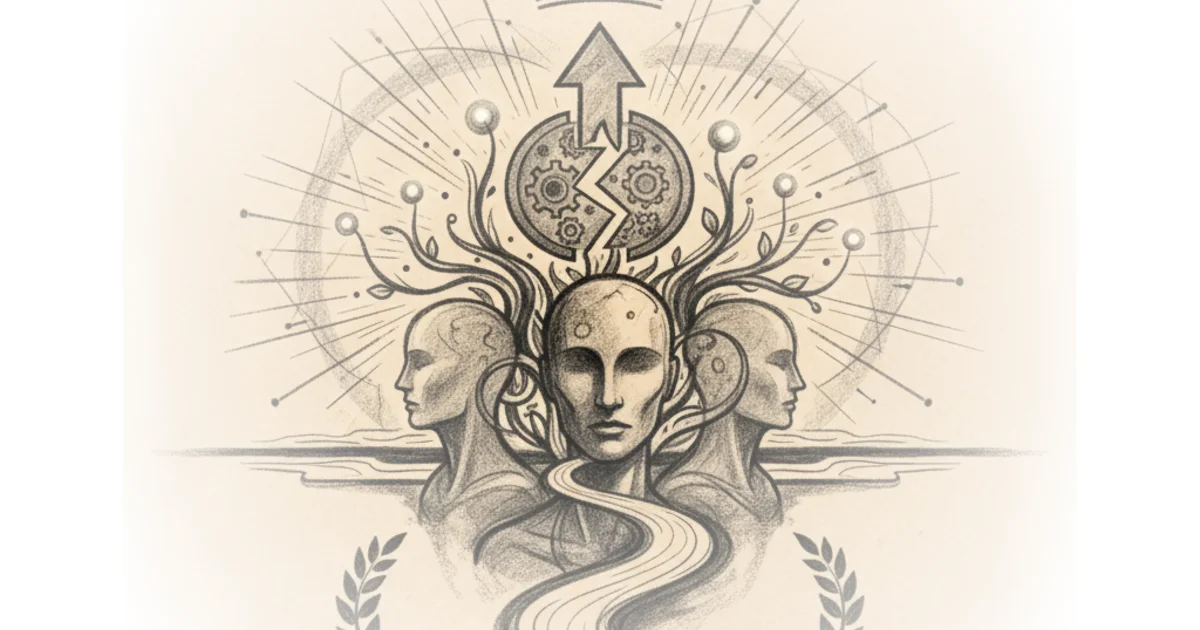
This distinction is crucial. It suggests that having a working tool isn't enough; you need to understand the underlying physics to improve it. The commentary here is sharp: without that theoretical foundation, investing in new technology was as risky as alchemy. "Without a realistic foundation of scientific understanding, investing in a new way to make stronger steels was functionally no different from investing in a new way to turn lead into gold." This lands because it explains why the Industrial Revolution didn't happen in Rome or China, despite their technological sophistication. Critics might note that this view slightly underplays the role of institutional factors like property rights in the pre-industrial era, but the core thesis on the necessity of scientific literacy remains robust.
Sustained economic progress, as it turned out, required more than just a prayer to the machine god.
The Collision of Theory and Practice
The narrative then pivots to the catalyst for change: the Enlightenment. Economics Explained argues that the key wasn't just new ideas, but the social structure that allowed those ideas to mix with labor. "The Enlightenment across Europe in the 1700s brought these two groups closer together and allowed these ideas to actually go back and forth for the first time in history." The author highlights the British apprentice system as a unique vehicle for this, where theoretical knowledge met practical application. This is a compelling reframing of economic history, moving away from the "great man" theory of invention toward a systemic view of knowledge transfer.
The piece then introduces the second half of the prize, awarded to Philip Azion and Peter Howitt, who modeled the mechanics of "creative destruction." The author explains their framework simply: economic growth is the product of the scale of innovation multiplied by the frequency of innovation. "The rate of economic growth was the product of the scale of innovations multiplied by how often those innovations came about." This mathematical grounding gives weight to the idea that growth requires the constant failure of old industries to make room for new ones.
The Innovation Dilemma
Here, the commentary turns to the modern implications, specifically the tension between protecting innovators and preventing monopolies. The author uses Nvidia as a case study for the "carrot" of intellectual property, noting that massive profits are necessary to fund decades of R&D. However, the piece wisely warns that this balance is delicate. "If the market is just insanely cutthroat... nobody would be willing to innovate because there would be no profit motive to do so. Likewise, if companies just collude on price or the market is an uncontestable monopoly, they also won't innovate."
This is the most relevant section for today's listener. The author describes an "inverted U curve" where both total chaos and total stagnation kill growth. The argument is that policy must walk a tightrope: protect enough to incentivize risk, but bust enough to ensure competition. "The solution to maximizing innovation was to create economic policies that made a little bit of market dominance possible through protecting intellectual property, but also avoided too much dominance through trust busting." A counterargument worth considering is whether the current pace of AI development allows for this slow, legislative balancing act, or if the technology is moving too fast for traditional antitrust tools to be effective.
Creative destruction may be the driver of innovation, but if the organizations that are going to be creatively destroyed have any say over it, they're probably going to try their best to stop it.
The AI Crossroads
Finally, the piece connects these historical lessons to the artificial intelligence boom. The author suggests AI could be the ultimate bridge between theory and practice, making complex knowledge accessible to everyone. "An optimistic interpretation of this technology could be that it makes theoretical knowledge even more accessible to average workers, making more advancements possible." Yet, the shadow of creative destruction looms large. The author hints at a darker possibility where the "industry that is potentially getting creatively destroyed are the workers themselves."
This ending is intentionally open-ended, reflecting the uncertainty of the field. It forces the listener to confront the idea that the same forces that created modern wealth could dismantle the labor market that sustains it. The author doesn't offer a solution, but rather a framework for the debate: we must ensure that the new AI-driven economy maintains the conditions for competition and the blending of skills, or risk hitting a new plateau.
Bottom Line
The strongest part of this piece is its refusal to treat economic growth as a natural law, instead presenting it as a fragile social construct that requires constant maintenance. Its biggest vulnerability is the assumption that political systems can adapt quickly enough to manage the disruptive power of AI. Readers should watch for how policymakers attempt to apply the "inverted U curve" of innovation to the tech giants of today, as that will determine whether we enter a new golden age or a new era of stagnation.