A satirical novel set inside a mythical tower's communications department sounds like a gimmick until the second sentence reveals it as something sharper: a dissection of how institutions manufacture consent, hoard privilege, and distract the public with trivialities while the real levers are pulled behind closed doors. PILCROW's serialized fiction uses the ancient architecture of the Tower of Babel to hold up a mirror to modern corporate and governmental bureaucracy — and the reflection is uncomfortably precise.
The Mathematics of Righteousness
The piece opens with a negotiation between the Tower Operating Committee and its Hundred Righteous Men — hostages of a sort, maintained on the payroll as insurance against divine wrath. PILCROW writes, "The fight would come down to the mathematicians against the youngest and dumbest of the Hundred Righteous Men, like it always does." The righteous men occupy an entire floor of the tower, with lavish apartments and panoramic views, yet they arrive at negotiations demanding a second floor, more servants, higher stipends, a shorter workweek, and the right to take third wives.
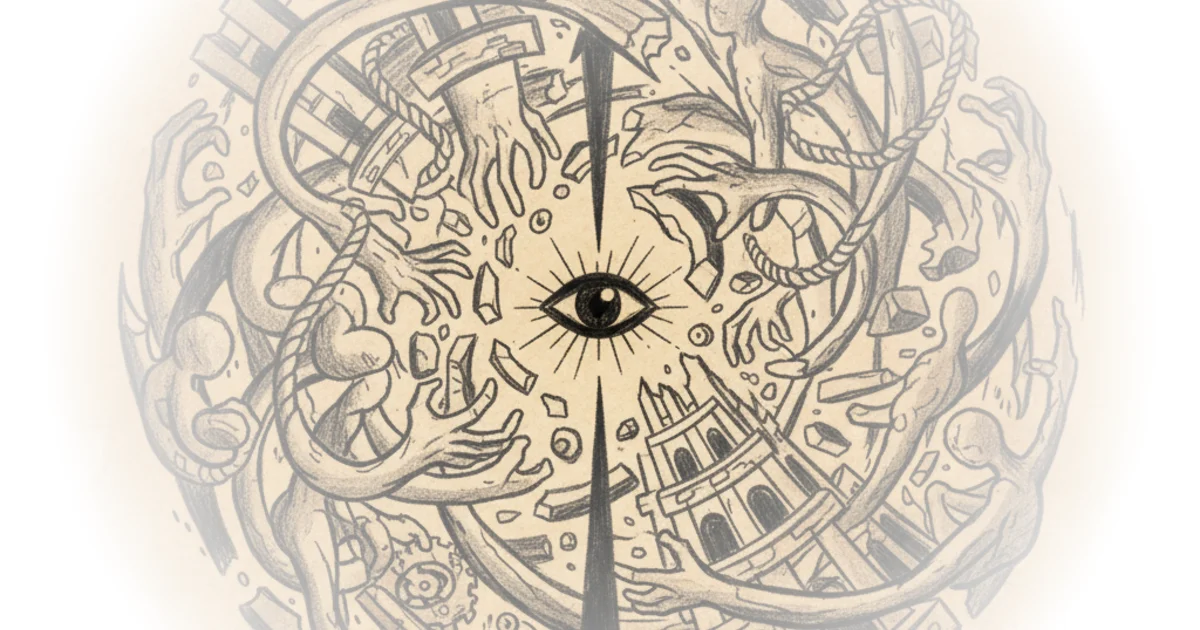
The absurdity is deliberate and precise. To determine "how much luxury can a man enjoy and still be righteous," the tower's priests conduct an inventory so exhaustive it borders on parody: counting corn kernels, weighing newborn ox femurs, measuring elevator transit times, tracking the opacity of furnace smoke. PILCROW writes, "Their calculations took a full year and burned through what was, to my scribe's eyes, a heart-breaking amount of papyrus." The numbers will be final. They will circumscribe the debate. They will change nothing about the underlying arrangement.
The satire lands because the reader recognizes the ritual. Institutions everywhere commission studies to legitimize decisions already made, deploy expert panels to manufacture the appearance of rigor, and use quantitative frameworks to dress up fundamentally political choices. The question of how much privilege the Hundred Righteous Men deserve is not a mathematical question at all. It is a question of power.
"The birds will stick in the mind, leave people with the vivid picture that would take the place of knowing what's going on or thinking of what's at stake."
The Birds
This is the chapter's central insight about communications strategy. When the narrator's mentor Jerr explains how to cover the negotiations, the instruction is candid: make the story about the birds. Hundreds of them — trapped on the righteous men's floor by the terror of height, defecating, squawking, requiring constant cleanup. As PILCROW puts it, "The idea of a floor so high that it scares even birds speaks to the glorious scale of the tower."
Jerr's media strategy is a masterclass in manufactured narrative. The birds are vivid enough to replace substance. They produce a mental image that crowds out any consideration of what the righteous men actually do, how much they cost, or why the tower needs so many of them. "Be sure I made the story long enough that people would forget," Jerr instructs.
The mechanism is familiar to anyone who has watched how institutions manage public attention. A colorful distraction — an animal, a personality clash, a symbolic gesture — absorbs the public imagination while structural arrangements proceed uninterrupted. PILCROW does not need to name any contemporary equivalent. The pattern is self-identifying.
Critics might note that the piece leans heavily on a single satirical conceit — the tower as stand-in for bureaucratic institutions — and that the allegorical distance, while elegant, can also feel safe. There is no direct confrontation with the institutions being satirized, only the comfort of ancient costume.
The Climb
The second half of the chapter tracks the narrator's promotion and his courtship of Clauvia, a Chaldean woman from an old tower family. The title changes — "Associate Executive Managing Vice Nimrod, Divine Compliance, Workplace Piety & Communications" — and the narrator notes that "each promotion improved virtually every aspect of my life. More money, more authority, more people laughed at my jokes."
PILCROW writes, "By this time, I was the funniest guy in my department, just behind the twenty men and women above me." The sentence is devastating in its economy. Humor as a function of hierarchy. Laughter as a performance of deference.
The narrator's marriage to Clauvia is framed not as romance but as another rung on the tower's social ladder. He was there on "rumor patrol" after astronomers spilled blood on the roof of a newly completed level — a detail dropped casually, the way institutional violence is always dropped casually. The tower's One Language policy, the astrological surveillance of the night sky, the "barrel-thick scrolls of tables, numbers, crocodiles, bears" — PILCROW is building a world that feels simultaneously ancient and thoroughly modern in its institutional paranoia.
"Everyone forgets. Everyone does, except management."
Jerr's warning — the one piece of genuine advice he offers — echoes beyond the chapter's setting. The tower's management never forgets who is replaceable. The righteous men can be reshuffled. The support staff is interchangeable. The narrator, for all his ambition, is a functionary who serves at pleasure. PILCROW captures something essential about institutional life: the gap between those who design the system and those who merely inhabit it, climbing floors that were never theirs to own.
The references to Sodom and Gomorrah in the novel's wider architecture — the neighboring cities that boasted about their own moral deficits as tourism come-ons — deepen the satire. PILCROW's tower is not just any bureaucracy. It is a bureaucracy that has internalized catastrophe as a line item, that treats divine judgment as a risk to be hedged, and that believes a sufficiently large organization can negotiate its way out of consequences.
Bottom Line
PILCROW has written something that reads like a corporate training manual filtered through the Book of Genesis — and the result is sharper than most contemporary political fiction because it refuses to name its targets directly. The tower is every tower. The birds are every distraction. The righteous men are every insulated class that convinces itself its comfort is earned. The novel's strength is not in what it says about ancient myth but in what it reveals about the architectures we still live inside.