Most historical accounts of Caesar's assassination focus on the moral grandeur of the conspirators or the immediate political vacuum. Kings and Generals, however, frames the event not as a triumph of liberty, but as a catastrophic miscalculation that instantly destabilized the very order the assassins claimed to save. This narrative is vital for understanding how quickly political violence can spiral when the underlying social contract is ignored, offering a stark lesson on the fragility of institutions.
The Illusion of Restoration
The piece opens by dismantling the conspirators' core justification. "The conspirators had assassinated Caesar supposedly under the impression that by removing a tyrant order and true Republican rule would be restored to Rome if this was their intention then it was horribly misjudged," Kings and Generals writes. This sets a grim tone immediately, suggesting that the assassination was less a surgical strike for democracy and more a blind gamble. The author argues that the immediate aftermath was not peace, but "the last Civil War of the Republican era," a framing that shifts the focus from the morality of the act to its inevitable geopolitical consequences.
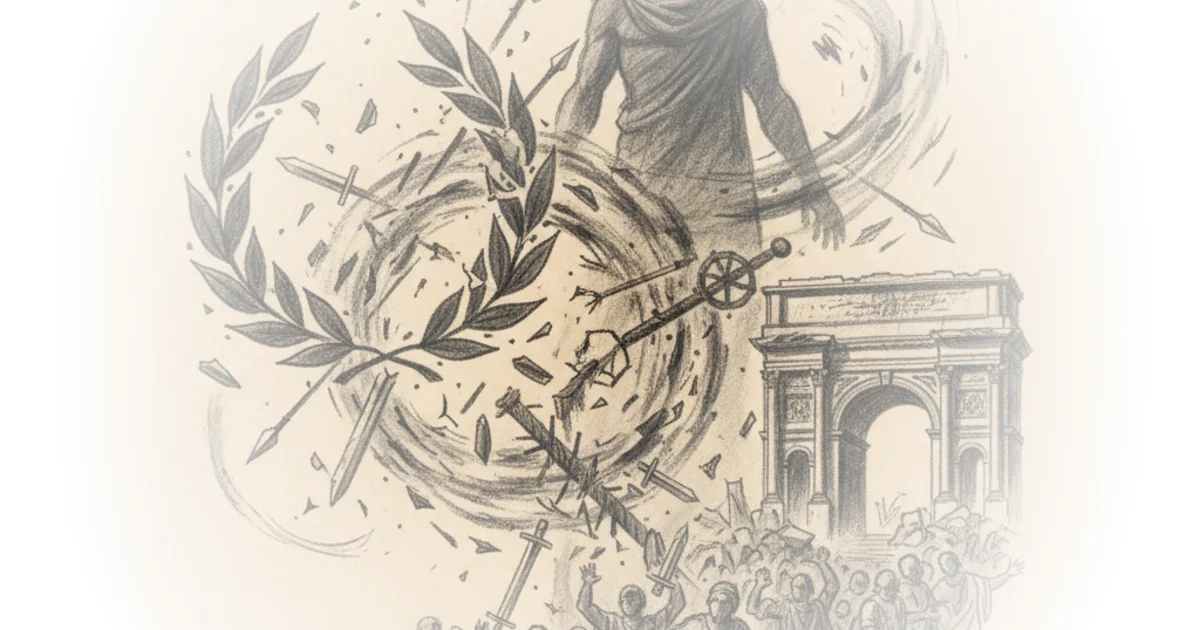
The coverage highlights the chaos in the Senate, where senators, "unaware of who was involved in the plot or who the targets were ran from the Senate fearing for their lives." This detail is crucial; it underscores that the conspirators failed to secure the loyalty of the broader political class, leaving them isolated. As Kings and Generals notes, "all the public saw however was the leaders of government shouting and panicking some covered in blood and others wielding weapons." The visual of blood-stained senators brandishing daggers while proclaiming liberation is a powerful rhetorical device used to illustrate the disconnect between the assassins' self-perception and public reality.
Critics might argue that the conspirators had no choice but to act, given Caesar's accumulating power, but the narrative suggests their failure was one of execution and timing rather than principle. They assumed the Republic would automatically spring back to life once the "tyrant" was gone, ignoring the complex web of patronage and military loyalty Caesar had cultivated.
The Power of the Will and the Mob
The turning point of the narrative arrives with the reading of Caesar's will, a moment Kings and Generals describes with dramatic flair. The conspirators had secured a political compromise, agreeing to ratify Caesar's laws in exchange for their own safety. However, the public reading of the will shattered this fragile peace. "Caesar's body was brought out with the crowd lamenting loudly and the stage was set for Anthony to have arguably his most impressive moment in Roman politics," the author writes.
Mark Antony's manipulation of the crowd is presented as a masterclass in political theater. He didn't just read the laws; he weaponized grief. "Finally he unveiled a wax replica of Caesar with 23 stab wounds at this point the liberators hurry from The Forum and the crowd erupted into chaos," Kings and Generals recounts. This visual of the wax model serves as the emotional pivot of the entire piece, transforming the public from passive observers into an active, violent mob.
With one speech Anthony had turned the public against the liberators and forced them to flee.
The commentary effectively uses this moment to show how quickly public opinion can swing when emotional appeals override political logic. The conspirators had won the Senate but lost the street. The narrative notes that the crowd "rampaged Burning Down the Senate chambers where Caesar had been assassinated and hunting for the liberators throughout the city." This escalation demonstrates that the assassination did not end the conflict; it merely changed the battlefield from the Senate floor to the streets of Rome.
The Rise of a New Power
In the vacuum left by the chaos, the narrative tracks the rapid consolidation of power by Mark Antony and the unexpected emergence of Octavian. While Antony initially tried to balance the Senate and the people, he quickly began "abusing his power" by spending Caesar's fortune and fabricating legislation. Kings and Generals points out that "Anthony effective held as much power as Caesar had done," raising the question of whether the assassination had merely replaced one autocrat with another.
The arrival of Octavian is framed as the final piece of the puzzle. Despite advice to remain a private citizen, "huge crowds flocked to him and V an greeted him as Caesar's son." The author notes that Octavian "immediately accepted the adoption officially changing his name to gas Julius Caesar," a move that instantly legitimized his claim to the Caesarian legacy. This shift is critical: the assassination of a dictator ultimately paved the way for an empire, a paradox that Kings and Generals highlights without needing to moralize.
The narrative suggests that the conspirators' failure was structural. They could kill the man, but they could not kill the system of loyalty and patronage he built. As the text puts it, "by the end of it a man with more power than Caesar could have dreamed of would be leading Rome into a new era the Roman Empire."
Bottom Line
Kings and Generals delivers a compelling analysis of how the assassination of Caesar was a strategic disaster for the Republic, driven by a fundamental misunderstanding of the political landscape. The piece's greatest strength is its focus on the immediate, chaotic consequences rather than the abstract ideals of the conspirators, effectively arguing that the removal of a leader is meaningless without a viable plan for succession. The narrative's vulnerability lies in its heavy reliance on dramatic storytelling, which occasionally overshadows the nuanced legal and diplomatic maneuvers of the Senate, but it remains a vivid and necessary reminder of the dangers of political violence. Readers should watch for how the legacy of this chaos continues to shape the transition from Republic to Empire in the coming chapters of history.