Joeri Schasfoort confronts a paradox that defies standard economic logic: how can a nation simultaneously suffer a crushing property collapse and record-breaking industrial dominance? His analysis cuts through the noise of "China is lying" narratives to reveal a state-engineered pivot that no other major economy has attempted, forcing a reevaluation of what a modern economic crisis actually looks like.
The Myth of the Lie and the Reality of the Bubble
Schasfoort begins by dismantling the most convenient explanation for China's confusing data: fraud. He notes that while skepticism is common, "according to recent research by US Federal Reserve researchers, China appears to be honest about their GDP numbers." This is a crucial pivot; if the numbers aren't fake, the economic reality must be genuinely bizarre. He argues that the traditional "Japanification" model—where a property crash leads to a total stagnation of manufacturing—is only half the story. The author explains that both Japan and China historically used housing bubbles to simulate wealth and boost consumption after their infrastructure building phases slowed. "Rising home prices made both the Japanese and Chinese consumers feel richer, allowing them to spend more freely," Schasfoort writes, noting that this mechanism allowed growth to continue even when productive investment opportunities dried up.
"If one borrower was not trustworthy, the bank can just take the house. After all, it only keeps going up in value."
The commentary here is sharp because it highlights the fragility of this model. When prices fall, the "virtuous cycle" flips into a "doom loop," causing consumers to stop spending and banks to stop lending. In a normal economy, this would crush industrial output. Schasfoort points out that in Japan, "industrial firms stopped investing and lost their edge" because private banks refused to take risks. This sets the stage for China's divergence. Critics might argue that ignoring the social cost of this "doom loop" on households is a dangerous omission, yet Schasfoort's focus remains on the macro-mechanics of why the factories are still humming.
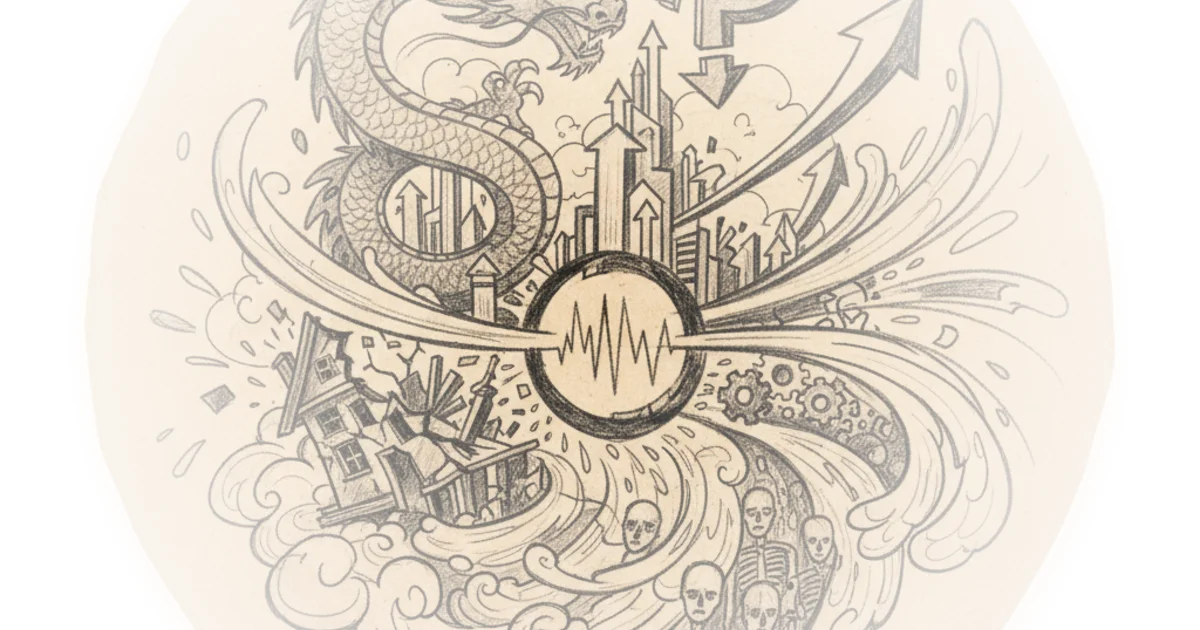
The State as the Ultimate Bank
The core of Schasfoort's argument lies in the unique power of the Chinese state to override market signals. He observes that "China is no normal economy because its state is so much more powerful than in Japan or in the west." When the housing bubble burst, the government did not let the banks retreat; instead, they "ordered its state-owned banks to pivot hard and turn on the lending tabs to industries that it considered essential." This explains the second miracle: a massive lending boom directed specifically at green technology, electric vehicles, and advanced manufacturing, even while domestic consumers are broke.
"This is the key difference with Japan. And in Japan, private banks did not do this because it was far too risky."
This distinction is the piece's most valuable insight. It reframes China's export explosion not as organic market success, but as a state-subsidized flood of capital. Schasfoort argues that "with so much state support, Chinese manufacturers now had a significant edge over foreign firms," leading to an export surge that masks domestic deflation. The author's tone shifts from analytical to cautionary here, noting that this strategy is a "really risky bet." He warns that "Chinese economic growth is now even more dependent on foreigners wanting more and more Chinese products," a vulnerability as the US and other nations like Brazil and India begin to erect trade barriers.
"The Chinese Communist Party itself essentially agrees with me. At least that's what they write. It's not what they do, but it's what they write."
This observation underscores the gap between policy rhetoric and action. While the party officially calls for "high-quality growth" that avoids debt accumulation, Schasfoort points out that the debt-to-GDP ratio is "once again rapidly rising." He calculates that when combining household, corporate, and government debt, China is "now even more indebted than the United States," though still below Japan's peak. The argument suggests that while a collapse isn't imminent, the sustainability of this model is questionable, especially as the working-age population begins to decline.
Bottom Line
Schasfoort's strongest contribution is his refusal to choose between the "booming" and "failing" narratives, instead showing how the Chinese state is forcibly sustaining both through unprecedented financial engineering. The argument's greatest vulnerability is its reliance on the assumption that foreign markets will remain open long enough for this debt-fueled export strategy to pay off. Readers should watch closely for how global trade retaliation accelerates, as that will be the first true stress test of this "second miracle."