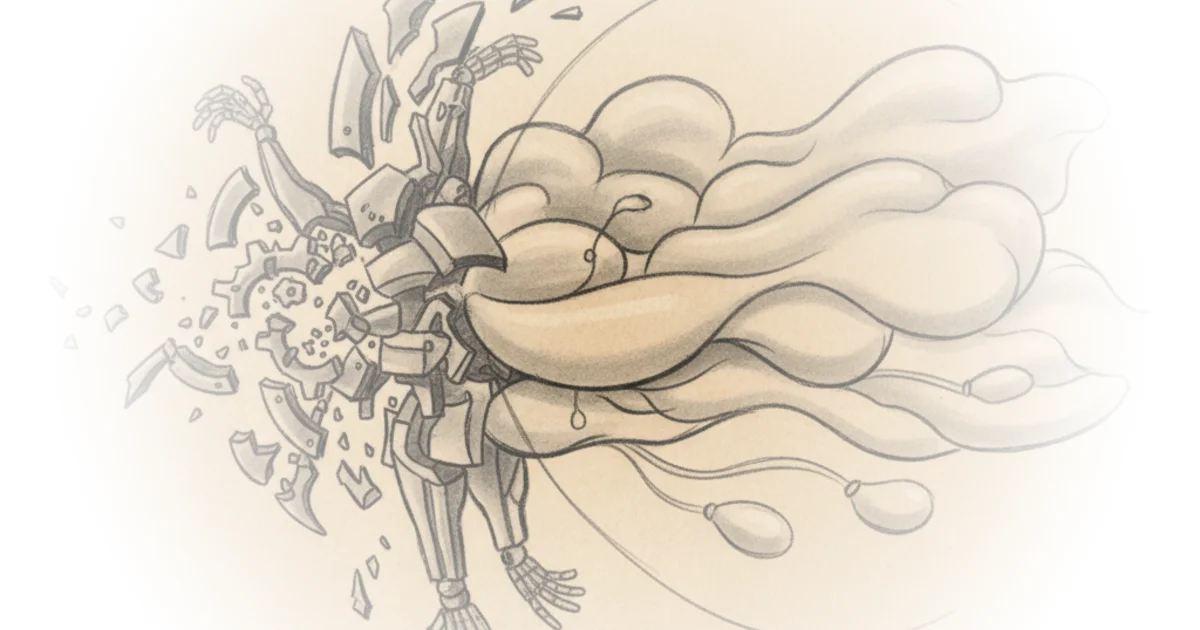
\Derek Muller challenges a deeply ingrained assumption: when people imagine robots, they picture something metallic and humanoid — think Boston Dynamics. But the robots we'll see in our daily lives might look radically different. The core argument is striking: "instead of Sunny from iRobot, no something like Baymax from Big Hero 6 might be closer to what's in our future." This reframes what we expect from machines that share our spaces.
The most compelling evidence comes not from science fiction but from Dr. Elliot Hawks's work on Vine robots — a name derived from the way these devices grow like plants. "This is sort of the backbone of a robot," Hawks explains, "this is what allows us to build our type of robots." The design emerged from an observation as simple as watching a vine slowly grow out toward sunlight in his office over months.
Growing Without Buckling
What makes Vine robots revolutionary isn't their sleek appearance — it's the principle driving them. "Powered by compressed air, they grow from the tip," Muller explains. This allows the robot to pass through tight spaces and over sticky surfaces that would halt a traditional machine. The paradox at work here is remarkable: "you can get a large overall force with low pressure as long as the area is large enough." A tenth of an atmosphere applied over a square meter can lift something as heavy as 1,000 kilograms while remaining soft.
The mechanical intelligence built into these devices is what sets them apart. "It's really neat example of kind of a passive intelligence mechanical intelligence," Hawks says, "where it can find its path even if we don't know exactly the shape beforehand." This isn't science fiction — it's already deployed in archaeology.
These robots are actually really hard to stop so you can take them throw them into a collapse building and they will continue to go somewhere.
From Temples to Patients
The practical applications Muller documents are genuinely surprising. The Vine robot was taken to Peru to investigate shafts built between 1500 and 500 BC in the Andes Mountains — spaces too narrow for humans but accessible to these growing machines. "We were able to successfully use the vine to explore three of the tunnels that couldn't have been seen through other means," Hawks says, and the archaeology team received video inside entire tunnels.
But perhaps more impactful is medical intubation. Traditional procedures require highly trained professionals using an endoscope. "If you can see right now I just got it in to the trachea oh yeah right there," Muller demonstrates after minimal practice. Researchers are hoping miniature Vine robots could make intubation faster and safer — "somebody like me with no training could pretty simply insert this device aim towards the nose." The cadaver lab results show real promise for in-vivo applications.
Why This Matters Now
The argument gains urgency when Muller connects these soft robots to space exploration. "Mars they tried to have a burrowing robot but it got stuck" — specifically, NASA's Mars Insight Mission. Traditional probes relied on friction with the surrounding material, which failed entirely. The Vine robot approach would simply extend its tip through granular media without relying on interaction with what surrounds it.
The broader implication is significant: "non-humanoid robots aren't just safer for us to interact with one of their biggest advantages over traditional robots is that they don't just do things humans already do but better — instead they're specialized to master entirely new abilities often ones that no human can tackle."
Critics might note that focusing on soft robotics as the solution overlooks cases where rigid machines remain superior — certain surgical procedures, manufacturing, and high-precision tasks demand traditional designs. The piece doesn't fully address where soft robots fall short.
Bottom Line
Muller has a persuasive point: our imagination of robots is stuck in science fiction, while real innovation looks radically different. The strongest evidence comes from Dr. Hawks's demonstrations — the intubation capability alone could save lives in emergencies, and archaeology applications show how elegantly these machines solve problems we assumed required human intervention. The biggest vulnerability is practical: soft robotics face manufacturing scalability challenges that rigid designs don't share. But watching a vine robot navigate twisted passageways or lift enormous pressures while feeling soft suggests we've only begun to see what these machines can do.