GWAS Stories delivers a rare and vital correction to the drug discovery playbook: the next great therapeutic breakthroughs may not lie in comparing differences between people, but in mining the profound biological diversity that exists within a single human body. While the industry obsesses over genetic variants across populations, this piece argues that cell-type-specific defenses—like a newly discovered protein that acts as a gatekeeper for the human brain—offer a completely unexplored frontier for treating viral infections.
The Blind Spot in Genetic Research
The article opens by challenging a fundamental assumption in modern medicine. "We human geneticists always go in search of genetic diversity across humans to find drug targets," the piece notes, but then pivots to a startling realization: "there is incredible biological diversity within humans that has been largely unexplored to date." This distinction is not merely semantic; it represents a massive gap in our understanding of how to design effective medicines. By focusing almost exclusively on inter-individual differences, researchers have potentially overlooked the unique, evolution-honed mechanisms that specific tissues, like the brain, have developed to survive.
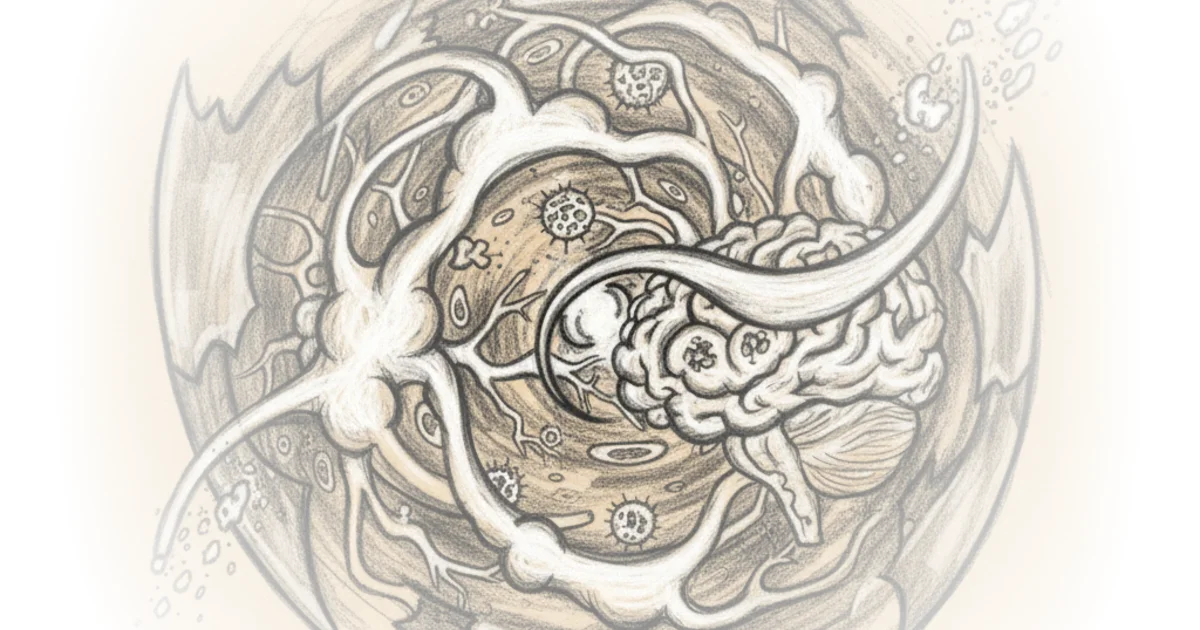
The commentary traces this oversight back to the history of immunology, where mouse models often led the way. The editors point out that for decades, scientists relied on animal studies to understand immune pathways, such as the interferon signaling axis. "Many of those discoveries were in fact driven by prior knowledge of the genes and pathways associated with such diseases," GWAS Stories reports. This reliance on prior knowledge created a feedback loop where researchers only looked for what they already expected to find. However, the piece highlights how human genetics eventually broke this cycle, revealing nuances that animal models missed. For instance, while mouse studies suggested a broad role for the STAT1 protein in fighting viruses, human genetic analysis revealed a more complex reality: "our study of humans shows that IFN-α/β is crucial for protective immunity to viruses in natural conditions of infection." This human-specific insight was critical because it clarified that complete loss of this protein leads to lethal viral susceptibility in ways that partial defects do not.
The search for genetic causes of unexplained infectious diseases has always been guided by prior knowledge... But sometimes, human genetics can surprise scientists by revealing something completely new, something extraordinary, opening the door to a new therapeutic mechanism.
Critics might argue that relying on rare genetic cases—like the two individuals who lacked a specific brain protein—is a fragile foundation for broad drug development. After all, these are extreme outliers. Yet, the piece effectively counters this by showing how these rare "knockouts" act as natural experiments, revealing mechanisms that are otherwise invisible in the general population. The rarity of the defect is precisely what makes the discovery so powerful; it isolates the variable with perfect clarity.
The Brain's Hidden Shield
The core of the new discovery centers on a protein called tomoregulin-1, encoded by the gene TMEFF1. For nearly three decades, scientists knew this protein existed in the brain but had no idea what it did. "Until this year, scientists had little idea what this protein does, except that it is specifically expressed in the brain," the article explains. The breakthrough came when researchers, led by Jean-Laurent Casanova and Yi-Hao Chan, investigated patients with Herpes Simplex Encephalitis (HSE), a rare and devastating condition where the virus invades the brain.
In most people, the brain is a fortress. The piece notes, "brain is extraordinarily protected, thanks to evolution," to the point where even severe systemic immune deficiencies rarely allow herpes to reach the neurons. However, two patients—one a French woman and the other a Turkish man—suffered from severe HSE because they were born without a functional copy of TMEFF1. "Both recovered from HSE after intravenous acyclovir treatment, though not without neurological sequelae," GWAS Stories reports, underscoring the high stakes of this biological vulnerability.
The investigation revealed that TMEFF1 is not just a passive marker but an active soldier. The researchers found that the protein sits on the surface of neurons and physically blocks the virus from entering. "It turned out that you don't even have to express the whole protein, just over expressing part of the protein that protrudes outside the membrane is sufficient to prevent HSV-1 from entering the cells," the piece argues. This finding is revolutionary because it suggests a therapeutic strategy that doesn't require the complex machinery of the immune system to be activated; instead, it relies on a simple physical blockade. The protein works by interfering with the virus's ability to bind to its receptor, NECTIN-1. "So the TMEFF1 protects neurons by interfering with HSV-1 binding to its receptor NECTIN1 to enter inside the cells," the editors summarize.
This mechanism is distinct from all known antiviral pathways. The authors tested whether TMEFF1 worked through standard interferon signaling and found it did not. "It turned out TMEFF1 mechanism is unrelated to any of the known neuron-intrinsic antiviral pathways," the article states. This independence is crucial because it means the protein can function even when other parts of the immune system are compromised or overwhelmed.
A New Paradigm for Drug Design
The implications of this discovery extend far beyond herpes. The piece posits that the existence of TMEFF1 opens the door to a new class of "evolution-validated drug designs." If a protein has been naturally selected over millions of years to protect the brain, mimicking it synthetically could be a potent strategy. "Now we know that TMEFF1 has the ability to restrict HSV-1 entry into the cells, we can create synthetic soluble versions of this protein and use it like a vaccine to prevent HSV1 infection or reactivation," GWAS Stories reports. The editors are optimistic that this approach could work for other strains, including HSV-2, and potentially other neurotropic viruses.
The commentary concludes by reinforcing the central thesis: the key to future breakthroughs lies in looking inward, not just outward. "The main take home for me from this study is that biological diversity between cell types in humans offers a unique opportunity to mine targets," the piece argues. This aligns with other recent findings, such as the discovery of "Big tau" in brain tissues resistant to Alzheimer's, suggesting a broader trend where tissue-specific biology holds the keys to solving complex diseases.
The idea aligns closely with our previous story of Big tau expressed only in brain tissues resistant to neurodegeneration in Alzheimer's disease. I am excited about this emerging new idea of leveraging within individual biological diversity to uncover novel drug targets.
A counterargument worth considering is the difficulty of translating a membrane protein's function into a viable drug. Creating a synthetic version that can effectively cross the blood-brain barrier or mimic the precise interaction of the native protein is a significant engineering challenge. However, the piece's emphasis on the simplicity of the mechanism—blocking a single receptor interaction—suggests that the path to a solution, while difficult, is conceptually clear.
Bottom Line
GWAS Stories makes a compelling case that the future of infectious disease treatment lies in the specialized, cell-type-specific defenses that evolution has already built into our bodies. The strongest part of this argument is the shift from population-level genetics to within-individual biological diversity, a perspective that has been dangerously underutilized. The biggest vulnerability remains the translational gap between identifying a protective protein and engineering a drug that can replicate its function in the clinic, but the discovery of TMEFF1 provides a concrete, high-value target to begin that work.