The Administration at the Pearly Gates
The Bulwark's latest Morning Shots captures a moment where political power, religious rhetoric, and institutional erosion converge. Sarah Longwell, Tim Miller, and Bill Kristol document how the current administration's relationship with evangelical Christianity has evolved into something neither purely political nor purely spiritual—but a transactional arrangement with dangerous consequences for democratic norms.
A Bespoke Soteriology
The piece opens by noting the administration's casual deployment of election conspiracy theories alongside racially charged content. Sarah Longwell, Tim Miller, Bill Kristol write that such posts combine election fraud allegations with racist imagery, observing: "There's no political benefit to this, and there will be no political price. It's just the stuff he likes." The reference to 4G wireless chips in voting machines echoes persistent misinformation about election infrastructure—a claim that resurfaced despite repeated debunking by election security experts.
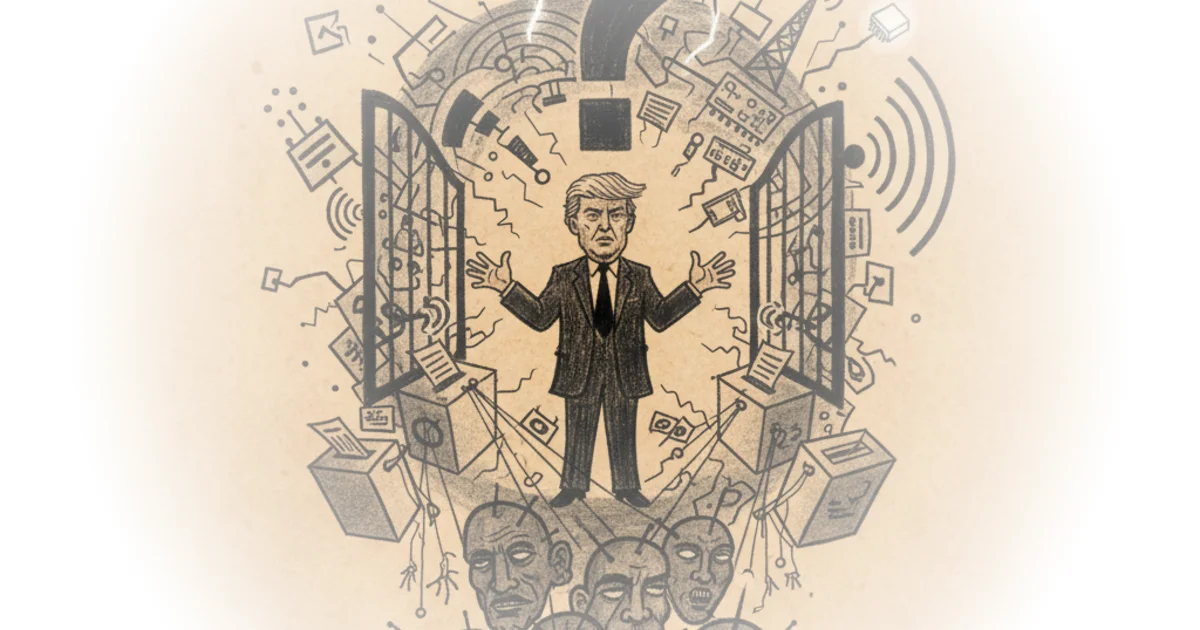
The National Prayer Breakfast becomes the central scene. The authors describe an event where Salvadoran President Nayib Bukele framed his authoritarian policies as divine struggle against gangs, while administration allies offered unrestrained praise. Paula White, a televangelist adviser, called the president "the greatest champion of faith that we have ever had," a man who has "brought religion back to this nation and beyond."
The Moral Accommodation
The most revealing passage captures the president's own theology. Sarah Longwell, Tim Miller, Bill Kristol quote him directly: "I really think I probably should make it... I'm not a perfect candidate, but I did a hell of a lot of good for perfect people." This formulation reveals what the authors call a "bespoke soteriology"—a personalized salvation theory where moral transgressions are offset by political service to the righteous.
The administration's leader draws a sharp boundary between himself and genuinely religious figures like Speaker Mike Johnson. As Sarah Longwell, Tim Miller, Bill Kristol report: "Mike Johnson is a very religious person. He does not hide it. He'll sometimes say to me at lunch, 'Sir, may we pray?' I'll say, 'Excuse me? We're having lunch.'" In this framing, Johnson is inside the church; the president stands outside, unconstrained by moral scruples, performing dirty work that protects believers.
"When Christians come under attack, they know [their attackers] are going to be attacked violently and viciously by President Trump. I know it's not a nice thing to say, but that's the way it is."
This self-conception as Christianity's Punisher—someone who blackens his own soul to protect the righteous—forms the core of what makes this political-religious partnership dangerous. Sarah Longwell, Tim Miller, Bill Kristol argue that MAGA faithful view the political project as "utterly righteous, the work of God on earth against the forces of Satan," yet grant broad license to transgress moral boundaries in pursuing that work. When transgressions occur, believers don't reevaluate the leader's moral standing. Instead, they become "perversely grateful that he's doing it so their hands can be clean."
Critics might note that this framing oversimplifies evangelical political engagement—many religious conservatives maintain robust theological critiques of administration policies while supporting certain judicial or policy outcomes. The authors' characterization risks painting all evangelical political support as morally compromised rather than strategically differentiated.
Don't Forget Epstein
Bill Kristol's section shifts to a different institutional failure: the Epstein files. The headline is direct: "Don't Forget Epstein!" The New York Times recently published documents showing Epstein's pattern of leveraging knowledge about wealthy associates. Epstein wrote to billionaire Leslie Wexner: "You and I had 'gang stuff' for over 15 years," with clear implication that secrets were being held—and could be released.
Sarah Longwell, Tim Miller, Bill Kristol note that the Justice Department has closed its review. Deputy Attorney General Todd Blanche stated prosecutors' review "is over," then added: "The American people need to understand that it isn't a crime to party with Mr. Epstein." When questioned about justice for Epstein's victims, the president told a CNN reporter to smile more and said it was "really time for the country to get onto something else."
The authors make a crucial distinction: the administration's handling of Epstein files is a scandal, but "the collusion and complicity of a swath of America's elite over a quarter century in Epstein's behavior is an even deeper scandal and outrage." They coin a precise phrase: "It would be unfair to say large swathes of American elites are pro-Epstein. But they are effectively anti-anti-Epstein."
Critics might note that the Epstein investigation involved legitimate privacy concerns and that not all associations with Epstein indicate knowledge of criminal activity. The authors' call for continued investigation assumes guilt by association rather than proving specific knowledge.
Schedule F Arrives
A brief but significant note: the administration has finalized rules removing civil-service protections from approximately 50,000 federal employees in "policy-related" roles. These positions will now serve at the president's will, like political appointees. The Office of Personnel Management stated that political patronage and loyalty tests remain prohibited, yet critics question whether trust is warranted.
Sarah Longwell, Tim Miller, Bill Kristol quote Max Stier of the Partnership for Public Service: "Their track record does not justify trust, and our history as a country demonstrates that these kind of changes lead to worse government results, not better." This restructuring—often called Schedule F—represents a fundamental shift in how the federal workforce operates, potentially enabling rapid personnel changes based on political loyalty rather than expertise.
Tulsi's Raid
The administration's story about why Director of National Intelligence Tulsi Gabbard attended an FBI raid on a Georgia election office keeps changing. Initially, the president said he didn't know why she attended. Gabbard wrote to Senate Democrats that the president "specifically directed my observance." Then the president said Attorney General Pam Bondi instructed Gabbard to go. Sarah Longwell, Tim Miller, Bill Kristol note the contradiction: the latest telling "no more aligns with Gabbard's claims than his old one did."
This episode touches directly on election administration integrity—Georgia's Fulton County has been central to election conspiracy theories since 2020. The presence of the intelligence director at an election office raid, regardless of justification, signals federal involvement in local election processes that traditionally remain separate.
Bottom Line
Sarah Longwell, Tim Miller, Bill Kristol document an administration where religious rhetoric serves political power, where elite complicity shields corruption, and where institutional norms dissolve through repeated contradiction. The moral accommodation offered to believers—transgression in service of righteousness—rejects core Christian teaching that sin requires personal accountability regardless of political outcome. The Epstein closure and Schedule F restructuring suggest a pattern: investigations end when inconvenient, and workforce protections vanish when loyalty matters more than expertise.