The Wrecking Ball at Munich
A transatlantic alliance built over eight decades to prevent another world war fractured publicly this past weekend, not on a battlefield but at a conference table in Bavaria. What made the 62nd Munich Security Conference remarkable was not merely the absence of American leadership but the active dismantling of the principles that made such leadership meaningful in the first place.
Present at the Destruction
Heather Cox Richardson anchors her account in the conference's own security report, which delivered a verdict as stark as any wartime cable: "The world has entered a period of wrecking-ball politics. Sweeping destruction—rather than careful reforms and policy corrections—is the order of the day." The Munich Security Conference, founded in 1963 when the Cold War divided the globe into armed camps, was designed to keep democracies talking rather than fighting. The postwar architects believed that representative government, economic interdependence, and international institutions could make large-scale war unthinkable. For more than eighty years, that experiment largely worked.
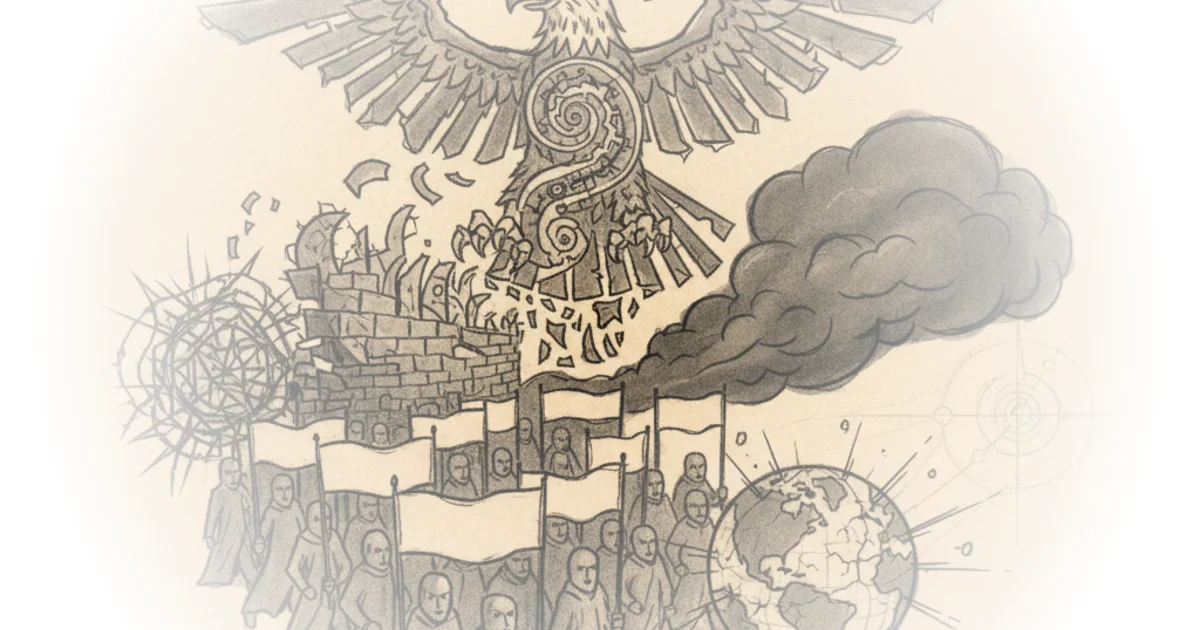
Richardson notes the irony embedded in the conference report's central finding. The same administration promising to restore national greatness is constructing "a world that privileges the rich and powerful, not those who have placed their hopes in wrecking-ball politics." The rhetoric speaks of liberation; the architecture being built concentrates wealth and dissolves the multilateral frameworks that once checked authoritarian power.
"The culture war of the MAGA movement is not ours. Freedom of speech ends here with us when that speech is turned against human dignity and the constitution."
Rubio's Fantasy Past
Secretary of State Marco Rubio took the stage and systematically rejected all three pillars of postwar American foreign policy. Global trade had ruined the economy, he argued. International institutions undermined sovereignty. Climate commitments constituted a "climate cult" imposing "energy policies that are impoverishing our people." But his most elaborate argument concerned migration, which he described as threatening "the cohesion of our societies, the continuity of our culture, and the future of our people."
Richardson dismantles Rubio's invocation of "Western civilization" with surgical precision. His vision of shared heritage — "forged by centuries of shared history, Christian faith, culture, heritage, language, ancestry" — conveniently erased Indigenous Americans who shaped colonial identity, the Spanish and Mexican populations who inhabited the American West for centuries, and Black Americans who were among the first inhabitants of the original colonies. Rubio even cited the Rolling Stones as emblematic of Western civilization while ignoring that the band's entire catalogue was built on the work of Black American blues musicians like Muddy Waters and Howlin' Wolf. Richardson points out that Rubio ignored his own family's 1956 arrival from Cuba, anchoring his heritage instead in eighteenth-century Spain rather than the Latin American migration his administration criminalizes.
Europe Pushes Back
European leaders did not receive the American message quietly. German Chancellor Friedrich Merz warned that the U.S. leadership claim was "being challenged, perhaps already lost," and cautioned that a world of great-power rivalry would leave America "alone and weakened." European Union foreign policy chief Kaja Kallas was more direct, rejecting the premise that Europe faces "civilizational erasure." She noted that nations joining the European Union since the Soviet collapse had grown economically more than twice as fast as Russia — a data point that directly contradicted the administration's case for abandoning democratic partnerships in favor of transactional strongman diplomacy.
Hillary Clinton, speaking from the same stage, put the matter in blunt terms: the current administration "has betrayed the West, he's betrayed human values, he's betrayed the NATO charter, the Atlantic Charter, the Universal Declaration of Human Rights."
An Alternative Vision
Not every American at Munich carried the administration's message. California Governor Gavin Newsom signed a trade memorandum with Ukrainian representatives, demonstrating subnational diplomacy where the federal government had abdicated. Representatives Jason Crow and Alexandria Ocasio-Cortez offered what Richardson presents as the most intellectually honest diagnosis of the crisis: the working-class anger that fueled the current political movement is fundamentally economic, not cultural.
Ocasio-Cortez told the conference: "We can't fall into right-wing populism's lie that the most vulnerable in society are to blame for wealth inequality in our countries. We need to build movements that tell the truth: the story of wealth inequality is not a cultural one, but a class one." Crow characterized the administration's approach as turning foreign policy into "an extortion ring for Big Oil, for the Trump family, for elites."
Critics might note that Democratic counter-messaging at a security conference, however principled, carries no binding authority and risks further confusing America's allies about who actually speaks for the United States. Others could argue that Richardson's framing gives insufficient weight to legitimate grievances about how globalization hollowed out American manufacturing communities — grievances the current administration exploits even as its actual policies enrich the same financial elite that profited from offshoring in the first place.
Bottom Line
The Munich conference exposed what years of diplomatic cable traffic had obscured: the United States is no longer merely stepping back from the international order it built. It is actively arguing against the values that order was designed to protect. Whether Europe can fill that vacuum — or whether the vacuum fills with something far darker — will define the next decade of global politics.