Jeff Rich reframes the entire narrative of the Western Hemisphere, challenging the comfortable myth that the United States developed in isolation from its southern neighbors. By treating the Americas not as two separate stories but as a single, entangled history of rivalry and mutual definition, Rich argues that the modern world was forged in the friction between North and South, not just between Europe and the colonies. This is not merely a revisionist history; it is a necessary correction for understanding the deep roots of current geopolitical fractures.
The Entangled Hemisphere
Rich introduces the work of Yale historian Greg Grandin, whose book America América serves as the anchor for this month's historical inquiry. The core of Rich's commentary is the assertion that we must stop viewing the United States as the sole protagonist of New World history. Instead, Rich highlights Grandin's thesis that "America, América argues that the New World's magpie rivalry, its immanent critique, played a vital role in the creation of the modern world." This reframing is powerful because it dismantles the idea of American exceptionalism, suggesting instead that U.S. institutions and moralities were constantly shaped by their competition with Latin American projects.
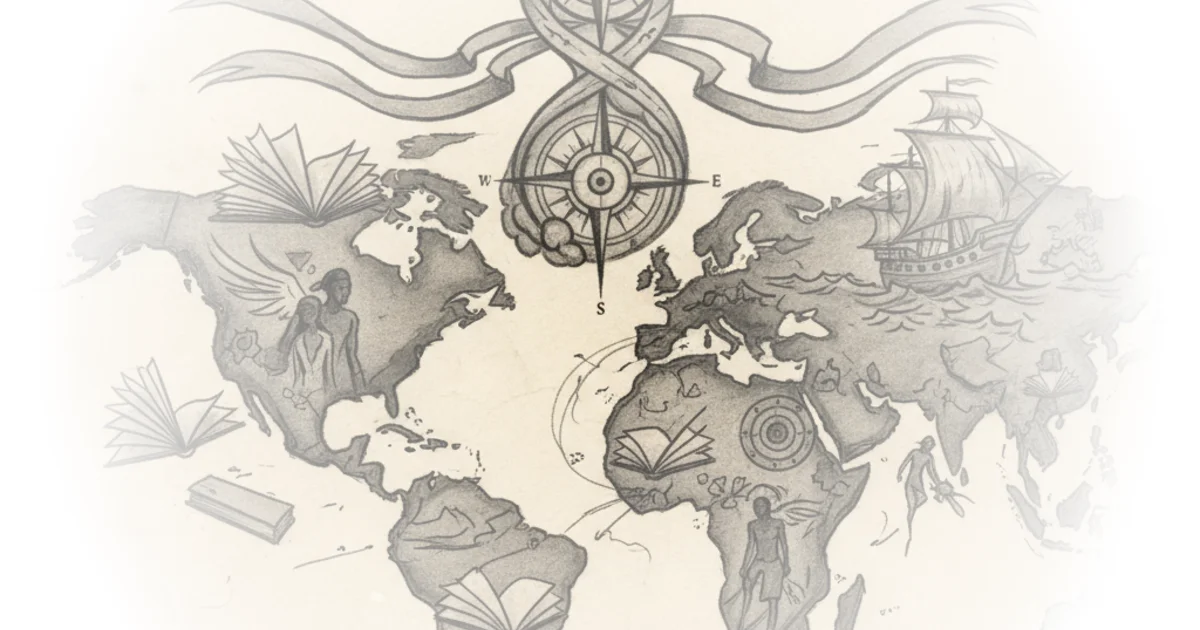
Rich notes that Grandin, who previously served as a consultant to Guatemala's Historical Clarification Commission, brings a unique depth to this analysis. This connection to truth and reconciliation efforts in Central America lends weight to Grandin's treatment of violence and statecraft. Rich writes, "Latin America taught North America as much about international law as the USA used South America as a workshop of imperial covert operations." This reciprocal relationship is often ignored in standard curricula, which tend to focus solely on American expansionism. By emphasizing this two-way street, Rich forces the reader to confront how U.S. foreign policy was not just imposed from above but was a reaction to the political experiments happening in the south.
"If the Conquest inaugurated the 'slow creation of humanity,' we, America, América, seem to be living through its dismantling."
Rich structures the commentary around Grandin's eight-part narrative, moving from the theological debates of the Spanish conquest to the Cold War assassinations that defined the hemisphere's modern trauma. In discussing the early English settlement, Rich points out how Grandin exposes the "fiction of 'empty' land that underwrote settlement." This is a crucial distinction; it moves the conversation from a simple story of discovery to one of calculated dispossession. The argument lands hard because it connects historical legal fictions to the ongoing struggles over land rights and sovereignty today.
The Collision of Ideals
As the timeline moves into the nineteenth and twentieth centuries, Rich focuses on how the Monroe Doctrine was not a static rule but a contested space. Rich explains that Grandin traces how the doctrine was reinterpreted "to justify both U.S. intervention and Latin American claims to reshape international order." This nuance is vital. It shows that Latin American leaders were not passive victims but active participants who used the language of hemispheric solidarity to demand a more egalitarian global system.
Rich draws attention to the assassination of Colombian leader Jorge Eliécer Gaitán in 1948, describing it as the moment when "hemispheric dreams of a more equal 'America/América' collide with a new age of cold, covert war." This event serves as a grim pivot point in the book's narrative, marking the end of a brief era of convergence and the beginning of a violent Cold War. Rich's inclusion of this specific tragedy is effective because it personalizes the geopolitical shift, reminding readers that the "laboratory of the world" was often a testing ground for human suffering.
Critics might note that focusing so heavily on the "rivalry" between the two Americas could obscure the internal divisions within each region. Not all Latin American movements were social democratic, and not all U.S. actors were imperialists. However, Rich's framing remains compelling because it highlights the dominant structural forces that shaped the hemisphere's trajectory, rather than getting lost in the minutiae of every local exception.
The Dismantling of Protocols
The commentary concludes with a sobering look at the present day, where Rich quotes Grandin's observation that "In the 1930s, the best of the Americas converged. Now, the worst, despite efforts by good people in both sides of the border to hold off the eclipse." This stark contrast serves as the emotional climax of the piece. Rich uses this to argue that the suppression of Latin America's democratic traditions has unleashed the "worst military, libertarian and imperial instincts" in the North.
Rich's analysis of the book's structure—fifty brief chapters designed to be accessible without sacrificing depth—suggests that this history is not just for academics but for anyone trying to make sense of current events. Whether discussing the crisis in Venezuela or the resurgence of isolationist rhetoric, the historical context provided by Grandin, as interpreted by Rich, offers a lens that is both sharp and necessary. The connection to Fernando Cervantes' upcoming work on the Conquistadores further enriches this perspective, promising a deeper dive into the origins of the "greatest mortality event in human history" that still echoes today.
"The Protestant settlers who colonized... looked to Spanish America not as an alien other but as a competitor, a contender in an epic struggle to define a set of nominally shared but actually contested ideals."
Bottom Line
Jeff Rich successfully leverages Greg Grandin's scholarship to expose the false boundary between the United States and Latin America, revealing a shared history of violence, law, and ideological struggle. The strongest part of this argument is its ability to recontextualize familiar figures and doctrines as part of a continuous, hemispheric dialogue rather than isolated national events. The biggest vulnerability lies in the sheer scale of the tragedy described; while the historical analysis is rigorous, the emotional weight of the "dismantling of humanity" requires the reader to confront uncomfortable truths about the foundations of modern democracy.