Heather Cox Richardson does something rare in political commentary: she connects a bizarre social media post about a 1950s cowboy to the immediate, terrifying reality of a nation unraveling its own institutions. While others focus on the spectacle of the moment, she reveals the deliberate, decades-long strategy behind the administration's current actions, showing how a fantasy of the frontier is being weaponized to dismantle the modern social contract.
The Frontier Fantasy vs. Federal Reality
Richardson begins by dissecting the administration's recent fixation on Davy Crockett, a figure from a Disney television craze that once sold $300 million in merchandise. The author notes that the President recently posted a video of the theme song, claiming Crockett would be proud of Representative Jasmine Crockett, despite no evidence of a familial link. "It feels frighteningly appropriate for a 1950s television western to seem more important to Trump right now than the real world of April 2026 does," Richardson writes. This observation is not merely a critique of taste; it is an indictment of a political worldview that prioritizes myth over governance.
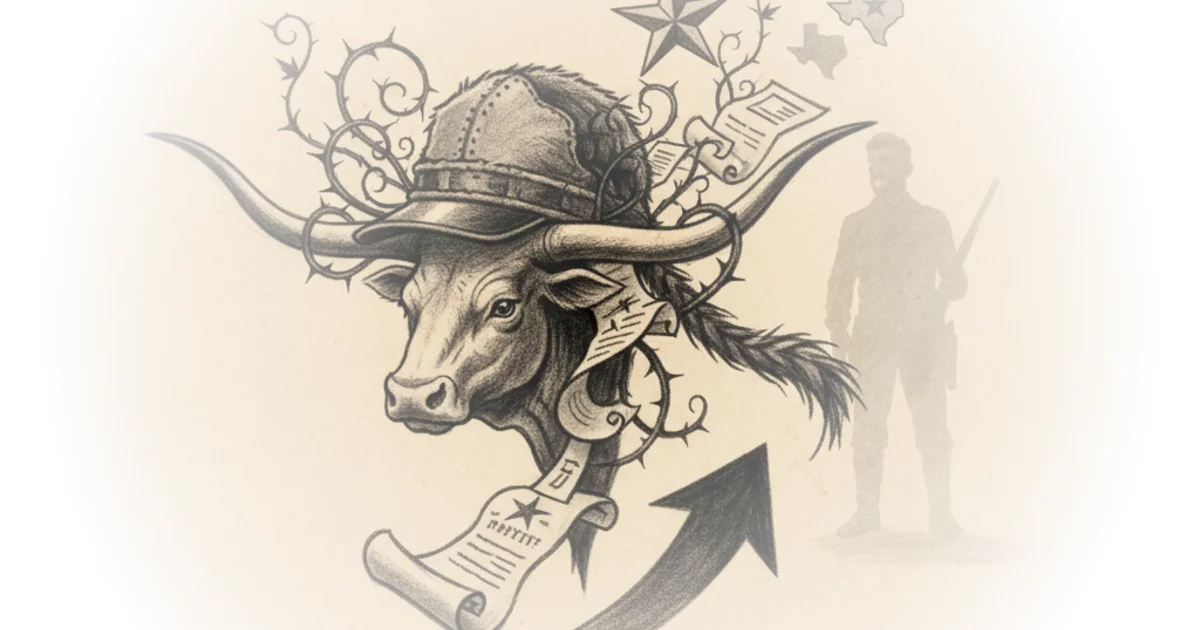
The piece argues that this obsession is not accidental but ideological. Richardson explains that the "western hero" narrative was cultivated in the 1950s and 60s by those seeking to dismantle the New Deal consensus. She draws a direct line to Barry Goldwater's 1960 book, The Conscience of a Conservative, which argued that the Constitution was designed to prevent "the tyranny of the masses." Richardson points out the irony that Goldwater, who wore a cowboy hat, grew up with a live-in maid and a chauffeur, yet championed a fantasy of the independent white man who wanted nothing from the government.
"Trump is trying to bring to life a right-wing political fantasy of the 1950s, and Americans in the present are making clear they reject it."
This framing is powerful because it contextualizes current policy shifts not as spontaneous reactions, but as the fulfillment of a long-held agenda. The administration's recent comments on daycare and Medicaid, where the President insisted these responsibilities must be shifted to the states because the federal government "can't take care of" them, echo Goldwater's argument that federal action destroys liberty. Critics might argue that states' rights are a legitimate constitutional debate, but Richardson effectively counters this by highlighting the administration's simultaneous demand for a massive military buildup, revealing a preference for concentrated power in the executive branch while offloading social costs to the states.
The Machinery of Exclusion
The commentary shifts sharply from rhetoric to the brutal reality of enforcement. Richardson details how the administration has institutionalized the "cowboy individualism" narrative through the Department of Homeland Security. She cites a recent analysis by Wired journalists revealing that the agency has deployed special units, accustomed to high-risk manhunts, for civilian immigration sweeps. These agents, part of the Border Patrol Tactical Unit, are described as "the most violent of the hundreds of federal agents deployed to Chicago."
The author does not shy away from the human cost. She recounts the death of Nurul Amin Shah Alam, a visually impaired Rohingya refugee found dead after being dropped off in a parking lot by Border Patrol agents, a death the medical examiner ruled a homicide. When a DHS spokesperson dismissed the ruling as a "hoax," Richardson uses the moment to illustrate the administration's detachment from accountability. "Racism was central to the rhetoric of cowboy individualism, and the institutionalization of that racism in the mass deportations and incarcerations of the Department of Homeland Security under Trump has created a backlash," she writes.
The evidence presented here—specifically the use of military-grade tactics against civilians and the dismissal of homicide rulings—suggests a system operating outside traditional norms of law enforcement. A counterargument might suggest that border security requires aggressive tactics, but the specific details of the "courtesy ride" that led to a death and the use of force guidelines rewritten by a former tactical unit member undermine the claim of standard procedure. The administration's refusal to acknowledge these failures, instead labeling them as media fabrications, deepens the crisis of trust.
The Concentration of Power and the War Machine
Perhaps the most alarming section of the piece addresses the administration's attempt to consolidate power within the presidency. Richardson highlights a new legal opinion from the Office of Legal Counsel, authored by Assistant Attorney General T. Elliot Gaiser, which claims the Presidential Records Act is unconstitutional. The memo argues that the act "unconstitutionally intrudes on the independence and autonomy of the President." Richardson connects this legal maneuver to the broader strategy of insulating the executive branch from congressional oversight.
This legal theory is put to the test in the administration's handling of foreign policy. Richardson describes a recent address on the war in Iran where the President, speaking in a monotone, claimed the conflict was nearly over while simultaneously announcing an intensification of operations. The result was immediate market panic, with stock futures erasing $550 billion in value in 25 minutes. "What the hell did he just say?" one Republican strategist texted, calling the speech "nonsense."
"Yesterday evening, Trump commandeered time from television networks to deliver what officials billed as a major announcement on the Iran war. But rather than announce anything new... Trump rambled for 19 minutes."
The fallout extends to the military itself. Richardson details the firing of Army Chief of Staff General Randy George by Defense Secretary Pete Hegseth, an act driven by George's refusal to remove officers from a promotion list at Hegseth's insistence. This move, alongside the removal of other senior leaders, signals a shift toward a military leadership that is loyal to the administration's personal vision rather than professional military judgment. The administration's attempt to bypass Congress on the war and its purging of the Army's top leadership suggest a government operating on a different set of rules than the one established by the Constitution.
Bottom Line
Richardson's strongest argument is her ability to weave a 70-year-old ideological project into the chaotic events of a single week, showing that the current administration's actions are not random but part of a coherent, if dangerous, vision. Her biggest vulnerability is the sheer density of the crisis she describes; the sheer volume of simultaneous failures—from the Iran war to the firing of the Attorney General—risks overwhelming the reader's ability to process the systemic nature of the collapse. The most critical thing to watch next is whether Congress will finally assert its authority or if the administration's legal theories on presidential power will become the new normal. The fantasy of the frontier is colliding with the reality of a modern state, and the wreckage is just beginning to show.