Choral Music as a Window into Civilization
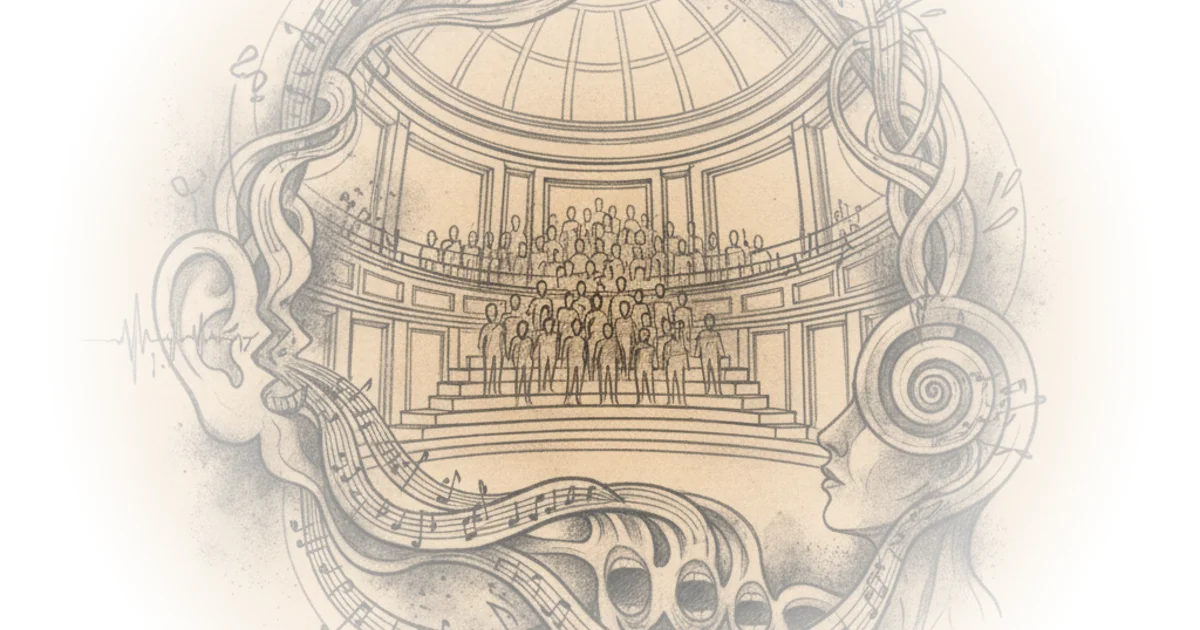
Tyler Cowen, the economist and cultural commentator, sits down on the Tetragrammaton podcast to do something unusual for a public intellectual: walk through a mixtape. Not of pop songs or jazz standards, but of choral music spanning eight centuries, from the medieval polyphony of Perotin at Notre-Dame to Caroline Shaw's 2014 Partita for Eight Voices. The conversation is a guided tour through Western civilization told entirely through the human voice, and Cowen's thesis is sharper than it first appears.
I think if you study choral music, and I mean now 20th century choral music, you will understand the 20th century artistically and historically in very different terms. So we often think of the 20th century as a pretty secular century or a secularizing century. But so many of the top composers were deeply religious or they were into religious music and religious ideas.
This is Cowen at his most characteristic -- taking a widely held assumption (the twentieth century was secular) and flipping it using evidence most people have never encountered. The argument gains force precisely because it is delivered not through data or footnotes but through listening. Each piece he plays becomes an exhibit in a case that the spiritual and the artistic remained deeply entangled long after the Enlightenment supposedly separated them.
Finland as a Case Study in Cultural Production
The conversation anchors itself in Finland, and for good reason. Cowen describes a country where the boundary between professional and amateur singer barely exists, where communal music-making is woven into daily life, and where classical music retains a cultural centrality that has largely vanished elsewhere in the West.
Finland is a somewhat culturally collectivistic place. People do things together. I think on average it makes them happier. For my tastes it makes them a bit too socialistic. But forget about that.
That throwaway qualifier -- "for my tastes it makes them a bit too socialistic" -- is revealing. Cowen, a libertarian-leaning economist, readily concedes that Finland's collectivism produces better choral music and possibly happier people, then waves his own ideological objection aside. The music matters more than the politics. It is a rare moment of an intellectual letting aesthetic evidence override doctrinal preference.
The Finnish choral tradition, he argues, reflects the country's Lutheran sobriety: stripped down, serious, demanding of attention. Their churches are plain, their temperament reserved, and the music mirrors both. Cowen contrasts this with the more jubilant Catholic traditions of southern Europe without declaring either superior -- a restraint that serves the conversation well.
The Franco-Flemish Revolution
One of the most striking threads in the discussion is the historical geography of choral music. Cowen traces the origins of polyphony -- the technique of weaving multiple independent vocal lines together -- to medieval northern France and the Franco-Flemish region. This is not merely a footnote about music history. Cowen treats it as evidence of civilizational recovery.
Those churches to this day are among mankind's most beautiful creations. Many are quite intact and the music is incredible and that this all happened at once coming out of the dark ages, just this amazing power of how the world can change and for the better.
The host draws a parallel to the discovery of perspective in painting, calling polyphony a "revolutionary shift" that "makes everything else possible." Cowen agrees. The implication is that certain technical innovations -- in art, in architecture, in music -- are not mere stylistic developments but markers of something deeper: a civilization gathering confidence and complexity.
A counterpoint worth raising: attributing civilizational health to specific artistic innovations can veer into post hoc reasoning. Northern France in the twelfth and thirteenth centuries also saw the Albigensian Crusade, feudal warfare, and widespread serfdom. Great art and great suffering coexisted, as they usually do. The choral tradition emerged not from some pure cultural flowering but from an institutional church that wielded enormous economic and political power. Cowen acknowledges this when discussing Palestrina's constraints under the Council of Trent, but the larger narrative sometimes smooths over how much of this music was produced under coercion as much as inspiration.
The Secular-Sacred Divide Is Messier Than It Looks
Cowen's discussion of Arnold Schoenberg's choral work complicates his own thesis in productive ways. Schoenberg's "Kol Nidre" is deeply Jewish but, as Cowen notes, not obviously theological. It is cultural rather than spiritual, a historical meditation on suffering rather than a prayer.
I don't know whether he believed in God. He identified with being Jewish very strongly. So spiritual and cultural, I'm not sure they're truly theological at all. And to me, they don't sound theological, they sound cultural.
This complicates the claim that choral music reveals the twentieth century's hidden religiosity. Schoenberg's work is religious in form but arguably secular in substance -- a composer using sacred structures to process historical trauma. The same could be said of Janacek's Glagolitic Mass, which Cowen calls "maybe the greatest choral work of the 20th century." It was a statement of Czech nationalism as much as faith, written in the political upheaval following World War One.
The tension between sacred form and secular purpose runs through much of the repertoire Cowen presents. Poulenc composed his "Figure Humaine" under German occupation; Britten wrote Christmas carols during the Blitz. These works use religious templates to process very worldly crises. Whether that makes the century more religious or simply shows composers reaching for the most powerful emotional tools available is a question the conversation raises without fully resolving.
AI as Music Companion
A brief but notable moment arrives when Cowen describes using large language models to deepen his listening. He asks AI what to listen for in a piece, what historical context surrounds it, what the Latin or Finnish or Czech text means. He reports that it improves the experience every time.
Every time it makes it much better.
This is a practical endorsement that cuts against the anxiety surrounding AI and the arts. Cowen is not describing AI as a replacement for aesthetic experience but as a preparation for it -- the equivalent of reading program notes before a concert, but faster, more personalized, and always available. His example of learning that Poulenc's choral cycle was written in 1943 under German occupation, and that its final movement is simply titled "Liberty," illustrates how context transforms listening from passive reception into active interpretation.
What Is Lost When Music Leaves the Church
Cowen floats a provocative hypothesis near the beginning of the conversation: that secularization may explain why there is less "truly great classical music today." The argument is not that religious belief is necessary for musical genius, but that the institutional and communal structures the church provided -- patronage, shared texts, regular performance contexts, audiences trained from childhood -- created conditions uniquely favorable to a certain kind of composition.
There is something to this. Caroline Shaw and Kali Malone, the two living composers Cowen highlights most enthusiastically, both work heavily with sacred forms and performance spaces. Shaw's Partita draws on Renaissance polyphony. Malone tours the world's great church organs. The sacred infrastructure continues to shape even deliberately contemporary work. But a counterargument is equally available: the twentieth and twenty-first centuries have produced extraordinary choral music outside religious contexts entirely. Ligeti, Reich, Laurie Anderson, and Meredith Monk -- whom the conversation briefly touches -- demonstrate that the human voice in concert can generate transcendence without theology.
Bottom Line
Cowen's choral mixtape works because it treats music not as illustration but as argument. Each piece builds a case that the human voice, organized into collective expression, reveals things about a civilization that its politics, economics, and philosophy cannot. The conversation is at its best when Cowen lets the music complicate his own claims -- when Schoenberg's Jewishness is cultural rather than theological, when Janacek's mass is nationalist rather than devotional, when the line between sacred and secular blurs rather than sharpens. The weakest moments come when the narrative smooths too neatly, suggesting that great choral music flows naturally from religious commitment rather than from the more tangled interplay of patronage, politics, technical innovation, and individual genius. But as a two-hour argument for paying serious attention to an underappreciated art form, it is persuasive, well-curated, and frequently moving.