The Metropolitan Review offers a rare, unvarnished excavation of Jim Harrison's life, stripping away the myth of the "macho" outdoorsman to reveal a man haunted by grief, plagued by illness, and driven by a desperate, almost violent need to create. This is not a hagiography for the literary elite; it is a portrait of a writer who found meaning in the "dying of elk" and the "savor of food" while his body slowly failed him. For the busy listener, the piece's greatest value lies in its refusal to let Harrison's excesses define him, instead framing his life as a relentless, often tragic, struggle against mortality.
The Appetite and the Cost
The author begins by dismantling the easy label of Harrison as merely a man of "enormous appetites." While the New York Times' Dwight Garner called him "our poet laureate of lumbering desire," the Review argues that Todd Goddard's biography, Devouring Time, probes deeper into the source of that hunger. The text notes that Harrison was "deeply sentimental and disarmingly cerebral, but never didactic," finding his metaphysics in the physical world rather than abstract theory. This framing is crucial because it shifts the reader's focus from Harrison's lifestyle to his artistic engine. The Review writes, "He grappled with metaphysical questions though he resisted abstractions; he found meaning in the dying of elk, winter rivers, and the savor of food." This distinction matters: it suggests Harrison's work was not an escape from reality, but a fierce engagement with it.
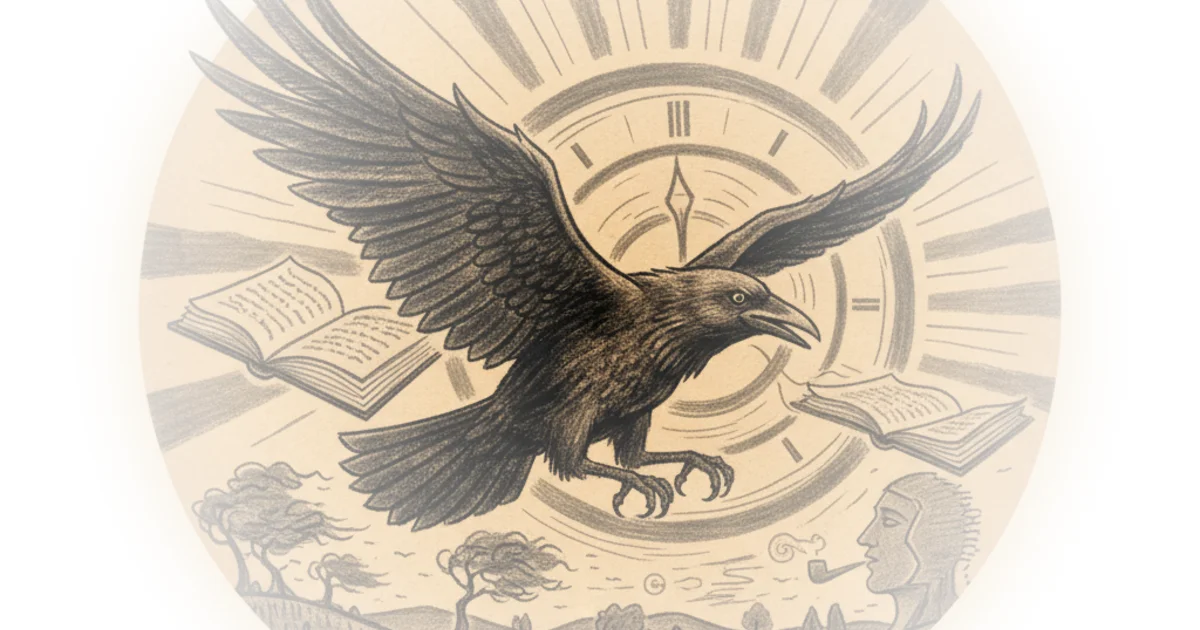
The biography also confronts the darker undercurrents of Harrison's relationships, particularly his marriage to Linda King. The Review points out that while Harrison wrote voluminously about everything, he wrote almost nothing about her, a silence she preferred. Yet, Goddard reveals a profound dependency between them. "When times were lean — as they were until middle age — his inadequacy as a family provider weighed heavily upon him, a source of guilt and shame," the Review observes. This adds a layer of human complexity often missing from profiles of "wild" writers. Critics might argue that focusing on his financial struggles and marital distance softens the edge of his rebellious persona, but the Review insists this vulnerability is essential to understanding his drive.
"Suicide. Beauty takes my courage away / this cold autumn evening. My year-old daughter's red robe / hangs from the doorknob shouting Stop."
The Tragedy That Forged the Voice
The narrative pivots sharply to the 1962 tragedy where a drunk driver killed Harrison's father and sister. The Review highlights a chilling detail often omitted from celebratory accounts: Harrison's decision to view the "brutally mangled bodies" of his loved ones in a police photo. This act of confronting the grotesque reality of death became a catalyst for his writing. "You can see it in my first book, Plain Song," Harrison remarked, "If people die then you better get down to business." The Review uses this to argue that Harrison's famous "lumbering desire" was, in part, a frantic attempt to outrun the void left by his family's sudden absence.
This section of the coverage effectively contextualizes Harrison's later success. The Review notes that his breakthrough, Legends of the Fall, was financially underwritten by Jack Nicholson, a connection that brought him fame but also the "macho" label he despised. "The book's success marked a tremendous change in Jim's life," Goddard says, "more tied to Hollywood, screenwriting, cocaine, movie stars, and especially money." The Review astutely notes the irony that Harrison's most famous work cemented a reputation he actively fought against, writing about fishing and hunting not as a display of masculinity, but as a reflection of his upbringing. "Why is that macho?" he groused. This rhetorical question serves as a powerful critique of how the literary establishment categorizes regional voices.
The Decline and the Final Draft
As the piece moves toward Harrison's later years, the tone shifts from admiration to a sobering assessment of physical decay. The Review does not shy away from the grim reality of Harrison's ailments: diabetes, gout, kidney stones, and the loss of his mobility. Goddard's "acute descriptions of his ailments... should give pause to anyone prone to romanticizing his unruly modes of excess," the Review writes. This is a vital corrective to the romantic image of the writer in the wilderness. Harrison's own words capture this shift in perspective: "My work piles up, I falter with disease. Time rushes toward me — it has no brakes. Still, the radishes are good this year. Run them through butter, add a little salt."
The Review also touches on the cultural disconnect Harrison faced in America versus his adoration in France, where he was hailed as "le Mozart des grandes plaines." This contrast highlights the narrowness of the American literary establishment, which failed to nominate him for major awards despite his prolific output. The Review suggests this was because his focus on the "American hinterland" was too distant from coastal tastes. This observation invites the reader to question whose stories get elevated and why.
The essay concludes with a personal anecdote from the author, recounting a trip to Key West thirty years prior where Harrison "stole" the author's date. The story serves as a microcosm of Harrison's charisma and his ability to command attention, even as he was aging and using a cane. The author recalls waiting at Sloppy Joe's, only to learn the woman had boarded Jimmy Buffet's yacht with Harrison. The Review notes that Harrison was 58 then, but "seemed older," a detail that underscores the physical toll his lifestyle had taken. This personal touch grounds the biography, reminding us that behind the legend was a man who could be both magnetic and devastatingly self-absorbed.
"I'd rather sell my kidneys to a republican," he wrote to a friend.
Bottom Line
The Metropolitan Review succeeds in presenting Jim Harrison not as a static icon of American letters, but as a flawed, suffering, and fiercely alive human being whose work was inextricably linked to his pain. The strongest part of this argument is its refusal to separate the art from the cost, showing how Harrison's "ravenous" nature was both his creative fuel and his physical undoing. The piece's biggest vulnerability is its reliance on the biography's narrative arc, which may smooth over some of the more contradictory aspects of Harrison's later behavior, but the overall verdict remains clear: Harrison's legacy is one of radical honesty in the face of a dying world.