John Pistelli offers a rare intellectual sanctuary in an era of fragmented attention, arguing that the most potent defense against modern paranoia is not political maneuvering but a "pronoid reading" of our cultural canon. Rather than viewing literature as a tool of control, he posits that artists from Aeschylus to Toni Morrison have been quietly conspiring to liberate the human spirit through imagination and myth. This is not merely a book review; it is a manifesto for how we read, suggesting that the "Black Iron Prison" of our current anxieties can only be unlocked by recognizing the divine frenzy embedded in the stories we tell.
The Architecture of Narrative
Pistelli begins by dismantling the rigid boundaries of literary criticism, celebrating the fluidity of perspective that defines the greatest works of fiction. He champions the metafictional complexity of Don Quixote and the revolutionary "free indirect style" of Jane Austen, but his most striking insight concerns the reliability of the narrator itself. "Everyone has imitated but no one has outdone Don Quixote's use of first or third person in its intricate metafictional metatextual labyrinth," he writes, noting how these techniques allow characters to escape the ironies of their creators. This framing is effective because it shifts the reader's focus from the author's intent to the text's autonomous power, a concept that resonates deeply with the history of Greco-Buddhist art where the seated Maitreya of the 2nd century embodies a consciousness that transcends the sculptor's hand.
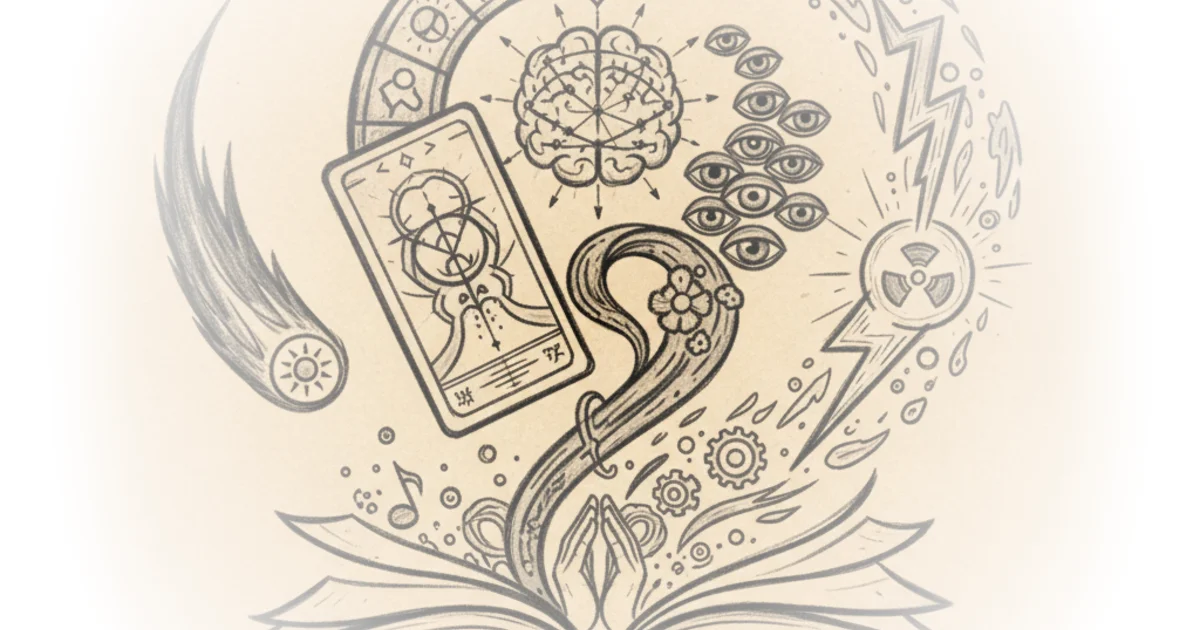
He extends this analysis to Toni Morrison's Paradise, describing it as a "neglected neo-/late-/post-modernist revisionist-Biblical dystopic-utopian magical-realist fairy-tale masterpiece." The core of his argument is that Morrison's work promotes a "syncretic gnostic-infused non-dualistic neo-Christianity presided over by a Black Madonna," a radical reimagining of spiritual authority. This lands powerfully because it reframes a novel often analyzed through purely sociological lenses as a metaphysical intervention. However, critics might note that such esoteric readings risk alienating readers who seek more grounded historical analysis, potentially obscuring the specific racial and gendered politics Morrison so carefully constructed.
"Who's really narrating Major Arcana, for example?"
The Dream of Reality
The commentary pivots to the intersection of film, psychology, and conspiracy theory, using Stanley Kubrick's Eyes Wide Shut as a case study. Pistelli challenges the popular "parapolitical" reading of the film, which often reduces it to a mere exposé of elite cabals. Instead, he argues that the film is a "portrait of paranoid interiority," a "Decadent salute from the 20th century's fin de siècle to the 19th's." He observes that "everything unfolds as if in a dream; every scene bathes in the oneiric night-light we experience only while asleep," suggesting that the conspiracy depicted is not just social but metaphysical. This distinction is crucial; it moves the discussion from the tangible dangers of real-world power structures to the internal landscape of fear, a shift that feels necessary in a time when external threats often feel overwhelming.
He connects this cinematic dream logic to the broader cultural moment, noting that the "conspiracy isn't just social; it's metaphysical, going all the way up and down." By linking Kubrick's avoidance of physicians to a broader "iatrophobic aversion" among the artistic set, Pistelli draws a line between the fear of the body and the fear of the state. This is a bold move, connecting the personal anxieties of the artist to the collective paranoia of the public. Yet, one must ask if this metaphysical framing inadvertently minimizes the very real, material consequences of the "expert class" and the institutions they represent, which often fail the vulnerable in ways that have nothing to do with dream logic.
The Politics of Belief
Pistelli tackles the dangerous spiral of modern populism and the rejection of expertise, warning that the revolt against the "expert class" often devolves into a "pogrom-structure of instrumentalized blame and resentment." He invokes the old adage that "anti-Semitism is the socialism of fools," using it to argue that "as long as you're slaughtering the kulaks and not the Jews, you're fine," the underlying mechanism of tyranny remains unchanged. This is the piece's most urgent political point: that the materialist dialectic of "counting and killing them first" to achieve utopia is a fatal error. He writes, "no matter how many bodies we pile up, if we don't alter both soul and structure, starting with our own, we will end up back where we started in The Revolution's customary 360-degree turn from tyranny to tyranny."
This argument is bolstered by a historical deep dive into Romanticism, which Pistelli presents not as a retreat from reason but as a "Platonic fulfillment of Enlightenment." He cites the System-Fragment's call for a "monotheism of the reason and the heart, polytheism of art and the imagination," suggesting that the separation of intellect and imagination is a modern pathology. This connects back to the ancient traditions he references, drawing a straight line from Aeschylus, who received his theatrical commission from Dionysus in a dream, to Shakespeare, and finally to Morrison. The implication is that the "pronoid reading"—the belief that artists want to liberate us—is the only way to break the cycle of violence. A counterargument worth considering is whether this reliance on the redemptive power of art is itself a form of escapism, one that fails to address the immediate, non-metaphorical needs of a fractured society.
"Why not, instead of a paranoid reading of the canon, which understands the cultural tradition to be our jailer in a prison of illusion, we favor a pronoid reading, one in which our artists, whether they knew it or not, wanted to liberate us this whole time?"
The Role of the Critic
In his reflection on the late scholar John Carey, Pistelli highlights the value of "commonsense thinking" that resists both Continental and American cultural extremism. He praises Carey's willingness to question reputations, quoting his brutal assessment of W.B. Yeats: "Was he really all that intelligent? He was substandard at school. He never learned to spell… His gullibility was seemingly fathomless." Yet, Pistelli argues that Carey's ultimate defense of the arts lies in their "ideological pluralism" and "indistinctness of ultimate reference," which create a "supple and flexible intellect" capable of navigating the "fractious 21st century." This serves as a final plea for a literature that does not offer easy answers but instead trains the mind to hold complexity. It is a reminder that the value of reading is not in confirming our biases but in expanding our capacity for ambiguity.
Bottom Line
Pistelli's argument is a compelling defense of the imaginative life as a necessary counterweight to the paralyzing fear of the modern age, successfully weaving together literary theory, film criticism, and political philosophy. Its greatest strength is the reclamation of the "pronoid" perspective, offering a hopeful alternative to the cynicism that dominates current discourse. However, the piece's vulnerability lies in its heavy reliance on metaphysical explanations, which may struggle to resonate with readers seeking concrete strategies for political engagement in a world defined by material suffering.