Jonathan Rowson offers a startling reframing of national identity: not as a rigid geographic or ethnic boundary, but as a necessary "political incubator" for human agency in an era of planetary crisis. While the calendar marks St. Andrew's Day with quiet indifference in Scotland, Rowson argues that the very act of celebrating a patron saint who never visited the land reveals a profound truth—that nations are "true fictions" we must actively construct to survive the metacrisis of the 21st century.
The Architecture of Belonging
Rowson begins by dismantling the idea that national holidays are mere sentimental distractions. He notes that while five million Scots might theoretically be eating Cullen Skink, the reality is that St. Andrew's Day is often ignored, even by banks and schools. Yet, he insists we should take these "makeshift mythologies" seriously. "Is it not human to make things up before making them real?" he asks, channeling the Buddhist cognitive scientist Evan Thompson to argue that while St. Andrew's Day is a construction, it is not an illusion because the nation it represents is undeniably real.
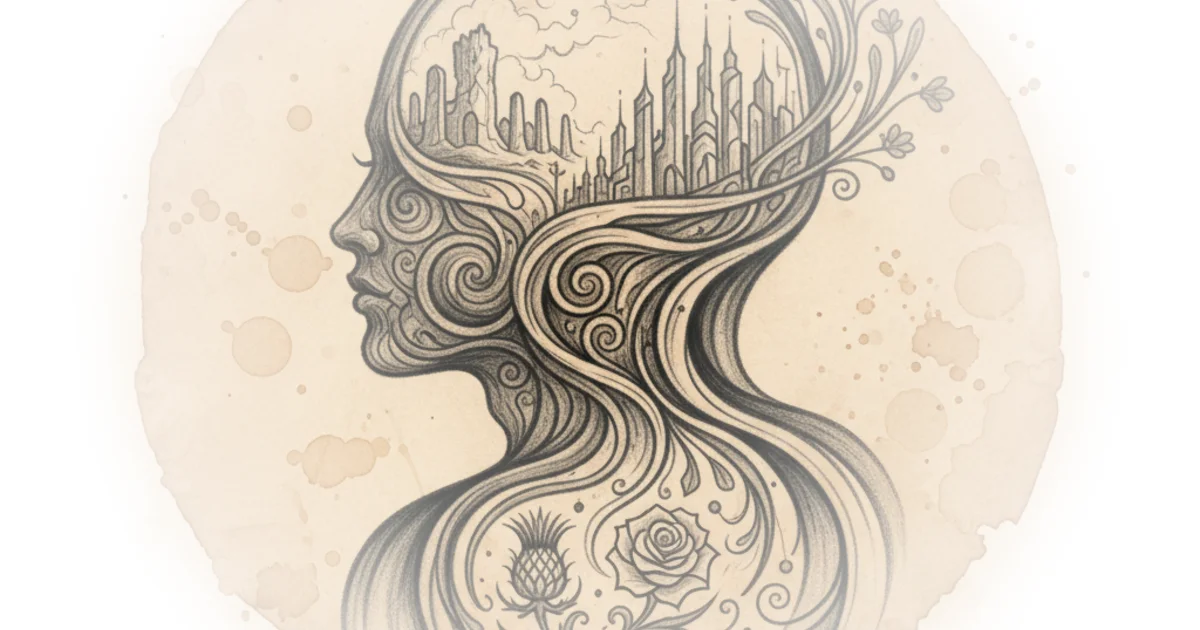
This distinction is crucial. Rowson writes, "Although some illusions are constructions, not all constructions are illusions. St Andrew's Day is a construction, but not an illusion, because Scotland is a nation, and nations are real." He suggests that in a world facing ecological collapse and algorithmic capture, the nation-state remains a vital vessel for solidarity, even if its current form is outdated. The argument lands powerfully because it refuses the binary choice between globalism and narrow nationalism, proposing instead a layered identity where one can be a "Scottish Londoner" and a European simultaneously.
A nation is a true fiction in which we can be ourselves in its setting and become ourselves through its plot.
Critics might note that relying on "fiction" to ground political agency risks romanticizing the very exclusions that have historically plagued nation-states. Rowson acknowledges this tension, admitting that nationalism is "legion, often harmful," but he pivots to a more constructive definition: "There are such things as nations, and nations should govern themselves." This shifts the focus from ethnic purity to the practical utility of national identity as a mechanism for self-determination.
Myth as Political Technology
The piece takes a fascinating turn when Rowson describes patron saints as the original "tech bros," offering an identity technology that transforms geography into personality. He highlights the historical irony that St. Andrew, the patron saint of Scotland, never set foot in the country and is claimed by Russia as well. The legend of the decussate cross—a white X-shaped cloud appearing before a battle in 900 AD—is treated not as fact, but as a foundational narrative.
Rowson paraphrases the legend of King Angus (or Óengus) dreaming of the apostle before a battle, noting that the resulting victory was attributed to a "white cloud shaped as a decussate cross." He points out the linguistic curiosity of "decussate," derived from the Roman numeral for ten, and muses on its relevance in a post-Twitter age. This historical weaving is effective because it connects the abstract concept of nationhood to tangible, albeit mythical, moments of collective action.
He draws a direct line from these myths to the Declaration of Arbroath in 1320, a document where Scottish nobles invoked St. Andrew to claim their distinct nationhood before the Pope. "In that declaration, Andrew is described as the first apostle," Rowson notes, linking the saint's humility to Scotland's "relatively egalitarian outlook." This connection between a religious figure's perceived character and a nation's political culture is a bold move, suggesting that the stories we tell about our origins shape our present-day values.
The Plot Over the Setting
Rowson's most significant theoretical contribution is his rejection of static definitions of nationhood. He lists the common attempts to define a nation—by language, geology, ethnicity, or territory—and dismisses them as mere "setting" in the play of nationhood. "The setting makes the plot possible, but it's the plot where the nation finds and creates itself," he argues. This aligns with the sociologist Rogers Brubaker's contention that "Nation is a category of practice, not (in the first instance) of analysis."
He elaborates on this by citing Ernest Renan's 1882 definition: "A nation is a soul, a spiritual principle. Two things which, properly speaking, are really one and the same constitute this soul, this spiritual principle. One is the past, the other is the present." Rowson uses this to argue that the nation is an ongoing act of "moral imagination," a phrase he borrows from Oliver Donovan via Doug Gay. The core of his argument is that the nation survives not because of its borders, but because of the continuous work of its people to define their shared story.
To understand nationalism, we have to understand the practical uses of the category 'nation', the ways in which it can come to structure perception, to inform thought and experience, to organise discourse and political action.
This perspective challenges the reader to see national identity not as a fixed inheritance, but as a dynamic tool. However, a counterargument worth considering is whether this "practice" can be sustained in an era of rapid digital fragmentation. If the "plot" is increasingly dictated by algorithms rather than shared civic rituals, the "soul" of the nation may fracture before it can adapt to a planetary ethic.
Bottom Line
Rowson's strongest move is reframing the nation as a flexible, necessary technology for human agency rather than a relic of the past. His biggest vulnerability lies in the practical mechanics of how to "transcend and include" the nation-state without losing the solidarity it provides. As the 21st century unfolds, the test will be whether these "true fictions" can evolve fast enough to address global crises without collapsing into the very divisions they seek to heal.